ABB ACS800 VFD-Gear Motor | Erratic Torque

Thread Starter

cawthrawilliam

Joined Jan 14, 2026
10
Hello,

I’m looking for insight from those experienced with ABB ACS800 drives, VFD grounding, or EMI/EMF issues.
I’ve been troubleshooting a persistent issue on an extrusion auxiliary drive (auger crammer/feeder motor) and have now ruled out mechanical, process, motor, drive hardware, PLC logic, and tuning. At this point I strongly suspect grounding, shielding, or EMI coupling, and I’m hoping for guidance on further diagnostics.

System Overview (Generalized):
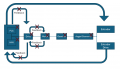
1768421695368.png
  • Drive: ABB ACS800
  • Motor: ~5 HP induction motor (multiple motors tested)
  • Application: Feeder / crammer auger for an extruder
  • Control Mode: Speed control (DTC)
  • Gearbox: Fixed ratio (44.71)
  • Crammer generally operates only when extruder is running, however results are the same in 'local' mode
  • There is an otherwise identical extruder line nearby, and on the same switch gear that runs without issue

Core Symptoms
  • The drive reports unstable and elevated torque feedback, especially upon start up and under load. If the motor and gearbox do not have an applied load, the torque% varies by +/- 4% where the nominal torque% varies between 10-14% continuously, even with the motor being fully decoupled from the gearbox
  • Torque frequently exceeds 100% and occasionally 150% during applied load startup/ transient periods. The erratic behaviors often trigger torque-based logic.
  • Based on all evidence, I do not believe these torque levels represent real mechanical load.

What Has Been Ruled Out
Mechanical / Process
  • Auger removed → issue persists
  • Motor run completely no-load
  • No flight-to-wall contact
  • No material present
  • No process surging (verified via melt / head pressure)
  • Identical system operates normally

Motor
  1. Multiple motors tested
  2. Same behavior under no load
  3. Problem does not follow the motor

Drive / Power
  1. Drive swapped → no change
  2. VFD motor cable replaced → no change
  3. Ran in local mode → no change
  4. Motor data verified
  5. MAG ID performed
  6. Speed tuning reviewed
  7. PI gains adjusted live → response changes but instability remains
  8. No drive faults present

Control PLC
  1. Speed command verified stable
  2. No dithering or oscillation in reference
  3. Logic identical to the good line
  4. Forced parameter value → no change (this was the ultimate proof that it was unrelated to plc logic)
Data & Analysis Performed
I logged and livestreamed drive feedback at 8–9 Hz effective sample rate about torque percentage:
FFT Results
A strong, narrow frequency component consistently appears at ~0.336 Hz (~3-second period)

  • The spike is repeatable across multiple datasets about the same parameter
  • The frequency does not scale with mechanical speed
  • Melt / head pressure does not show the same oscillation
  • Suggests a stable limit cycle, not random noise

Only Avenue I Have Not Investigated: Grounding / EMI
My mind has began to wonder about common-mode noise, shield termination, grounding topology, or EMI affecting the drive’s torque estimator, rather than true mechanical torque. But I'm not really too sure where I would start for debugging.

I am very open to any feedback and can gladly reciprocate feedback. This has been an ongoing issue for over a decade at the plant I work at and my ops team is considering doubling the motor's output power (same gear ratio) as a solution, but I'm pretty confident that wont solve the problem, just crutch it.

Thank you
 

GetDeviceInfo

Joined Jun 7, 2009
2,270
Tell us about the PLC to drive interface. Have you reviewed the routing of power and signal cabling. I worked on a larger ACS800 unit, discovering that a cabinet 'cleanup' had control wires passed along side a power duct.
 

MaxHeadRoom

Joined Jul 18, 2013
30,557
Only Avenue I Have Not Investigated: Grounding / EMI
My mind has began to wonder about common-mode noise, shield termination, grounding topology, or EMI affecting the drive’s torque estimator, rather than true mechanical torque. But I'm not really too sure where I would start for debugging.
This is often a common issue where several secions of a CNC machine are powered separatly and do not share something called equi-potential earth grounding and bonding.
It is generally cured, first by bonding the individual power commons to a central earthing point.
Then ensuring that all metalic sections of the machine are electrically bonded.
Siemens has an arlicle on this in one of thier publications.
See section 3
 

Attachments

MisterBill2

Joined Jan 23, 2018
27,164
As mentioned already: It seems like a wiring issue or a drive adjustment issue. The last "weird behavior" problem I fixed was a poor connection in one phase of the motor feed.
BUT a poor connection in the control input from the PLC analog out can cause a lot of problems. So can a poor connection someplace inside the motor drive connection. (By poor connection I mean excess resistance or even a broken wire. Or a loose connection within the drive system. Have you checked the motor current with a clamp-on ammeter. THAT found the loose connection for me once. only two turns loose on one motor phase lug.
On the PLC analog speed output, have you metered it while the problem is happening?? Then meter it on the drive input terminals.
 

tsan

Joined Sep 6, 2014
141
Drive / Power
  1. MAG ID performed
Is MAG ID a standstill identification? It's better to run "standard ID Run" with uncoupled motor. It rotates the motor and can do better identification which might help. It's good to set speed controller setting and torque limits parameters to initial values before making the ID run. I assume, that the ID run is designed to be run with initial speed controller and torque limits settings which they typically are when commissioning is started.

Is there a speed encoder which is used by DTC? There is feedback in the drawing. It causes problems if there is interference in speed feedback but I have no idea why it would be ~0.3 Hz.
 

MisterBill2

Joined Jan 23, 2018
27,164
A poor connection in the earth grounding would affect the performance if "ground" was used in any portion of the controls loop. Not exactly were I was pointing, but close. and since another system, nearby, is performing OK, a poor ground connection can certainly bring about a lot of noise. Funny how that works.
 

MisterBill2

Joined Jan 23, 2018
27,164
In a CORRECTLY designed system the ground IS NOT a part of any signal path. Certainly grounding matters, BUT it is no supposed to be any portion of any signal path.
 

MaxHeadRoom

Joined Jul 18, 2013
30,557
I don't recall seeing it mentioned that it was?
Also the practice of equipotential bonding has eliminated the need to ground one end of a shielded cable as it traditionally was, now the prefered noise suppresion method is to earth both end of the shield.
Possible now with equi-potential bonding.
 

MisterBill2

Joined Jan 23, 2018
27,164
EVERY industrial testing machine that included analog instrumentation had to have adequate shielding on all of the analog signal cables. And on many of those machines the connection of the shields to some specific point required a bit of experimenting. Most of the machines had either hydraulic or pneumatic solenoid valves, and quite a few limit switches. So in addition to the analog wiring there was a lot of control signal wiring. So "shielding adjustment" was a frequent activity.
 

MaxHeadRoom

Joined Jul 18, 2013
30,557
Hello,

I’m looking for insight from those experienced with ABB ACS800 drives, VFD grounding, or EMI/EMF issues.
I’ve been troubleshooting a persistent issue on an extrusion auxiliary drive (auger crammer/feeder motor) and have now ruled out mechanical, process, motor, drive hardware, PLC logic, and tuning. At this point I strongly suspect grounding, shielding, or EMI coupling, and I’m hoping for guidance on further diagnostics.

Only Avenue I Have Not Investigated: Grounding / EMI
My mind has began to wonder about common-mode noise, shield termination, grounding topology, or EMI affecting the drive’s torque estimator, rather than true mechanical torque. But I'm not really too sure where I would start for debugging.
After an extensive career installing and repairing industrial electronics, CNC retro-fits etc, Paying extensive attention to the proper earth grounding & bonding has prevented any post intallation 'noise' problems, I only recall one such incident in all that time.;)
 
I've worked with other brands of VFD's, not this ABB.
I'm assuming you have the drive's latest firmware installed.

Wild guess the torque vector is getting messed with. Due to noisy current sense or voltage sense.

I would look at the incoming power quality for the drive. With a power analyzer.
Because the 3 sec. FFT I have seen it was an induction heater causing (phase control) noise and notching of the mains sine-wave, everytime the heating element had power, every few seconds. This can cause a VFD to bungle its current/voltage measurement used for estimating torque.
Another rare cause is the motor cable being a bad length where you get transmission-line effects (reflections) that confuse the VFD.
You can change carrier frequency, or add an output inductor, or simply change the cable type/length to get the voltage reflections out of the way.

If you give up, like I have once, I just put an encoder on the motor.
 

Thread Starter

cawthrawilliam

Joined Jan 14, 2026
10
Tell us about the PLC to drive interface. Have you reviewed the routing of power and signal cabling. I worked on a larger ACS800 unit, discovering that a cabinet 'cleanup' had control wires passed along side a power duct.
No, I simply figured replacing the VFD cable twould be enough for me to rule this out. The cabinets are very organized. Our crew does a good job keeping things tidy. In so far as the conduit goes, it runs from the cabinet down and under the ground for about 40-50ft before coming up.
 

Thread Starter

cawthrawilliam

Joined Jan 14, 2026
10
Tell us about the PLC to drive interface. Have you reviewed the routing of power and signal cabling. I worked on a larger ACS800 unit, discovering that a cabinet 'cleanup' had control wires passed along side a power duct.
This is often a common issue where several secions of a CNC machine are powered separatly and do not share something called equi-potential earth grounding and bonding.
It is generally cured, first by bonding the individual power commons to a central earthing point.
Then ensuring that all metalic sections of the machine are electrically bonded.
Siemens has an arlicle on this in one of thier publications.
See section 3
When bonding, are you referring to prepping the mating surfaces (sanding/scuffing) and/or is there a dielectric grease application?
 

Thread Starter

cawthrawilliam

Joined Jan 14, 2026
10
As mentioned already: It seems like a wiring issue or a drive adjustment issue. The last "weird behavior" problem I fixed was a poor connection in one phase of the motor feed.
BUT a poor connection in the control input from the PLC analog out can cause a lot of problems. So can a poor connection someplace inside the motor drive connection. (By poor connection I mean excess resistance or even a broken wire. Or a loose connection within the drive system. Have you checked the motor current with a clamp-on ammeter. THAT found the loose connection for me once. only two turns loose on one motor phase lug.
On the PLC analog speed output, have you metered it while the problem is happening?? Then meter it on the drive input terminals.
My gut is ruling out the drive. We tried two out of the box drives, both ACS800's (first rated for 7.5 hp and the second rated for 10hp). There was no change after running the correct auto tunes. As soon as I saw that FFT spike (repeating periodic signal) I was sold on the drive because the response resembled a marginally stable system. and was shocked when A new drive did no change.
 

Thread Starter

cawthrawilliam

Joined Jan 14, 2026
10
I've worked with other brands of VFD's, not this ABB.
I'm assuming you have the drive's latest firmware installed.

Wild guess the torque vector is getting messed with. Due to noisy current sense or voltage sense.

I would look at the incoming power quality for the drive. With a power analyzer.
Because the 3 sec. FFT I have seen it was an induction heater causing (phase control) noise and notching of the mains sine-wave, everytime the heating element had power, every few seconds. This can cause a VFD to bungle its current/voltage measurement used for estimating torque.
Another rare cause is the motor cable being a bad length where you get transmission-line effects (reflections) that confuse the VFD.
You can change carrier frequency, or add an output inductor, or simply change the cable type/length to get the voltage reflections out of the way.

If you give up, like I have once, I just put an encoder on the motor.
I did look at the UVW legs twice, their inputs were on point
 

Thread Starter

cawthrawilliam

Joined Jan 14, 2026
10
Is this a new installation or an exising installation. ie has this run successfully previously?
No, it’s been in place for a while. The issue has been around for years and has been contended with. There once was a time when the issue was never a thing, however getting an accurate ‘what changed’ that led to the behavior change is like clearer than muddy water.
 
Top