72 led circuit

Thread Starter

JonoMc

Joined Jan 12, 2018
5
Would this work running off a 9v battery?
w=one white, R=one red and O=one orange

w@390 ohms
wwww @ 0 ohms
ooooo @27 ohms
ooo @ 220 ohms
ooo @ 220 ohms
ooo @ 220 ohms
ooo @ 220 ohms
w @ 390 ohms
ww @270 ohms
ooooo @ 27 ohms
oooo @ 120 ohms
oooo @ 120 ohms
oooo @ 120 ohms
oooo @ 120 ohms
rrrrr @ 120 ohms
rooo @ 120 ohms
rooo @ 120 ohms
ww @ 270 ohms
ooooo @ 27 ohms
ooooo @ 27 ohms
ooo @ 220 ohms
ooo @ 220 ohms
rrrr @120 ohms
rrrr @ 120 ohms
wwww @ 10 ohms

I plan on using tape on the table and sticking the led to it while I solder them so they cant move.
 

WBahn

Joined Mar 31, 2012
32,823
Four white LEDs will drop 12 V, five orange LEDs would drop 10 V, and five red LEDs would drop 10.5 V.

How do you expect a 9 V battery to drive them any of these?

At 3 V and wanting to drive 20 mA, then your current limiting resistor would need to be (9 V - 3 V)/20 mA = 300 Ω.

To get the same current in two 3 V LEDs you would need the resistor to be (9V - 2·3 V)/20 mA = 150 Ω

To get 20 mA through a string of four red LEDs the resistor would need to be (9V - 4·2.1V)/20 mA = 30 Ω.

But remember what I said about wanting some overhead? A new 9 V battery can have a terminal voltage in the 9.5 V range. A typical 0603 red LED can have a forward voltage at 20 mA of anywhere from 1.8 V to 2.4 V. So let's say the batch you get it at the low end giving you a total of 7.2 V across the LEDs. That would put up to 2.3 V across your 30 Ω resistor putting over 75 mA of current through the LEDs, at which they probably won't last long. At the other end of the spectrum, your battery voltage will drop as it drains. A common cutoff voltage for a 9 V alkaline is around 1.2 V per cell, or 7.2 V. Even at the nominal 9 V, your battery won't be able to push any current into 4 red LEDs if their forward voltage drop is anything above 2.25 V, which is entirely possible, and even at the 2.1 V that you are working from you couldn't drive any current once the battery got down to 8.4 V, which will probably be reached fairly early in the battery's life.

Let's see what happens with three red LEDs.

Nominally, you want a (9 V - 3·2.1 V) / 20 mA resistor, which is 135 Ω. That gives you nominally 2.7 V of overhead, which isn't great, but it's a LOT better than 0.6 V.

At the nominal 2.1 V forward voltage and going from a fresh battery at 9.5 V down to a cutoff at 7.2 V, your current would start out at about 24 mA and drop to around 7 mA. The human eye is pretty insensitive to changes of a factor of two in light intensity, so you might not notice a huge difference, especially since it will happen over some period of time.

Now let's look at the worst case. Assuming we have 1% tolerance resistors, we will ignore that effect. At 9.5 V with 1.8 V LEDs, the current would be around 30 mA. The LEDs can probably survive this for quite a while, but you would be taking some life off them. Since this is unlikely to happen, or last very long even if it did, this is probably an acceptable risk. At the other end, if you have 2.4 V LEDs you would be able to light them all the way down at a 7.2 V cutoff voltage, but even at 8 V you would still be getting 6 mA through them.

So unless you are using a regulated 9 V supply, I would not recommend putting more than three red or orange LEDs in a string and only two white LEDs. Putting one white and two colored ones in a string is probably doable, but the margins aren't very attractive.
 

Thread Starter

JonoMc

Joined Jan 12, 2018
5
There is a lot to learn. The leds I have I was told to run the orange and red at 1.7v and the white at 2.2. Do I have to run them at the minimum volt specified eg. the white one is 3.0-3.2v, orange 2-2.3v and the red at 2.1-2.3v?
Never thought about having overhead. I get what you are saying where I maxed each string out and I shouldnt have.
What would the resistor be for one white?
They will light up occasionally (doorbell) and for about 4 sec at a time. The switch is a push and hold switch just to see them light up.
The battery I thought of using is a rechargeable 9V 800mAh and is recharged through a usb cable. I could buy a AC 240V Converter DC 9V 1A Adapter Power Supply 1000mA. Would that be a better solution as a permanant/removable plug in, and a battery clip if i took it away from the unit for a moment.
 

dl324

Joined Mar 30, 2015
18,326
If you're considering an adapter now, you should consider a laptop charger which will give you about 18V at several amps. That would let you have strings of a half dozen or so.

You need to do the experiment I suggested to find an appropriate operating current for each color. Take note of the voltages of a number of the same color to get an idea of the range of voltages. Then you can calculate current limiting resistor values.

I looked at a datasheet for an orange SMT LED. It gave forward voltage range of 2.1V (typical) to 2.6V maximum at 20mA; with no specified minimum.
 

WBahn

Joined Mar 31, 2012
32,823
You don't really get to pick what voltage you run an LED at. You want a certain amount of current in it (the 20 mA we have been using but you can almost certainly get by with less -- running an LED at half it's rated current seldom has a noticeable affect on brightness but it can drastically extend the life of the LED). To get the desired current into it there has to be a certain voltage across it, but that voltage is not well-defined. You only know a range that it will fall in, say the 1.8 V to 2.4 V range that I gave earlier for a typical red LED. Most of the LEDs you pick up will likely fall in a narrower range, say 2.0 V to 2.2 V, but some will probably be outside it. Also, that voltage changes with temperature and the LED will heat up some, which makes the voltage across it go down for the same amount of current. If you WERE to try to run the LED by putting a fixed voltage across it, you would find that tiny changes in voltage would result in huge changes in current. It would not be uncommon to see the current go up by 2x to 5x with a change in voltage of just 100 mV or so.

Since the forward voltage is relatively fixed, we exploit this by setting the current using a series current limiting resistor which, give a fixed supply voltage and a fixed LED voltage, will have a fixed voltage across it allowing use to pick the value so as to give a pretty reliable current through it and, hence, through the LED.
 

Bernard

Joined Aug 7, 2008
5,784
If you have the option of using an AC adapter, go for it. I was given a bag of adapters ranging from 14V to 32V
& I was looking for 12V so used 14V. So they must be available. Look foe about12V to 15 V to have reasonable length strings. I would measure Vf of all LEDs & put them in piles of = V. When making up = V strings might consider every 5 th LED a resistor. Say V = 15 & will be red LED @ 1.7 V; 15/ 1.7 = 8.8, call it 9. 9/5 = 1.8, again call it 2. R =E/I, 1.7/ .005 = 340. so use 2-340 or 680 ohms in series with 7 LEDs.
 

Bernard

Joined Aug 7, 2008
5,784
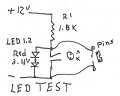
To check LED Vf, I use a simple test rig consisting of a V source around 12 V, a current limiting R to suit desired current, here about 5 mA, & 2 LEDs in series from R to neg. PS. so that V is greater than LEDs under test. IF LED is reversed there will be no damage, if connected a V meter will read LED V.

LED TEST 00000.jpg
 
Last edited:

ebeowulf17

Joined Aug 12, 2014
3,307
To check LED Vf, I use a simple test rig consisting of a V source around 12 V, a current limiting R to suit desired current, here about 5 mA, & 2 LEDs in series from R to neg. PS. so that V is greater than LEDs under test. IF LED is reversed there will be no damage, if correct a V meter will read LED V.

View attachment 143707
I like the built-in reverse voltage protection for the unknown LED under test. Looks like a good, simple test rig.
 

Bernard

Joined Aug 7, 2008
5,784
Two Cu strips spaced 1mm was easy to test a number of different styles of LEDs. Lowest V of visible LEDs is a Tex. Inst. 1970s 3mm @ 1.56V, smallest on hand, side looking SMT, red, 2.81 X 1.2 X .85 mm @ 1.86V & I thought that was small.
 

Bernard

Joined Aug 7, 2008
5,784
Using 8 V as average V of the 9V 800 mAh battery under load, for red or orange there might be 24.6 strings
of 520 ohms + 3 LEDs @ 5 mA for a drain of about 154 mA. White LEDs add 44 mA for total of 198 mA. or a run time around 4 h.
If using AC adapter of 15 V, strings might be red or orange, 820 ohms + 6 LEDs; white 750 ohms + 4 LEDs.
for 12.3 & 3.5 strings.
 
Top