5v Digital Signal to Solid 12V

ebeowulf17

Joined Aug 12, 2014
3,307
I think the problem may be that your first Schmitt trigger is biased at exactly 1/2 the supply voltage, thus the output can stay in either state with no input due to the hysteresis.
Bias it slightly low, as I did, so that with no input the output of the second gate is always low.
Of course you are correct. Seems obvious now that you've pointed it out (but I sure wasn't seeing it before!) Thanks, it works great now.

Also I think I figured out why I wasn't finding inverters in the voltage range / through hole combo that I wanted - I included the Schmitt trigger feature as a search parameter in my Digikey searches, but a lot of the devices aren't tagged as such. Live and learn. There are literally thousands and thousands of at least 4 different models that would meet my original plans - all I had to do was remove one search term!
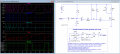
pulses-drive-relay-INVERTER_04-fixed.png
 

Thread Starter

bwilliams60

Joined Nov 18, 2012
1,450
Is this a working unit now? Relay will come on 100% upon vehicle movement and shut off when it stops?
I see there have been a couple other threads pop up looking for something similar to this based on crankshaft movement. Interesting.
 

ebeowulf17

Joined Aug 12, 2014
3,307
Is this a working unit now? Relay will come on 100% upon vehicle movement and shut off when it stops?
I see there have been a couple other threads pop up looking for something similar to this based on crankshaft movement. Interesting.
I don't have anywhere near @crutschow's expertise (obviously,) but as far as I can tell it's exactly what you need. I haven't built and physically tested it, but it logically makes perfect sense to me, and it works beautifully in simulation, so I think you're good!

As for specifics of performance, nothing is instant or perfect. The relay will turn on at the first positive transition of the Hall Effect signal. If a vehicle starts rolling at only 1MPH, there could be a roughly 1 second delay from the very first motion until the first positive pulse triggers the relay to turn on. Naturally if a vehicle accelerates away from the stop more quickly than that (as they typically do,) the delay will be much shorter than that. The relay will turn off any time positive pulses are more than ~1 second apart. So, if the vehicle slows down to less than 1MPH, but doesn't actually stop completely, the relay will turn off and on as long as the vehicle continues rolling at less than 1MPH.

So, performance is not 100% perfect or foolproof, but it's pretty darn good. Performance above 1MPH should be exactly as intended - it's only the performance under 1MPH and the slight delay on start that you need to think about. It's up to you if those are acceptable or not. Since you haven't told us what this is being used for, we don't know if a minor delay on start, or intermittent performance below 1MPH, is a problem.

Just to be clear, I'd go with @crutschow's version, not mine - I just did a simulation to see what I could learn, but I don't have the same familiarity with specific parts. His version has appropriate part numbers, and probably handles some other small details better as well.
 

Tonyr1084

Joined Sep 24, 2015
9,744
My truck, Toyota Tacoma, has a 4.10 to 1 ring gear ratio. That means my drive shaft turns 4.1 times per one single tire revolution. My transmission speed sensor turns nearly 3 pulses per revolution (off by 1/30th of a pulse, has to do with the driven gear). For sakes of argument, I'll call it 3 pulses per revolution. Tire size is 245/75R18. That translates into a tire diameter of (245 x 0.75 x 2 ÷ 25.4 +18) 32.469 inches tall. That times Pi = 102.003" travel per single tire rotation. There are 5280 feet in a mile (5280 x 12 = 63,360 inches per mile). 63,360 ÷ 102.003 = 621.158 tire revolutions per mile. 621.158 x 4.1 x 3 = 7640.25 pulses per mile. So at 60 MPH pulses are coming in at 7600 pulses per minute (or 126 2/3 Hz) at 60 MPH. That's MY truck. In the United States of the Great Pumpkin. You'll have to convert to metric. for where you're at if not in Pumpkin land.

One other thing I wanted to mention: Swap the transistor for a FET. Use a diode to prevent back current and let the natural capacitance of the FET hold your relay on. Use a bleeder resistor to drain the capacitance away at some given rate so the relay drops out when stopped. Sine this is a high pulse from the automobile, it will only pulse when the vehicle is running. There may be instances where the HET (Hall Effect Transistor) stops on a high output. My truck, that was roughly 50% of the time. So when you stop, your relay may stay on unless you pump the brake pedal briefly to move away from the sensor. Likely an annoyance if you ask me.

Here's a thought: Add a circuit that shuts the system off when you step on the brakes.

Hey! Are you trying to build an HHO device?
 
Last edited:
Top