555 oscillator overheating

Thread Starter

OrionV

Joined Jul 3, 2016
22
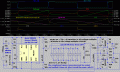
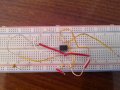
Hello. I am trying to build an oscillator to drive 9 volts from a battery through a transformer but the 555 chip is getting really hot. I checked the connections multiple times but can't find a problem. I am using a schematic as the one here http://www.ohmslawcalculator.com/555-astable-calculator
but am only using a 4k7 resistor on R2. Instead of R1 I have a jumper between pin #7 and Vcc. Capacitors: 10 nF, 50 V, 85 °C. Any help would be much appreciated!
Thanks.
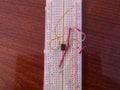
IMG_20160719_132701-800x600.jpg

IMG_20160719_132834-800x600.jpg

Mod Note:
Before you attach the photos, please compress the photos to a clear image and small resolution and size as 800x600 or 1024x768.
The photos already compressed to 800x600.
 

OBW0549

Joined Mar 2, 2015
3,566
Instead of R1 I have a jumper between pin #7 and Vcc.
That's why your 555 is overheating. What in the world made you think you could short the 555's Discharge pin to Vcc without disastrous consequences?? And what in the world made you think you should short the 555's Discharge pin to Vcc????? Good grief.

Put a resistor in there in place of the jumper, and the circuit will work like it's supposed to.
 

Thread Starter

OrionV

Joined Jul 3, 2016
22
That's why your 555 is overheating. What in the world made you think you could short the 555's Discharge pin to Vcc without disastrous consequences?? And what in the world made you think you should short the 555's Discharge pin to Vcc????? Good grief.

Put a resistor in there in place of the jumper, and the circuit will work like it's supposed to.
I need around 30kHz output frequency, the resistor should be around 5kOhm. If I change the places of the resistor and the jumper will it work then or do I need to have both resistors in place?
 

absf

Joined Dec 29, 2010
1,968
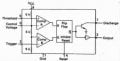
Here is a block diagram of the inside of the 555.

555.jpg
If you connect pin 7 (the collector) directly to Vcc. When the output of the flip flop turns High, the NPN transistor would be shorting the Vcc to Ground. That's why your IC would get hot. The resistor between Pin 7 and Vcc is not optional.

Allen
 

absf

Joined Dec 29, 2010
1,968
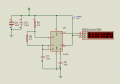
If you need a frequency of 30KHz, you may use the circuit attached. I have not tried it on a breadboard just simulate using Proteus. Not sure if the 555 would work well at that frequency.

555 30KHz osc.PNG
Allen
 

OBW0549

Joined Mar 2, 2015
3,566
I need around 30kHz output frequency, the resistor should be around 5kOhm. If I change the places of the resistor and the jumper will it work then or do I need to have both resistors in place?
Download a datasheet for the 555, such as this one, and read it. AFTER you've read it and made sure you understand it, THEN start designing and building. That's good practice for EVERY part you use in your designs, by the way: first, download the datasheet and read it before you design or build.

Yes, you need both resistors.
 

Thread Starter

OrionV

Joined Jul 3, 2016
22
Got it, thanks. The problem was that an online calculator showed 0 ohms on R1 and I thought that it would be okay without a resistor there. Thanks for the answers.
 

OBW0549

Joined Mar 2, 2015
3,566
The problem was that an online calculator showed 0 ohms on R1 and I thought that it would be okay without a resistor there.
Word to the wise: don't ever, EVER trust online calculators; you've no way of knowing whether it was designed by an expert or by an idiot. And the fact that the calculator you linked to allows a value of 0Ω for R1 without flagging it as an error, tells me that the person who created it was either lazy or not too bright.

Once again: DON'T EVER TRUST ONLINE CALCULATORS. Use the information on the datasheet, together with common sense, to choose component values.
 

Thread Starter

OrionV

Joined Jul 3, 2016
22
Alright, no calculators. My bad. I used two 1kOhm resistors and the chip stopped overheating. The new problem: it gets hot again when I attach the transformer to the output and Gnd. When connected to output and Vcc I get some AC voltage but the chip still gets very hot. Any ideas why this happens?
Thanks.
 

DickCappels

Joined Aug 21, 2008
10,661
You are driving the transformer primary with a pulse that cycles between a positive voltage and ground. If the end of the transformer not being driven is connected to V+ or ground there will be an average DC voltage across the transformer. Then you end up with current that is approximately the average voltage divided by the primary resistance.

You need to put a capacitor in series with the output of the '555.
 

Thread Starter

OrionV

Joined Jul 3, 2016
22
Ok, but what about the frequency? It matters the most for powering one of those small transformers from a wall charger, right? I was told that around 40kHz would be good but the output is minimal, around 3V.
 

ronsoy2

Joined Sep 25, 2013
71
Come on OB, be more uh, "liberal." All online calcs are not junk. Of course some are risky (if they can come up with ridiculous values) but there are a lot of very nice online calculators out there that can save you a lot of time. The key is to as you point out READ THE DATA SHEET and understand what you are doing before applying power.
On driving the transformer, the 30khz will work fine. The power output of this setup will not be particularly great so don't expect to light up a big fluorescent tube or some such with it! If we knew your final application more useful help could be given.
 

OBW0549

Joined Mar 2, 2015
3,566
Come on OB, be more uh, "liberal." All online calcs are not junk. Of course some are risky (if they can come up with ridiculous values) but there are a lot of very nice online calculators out there that can save you a lot of time.
You're absolutely right, of course; there are some online calculators out there, especially the ones run by the major semiconductor manufacturers, that are both good and very useful. However, note that I didn't say don't ever use online calculators; I said don't ever trust them-- especially when one does not yet have enough experience to tell when the online calculator is spitting out nonsense, as in the present case.

The same caveat applies, by the way, to using simulator programs like Spice: although Spice is a very useful (indispensable, IMO) design tool, it's nevertheless perfectly capable of coming up with the most outrageously silly simulation results from time to time. Again, experience is necessary when using Spice, to avoid being led astray.
 

Tonyr1084

Joined Sep 24, 2015
9,744
I've seen transformers that were designed to operate on 60 cycles and some that were designed to work on 400 cycles. This is my personal experience and is not a definitive conclusion on transformers.

With your lack of experience with electronics, you should know that you can't just grab a transformer and make it run at any frequency you desire. The transformer has to be of proper design in order to give you a specific result.

So far we've learned that you can overheat a 555 in a couple ways. We (or should I say "I") have learned that you have insufficient knowledge with electronics. We also don't know the exact application of whatever it is you're trying to build. So if you want help then you need to give us all the details. What's your goal and why.

30kHz - perhaps the 555 is not the best way to go about achieving your goal (whatever that may be). Also, different grades of 555's are available. Here again, the spec sheet is your friend. DON'T BUILD WITHOUT IT. Why not? Because with the spec sheet handy you can know what the limitations of a particular device is. In other words, you wouldn't put a watch battery in your car and expect it to be able to start the motor. The specs say it doesn't have enough OOMPH for the job. And maybe your 555 doesn't have enough for whatever your application is.

And without knowing your application - we can help very little. So please tell us what it is you're trying to do.
 

Thread Starter

OrionV

Joined Jul 3, 2016
22
So far we've learned that you can overheat a 555 in a couple ways. We (or should I say "I") have learned that you have insufficient knowledge with electronics. We also don't know the exact application of whatever it is you're trying to build. So if you want help then you need to give us all the details. What's your goal and why.

30kHz - perhaps the 555 is not the best way to go about achieving your goal (whatever that may be). Also, different grades of 555's are available. Here again, the spec sheet is your friend. DON'T BUILD WITHOUT IT. Why not? Because with the spec sheet handy you can know what the limitations of a particular device is. In other words, you wouldn't put a watch battery in your car and expect it to be able to start the motor. The specs say it doesn't have enough OOMPH for the job. And maybe your 555 doesn't have enough for whatever your application is.

And without knowing your application - we can help very little. So please tell us what it is you're trying to do.
I want to experiment with a spark gap and the frequencies it generates. I don't have a neon transformer so that is why I need the oscillator. And I don't have sufficient knowledge in electronics because that is not what I am studying, it's just a hobby.
 
Top