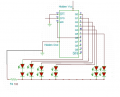
Here's the real story. I just tested a CD4017 using to white LEDs in parallel with a 270 ohm series resistor. Supply voltage 12.2 volts, output voltage from chip 8.6 volts, voltage across resistor 5.6 volts. That's 21 ma and output transistor dissipation of 12.2v minus 8.6v times .021 amp = 76mw, so should work.
But does not explain why the 555 should fry!
His point is that it does not. Not even close. It says that when operating on 12 V, the typical output current will be something between 0.9 mA and 3.5 mA.
That's not enough to light even one led. Most schematics show 4017s driving leds directly. I was thinking that the outputs of the 4017 being at around 12 volts and getting the led current from that. With what you're saying, the outputs shouldn't have enough current to drive any leds. Answers?
The Texas Instruments datasheets show the graph that other companies do not show. 17mA output easily when the supply is 12V.
The outputs go to +12V only with no load. a load reduces the output voltage by the amount that heats the output transistor inside the chip. The graph show that with a 12V supply and an output voltage dropped to 9V by the load, then the output current is 13mA and the heating in the output transistor is 3V x 13mA= 39mW which is well below the max allowed of 100mW.
The datasheet lists a typical output current of only 1mA when the supply is 5V and the noutput voltage is m4.6V.
With a 10V supply and an output voltage of 9.5V then the typical output current is only 2.6mA.
Those would be from people you should be avoiding. Electrical engineers and electronics technicians can read and should know better than to do something that would embarrass themselves, their schools, and their teachers.
A CD4017 driving 3V white or blue LEDs with a brand new 9V battery is fine producing a current of 13mA with no resistors and heating in each output transistor of only 78mW,
With 2V red LEDs then the current is 16mA and the heating is too high at 112mW.
I sort of go with AG on the stability of your driver and the compliance of the CD4017 waveforms being in spec.
The datasheet the shape of the waveforms no glitches, Possibly a parallel counter might have sync problems https://www.ti.com/lit/ds/symlink/cd4017b.pdf
who knows maybe supply issues with the 555 somewhere. One kit I found if build nicely has some promise the 9013s have some gain and there would be less chance failure do to possible circuit irregularities. The two comparators in the old 555 must have become tired.
Most schematics show 4017s driving leds directly.
[/QUOTE
No problem doing that as long as you don't exceed the dissipation specs for the device.
With your current design I measured 20 ma per output split between 2 LEDs, appx 10 ma each.
If you wire the LEDs in series and change R4 to 100 ohms you still get 20ma per output but now each LED is drawing 20 ma and the dissipation is 70mw within specs. This is the max you can expect driving the LEDs direct.
The typical specification of 1mA output high current at 4.6V with a 5V supply is not a limit.
The typical graph showing 12mA sourcing with a shorted to ground output when the supply is 8V and a dissipation of 96mW is not a limit.
20V for the supply and 100mW per output are the limits.
Interesting comments posted here. All I can say is I have a project on the breadboard that uses 11 CD4017 chips and have found the clock and reset pins to be sensitive if not properly defined. Additionally I short circuited several times by having the breadboard powered up while making connections from chip to chip and paths to VCC and GND were formed without the actual power pins connected.

 Facebook
 Google
 GitHub
 Linkedin