555 as inrush limitter for Motor [SOLVED]

AlbertHall

Joined Jun 4, 2014
12,629
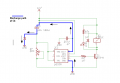
In the schematic would it be ideal to use a R2 as a bleed resistor for C6 so that it is discharged when the power to cut-off ? C6 acts as a delay time to switch ON the relay and R7 can be varied to control the delay time.
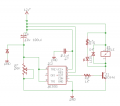
Better to use a diode, cathode to pin 2 and anode to gnd. This will discharge C6 more quickly and it won't affect the normal operation of the circuit.
 

AlbertHall

Joined Jun 4, 2014
12,629
How does the diode work here with its anode to ground ? how would it help in discharging the cap ?
The power has been on for a while and C6 is fully charged. Now without the diode, when the power is removed the top of C6 will be at 0V and as it is charged to 12V the bottom end will be at -12V.

With the diode, when the bottom end of C6 gets to about -0.6V the diode will conduct so discharging the capacitor.
 

Thread Starter

anishkgt

Joined Mar 21, 2017
549
With the diode, when the bottom end of C6 gets to about -0.6V the diode will conduct so discharging the capacitor.

Diodes when reverse biased do not conduct, rite ? so hows does the cap go from 12 to -0.6 when there is no path for it go ? And why does diode wait till gets to the -0.6v ?
 
Last edited:

sghioto

Joined Dec 31, 2017
8,634
Picture might be easier to comprehend. As soon as the power is removed the cap begins to discharge. The diode allows a faster discharge then using R2
SG
EEE 555 power on delay.PNG
 

crutschow

Joined Mar 14, 2008
38,540
How does the diode work here with its anode to ground ? how would it help in discharging the cap ?
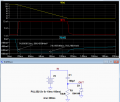
Below is he LTspice simulation of the capacitor, resistor, and diode.
Initially the top of the cap is 12V (Vin, yellow trace) and the bottom is 0V (Vout, blue trace), since R1 is connected to ground.
As Vin starts go from 12V to 0V (negative direction), this change in voltage is coupled through the capacitor to Vout, causing Vout to also start going negative.
When Vout reaches about -0.6V the diode starts to conduct (red trace), keeping the voltage from going more than about about 0.7V below ground, until Vin reaches 0V.

Make sense?

upload_2019-1-23_8-36-10.png
 

Thread Starter

anishkgt

Joined Mar 21, 2017
549
Below is he LTspice simulation of the capacitor, resistor, and diode.
Initially the top of the cap is 12V (Vin, yellow trace) and the bottom is 0V (Vout, blue trace), since R1 is connected to ground.
As Vin starts go from 12V to 0V (negative direction), this change in voltage is coupled through the capacitor to Vout, causing Vout to also start going negative.
When Vout reaches about -0.6V the diode starts to conduct (red trace), keeping the voltage from going more than about about 0.7V below ground, until Vin reaches 0V.

Make sense?

View attachment 168507

Thanks it does makes sense to an extend. But just can't digest how the diode conducts in the circuit.I always learned that diodes blocked when reverse biased and conducts when forward biased.
 

crutschow

Joined Mar 14, 2008
38,540
Thanks it does makes sense to an extend. But just can't digest how the diode conducts in the circuit.I always learned that diodes blocked when reverse biased and conducts when forward biased.
Entirely true.
Look at my simulation again.
The diode is indeed conducting in the forward direction (cathode negative with respect to ground).
 

sghioto

Joined Dec 31, 2017
8,634
Look at my simulation again.
When the 12 volt source is removed by way of a switch or powers down the only way C6 can discharge is through the diode and any other resistance to ground. The current flow in a discharging capacitor is from the positive plate to the negative. As you said yourself "(cathode negative with respect to ground)".
SG
 
Last edited:

Thread Starter

anishkgt

Joined Mar 21, 2017
549
A capacitor like any other current source would discharge from positive to negative but what puzzles me is that the cathode of the Diode is connected to the negative of the cap meaning the diode is reverse biased so the diode is blocking the current flow. Is the diode chosen such that the reverse break down voltage is considered here and due to that the current flows ?
 

crutschow

Joined Mar 14, 2008
38,540
what puzzles me is that the cathode of the Diode is connected to the negative of the cap meaning the diode is reverse biased so the diode is blocking the current flow.
In normal operation that's true, but we are discussing the situation where the input voltage is removed, which causes the voltage on the diode to go below ground potential which forward biases the diode.
Note that the "positive" and "negative" nodes on the capacitor are relative to each other, not to ground. The negative node on the cap can be either positive or negative with respect to ground.
Is the diode chosen such that the reverse break down voltage is considered here and due to that the current flows ?
No.
No reverse bias current ever flows (other than a very small diode leakage current).
 
Last edited:

Thread Starter

anishkgt

Joined Mar 21, 2017
549
which causes the voltage on the diode to go below ground potential which forward biases the diode.
Did not get that. voltage goes negative because the cap discharges, so the positive becomes negative and negative becomes positive when the power is removed. So here the diode has its cathode is connected in parallel to with the negative terminal of the cap. There is R1 in your LTspice through which the current from the cap can flow but how does anything flow through the diode ?


The only way the diode would conduct is from the GND.
 

crutschow

Joined Mar 14, 2008
38,540
There is R1 in your LTspice through which the current from the cap can flow but how does anything flow through the diode ?
R1 is not significantly involved in the process.
When the input voltage goes to zero the bottom of the capacitor goes negative and the current then flows through the forward biased diode, upwards through the capacitor.
Remember, a negative voltage (below ground) at the bottom of the capacitor, forward biases the diode (cathode more negative than the anode).
 

Thread Starter

anishkgt

Joined Mar 21, 2017
549
Remember, a negative voltage (below ground) at the bottom of the capacitor, forward biases the diode (cathode more negative than the anode).
I assume that is the property of a diode. I will just follow it than try understand it more. For my application this would work.
 
Top