555 as inrush limitter for Motor [SOLVED]

Thread Starter

anishkgt

Joined Mar 21, 2017
549
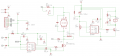
In the circuit attached i wish to slowly ramp up the voltage during start-up to avoid inrush current when controlling the speed of a motor after setting the desired PWM. The Motor draws close to 5A.

Would this be possible by adding a cap at pin 2 (TRIG) and GND or at Pin 3 (OUT) and GND on IC 2 if yes how much should it be, a rough value would do so that i could work it up and maybe a trim pot to adjust the ramp up time as well.

At the moment IC 2 acts as delay to switch ON a relay which bypasses R4.
Capture.PNG
 

AlbertHall

Joined Jun 4, 2014
12,626
To get a slow ramp up, IC1 needs to produce an increasing mark/space ratio.
Your circuit doesn't show how this is controlled, presumably by whatever is connected to JP2?
 

AlbertHall

Joined Jun 4, 2014
12,626
You might get away with doing this the really simple way by using pin 5. Use a larger value for C3.
When first powered up This capacitor will be discharged and will hold pin 5 low and the M/S ratio will be low. As this capacitor charges, pin5 voltage will rise and the M/S ratio will rise to that set by the pot.

The internal resistance of pin 5 is about 3.3k so, for instance, for a 1 second time constant of the rise you would need a 330uF capacitor on pin 5.
 

drc_567

Joined Dec 29, 2008
1,156
... Can't be too specific about dimensions, but it should be possible to construct a wire coil with sufficient inductance to inhibit start-up in-rush current. After the startup transient has passed, there will be little if any voltage drop across the inductor.
The reasoning for this particular phenomenon is explained by looking at the fundamental inductor equation and initial conditions, shown here, about 5 slides over, where it reads 2. Inductor:
https://www.slideshare.net/mobile/j...ial-conditions-of-resistor-inductor-capacitor

As far as building a specific inductor for your application, the following link may be useful:
https://www.allaboutcircuits.com/textbook/direct-current/chpt-15/factors-affecting-inductance/
 
Last edited:

crutschow

Joined Mar 14, 2008
38,532
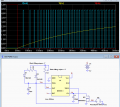
Here's the LT spice simulation of a 555 PWM circuit with a large capacitor to ground on the CV/CON pin 5 terminal.
When this pin is held low by a high INH signal to MOSFET M1, the output is off.
When INH goes low (red trace) , the PWM output starts with a lower duty cycle which increases to the set PWM with time determined by the value of capacitor C1.
Not sure if that will give you want you need, but it's worth a try.

upload_2019-1-22_10-49-53.png
 

ian field

Joined Oct 27, 2012
6,536
To get a slow ramp up, IC1 needs to produce an increasing mark/space ratio.
Your circuit doesn't show how this is controlled, presumably by whatever is connected to JP2?
The 2x 555 (556) with a 555 VFO triggering a 555 monostable is much easier - the single 555 PWM with balance pot between 2 opposite steering diodes in the charge/discharge path is a PITA to control other than turning the pot.

you can get a small range of adjustment by pulling pin 5.
 

Thread Starter

anishkgt

Joined Mar 21, 2017
549
Here's the LT spice simulation of a 555 PWM circuit with a large capacitor to ground on the CV/CON pin 5 terminal.
When this pin is held low by a high INH signal to MOSFET M1, the output is off.
When INH goes low (red trace) , the PWM output starts with a lower duty cycle which increases to the set PWM with time determined by the value of capacitor C1.
Not sure if that will give you want you need, but it's worth a try.

View attachment 168459
Thanks for that. So can we say lower the capacitance it would take less time to charge and hence the voltage ramp would be quicker ?
 

Thread Starter

anishkgt

Joined Mar 21, 2017
549
Why don't you just use a simple inrush current limiter thermistor rated for a bit above the steady-state current of your motor? Here's a viable candidate.

i initially planned on to use them but since these need time to cool down i would need to wait a while (not sure how long) i had drop it. The motor here drives a circular saw for wood cutting so the moto would not run for very long but would stop and run frequently.
 

Thread Starter

anishkgt

Joined Mar 21, 2017
549
The 2x 555 (556) with a 555 VFO triggering a 555 monostable is much easier - the single 555 PWM with balance pot between 2 opposite steering diodes in the charge/discharge path is a PITA to control other than turning the pot.

you can get a small range of adjustment by pulling pin 5.
VFO triggering, monostable, PITA. No idea what they mean. I am a hobbyist just getting into electronics. But thanks for the suggesstion.

So on 556 would the pins go exactly as the two 555 IC ? then i could just follow the pin names and swap them.
 

cmartinez

Joined Jan 17, 2007
8,777
i initially planned on to use them but since these need time to cool down i would need to wait a while (not sure how long) i had drop it. The motor here drives a circular saw for wood cutting so the moto would not run for very long but would stop and run frequently.
I doubt heat would be an issue. Those things are designed to work very hot. But if it does become a problem, the worst case scenario, IMHO, would be adding a small cooling fan pointed at the thermistor.
 

AlbertHall

Joined Jun 4, 2014
12,626
The motor here drives a circular saw for wood cutting so the moto would not run for very long but would stop and run frequently.
In that case, if you use the pin 5 capacitor then you should also have a diode, anode to pin 5, cathode to pin 8. This will quickly discharge the capacitor when the circuit is switched off.
 

Thread Starter

anishkgt

Joined Mar 21, 2017
549
I doubt heat would be an issue. Those things are designed to work very hot. But if it does become a problem, the worst case scenario, IMHO, would be adding a small cooling fan pointed at the thermistor.

What i meant by getting hot is that it would need to cool down before it can block the inrush current on the next run.
 

Thread Starter

anishkgt

Joined Mar 21, 2017
549
Got a bit lost when i saw the simulation as it was not what i had in the schematic. i guess there are several ways to the use 555 IC for an application. I got the schematic while browsing the internet so picked one.
 

Thread Starter

anishkgt

Joined Mar 21, 2017
549
In the schematic would it be ideal to use a R2 as a bleed resistor for C6 so that it is discharged when the power to cut-off ? C6 acts as a delay time to switch ON the relay and R7 can be varied to control the delay time.
 
Top