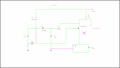
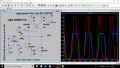
the oscillator in the schematic is very sensitive to the power voltage and the load according to my / by 2^ 15 counter for 1 hz clock. I am using two cd4040 counters and the oscillator has the power to make it work.
I don't understand the top part of the circuit with those strange transistors; it's new to me. I can't understand the attached file with my simple mind. I don't understand because I don't see myself in you.
The top part is a current mirror -it allows a grounded emitter amplifier to have a much higher gain with a given collector current than you could get with a resistor.
The current through the collector of Q2 is approximately the same as the current through R4 but at a much higher impedance. @Bordodynov please feel free to correct or elaborate.
What you see as "strange transistors" are really two PNP transistors with resistors attached to the emitters. With things all scrunched together it is hard to separate the parts.
Also, consider replacing one of the CD4040's with a CD4060. This chip has an oscillator section built-in, and the datasheet shows how to make a crystal oscillator.
Another alternative is a single CD4521. This is another oscillator/divider part, but with 24 stages. It can take the 32 kHz crystal all the say down to 1 Hz in a single chip.
A little bit about my scheme.The gain of one transistor depends on the resistance of the resistor in the collector and the current (in fact, the voltage gain is A <ic * Rc / 25.8mV).With a low supply voltage and with a resistive load, the gain may not be sufficient.This problem is solved using the "dynamic" load.A transistor at the same current with a resistor has a much higher resistance to alternating current (high dynamic resistance).And this makes it possible to obtain a large gain even at low voltages.
I added another npn transistor to increase the input impedance of the amplifier. The low input impedance of the amplifier shunts the oscillatory circuit, and this worsens the possibility of generation and also the stability of the frequency.
I calculated the generator at three different voltages: 3V, 3.5V and 5V.
I think the oscillator appeared unstable because the zero crossing of my transistor signal obtained the wrong count recognition of itself. A capacitor from collector to ground (47 pf) would help followed by a Schmitt trigger and then into a counter divider of 2^15 binary stages to create an output of 1hz.

 Facebook
 Google
 GitHub
 Linkedin