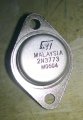
2N3773, fake or not

Thread Starter

R!f@@

Joined Apr 2, 2009
10,004
@Lestraveled

This is not working.
The resistor at BE to GND does not show anything while the CE voltage can be raised to 300VDC o_O
The BE is 100Ω while +Ve to Collector is at 100KΩ

Any idea on this ?
 

Lestraveled

Joined May 19, 2014
1,946
@R!f@@

OK, first I should have looked at the data sheet a little more and and used a calculator before suggesting the values.

The breakdown test with the base and emitter shorted was a valid test. It was just not the one I was talking about. My 2N3773 did the same as your transistor.

Change the 100K collector resistor to a 10K resistor and do two more tests.
1. Instead of the base and emitter shorted, connect a 100 ohm resistor between them. The CE voltage should exceed 150 volts with no appreciable current increase.
2. Change the base emitter resistor to 100K. The current should stay low unil 150 Volts. Then it will rise very quickly. (the voltage across the 100 ohm resistor stayed below a Milli-volt below 150 volts. Above 150 V it rose to many Milli-volts.

Sorry I didn't get it right the first time.

Oh, the 10K resistor will dissipate a couple watts in the last test.
 

Hypatia's Protege

Joined Mar 1, 2015
3,228
I bought these. Number is coming off.
I read one member pointed out how to test these.
Like to know how.
I got 1 PSU, 0 - 60 V 6A, CV and CC.
and another one 0-20V with no CC.
Tell me how to blow these transistors.
PS. I already opened a dispute.
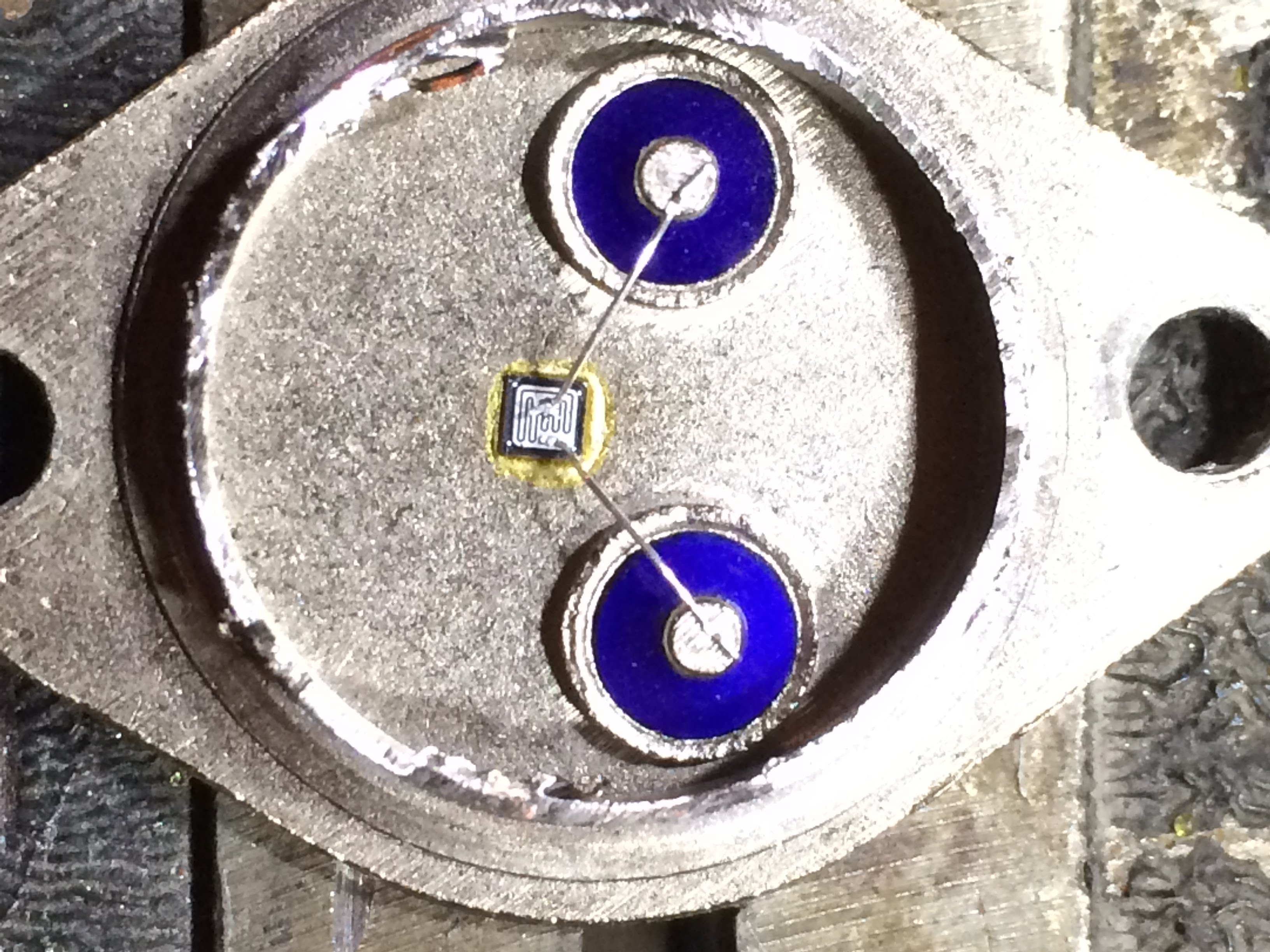
Sadly, counterfeits of popular TO3's are rather common (Been 'bitten' on two occasions myself:mad:) -- Moreover, simple electrical tests are often inconclusive inasmuch as the counterfeit's short term survivability varies greatly with application and nature of 'mislabeling' --- As a practical matter, 'authentication' is best achieved via visual inspection of the die for size, connection (i.e. substantial or dual leads each 'land') and proper mounting (i.e. metallic bonding -- as opposed to heat transfer paste) -- additionally, absence of the 'heavy' internal heatsink base (a.k.a. 'coin') is a dead giveaway! -- If you are concerned about proliferation of toxic substances secondary to grinding/cutting please be advised that it is a simple matter to shear the lid off via application of lateral force to same (as with a vise) -- note, however, that said liability is negligible (as regards TO-3 packages) where milling of the die or base/emitter seals is avoided...

Image of a genuine product -- Notice the heavy internal heatsink 'coin' (i.e. the 'anchor shaped' structure), reasonable die dimensions, proper bonding and heavy B&E terminal-to-die leads (Note that some genuine devices employ dual leads each connection)


Here we have an incontrovertible counterfeit -- Notice the absence of the internal heatsink base and the undersized, improperly bonded die.


Good luck!
Best regards
HP:)
 
Last edited:

Thread Starter

R!f@@

Joined Apr 2, 2009
10,004
What do you say to this.
I opened it. Just use a saw to cut just at the top rim. Will there be chemical hazard ?

1.jpg 2.jpg 3.jpg
 

Hypatia's Protege

Joined Mar 1, 2015
3,228
Addendum -- While the device appears to be of standard manufacture -- it remains possible that it is a 'raised' component (For instance a relabeled 2N3055) -- If your proposed application is critical, please consider contacting the (alleged) manufacturer --- in my experience semiconductor manufacturers/vendors are only too happy to assist with authentication of their products:)

Best regards
HP
 

Hypatia's Protege

Joined Mar 1, 2015
3,228
Manufacture is China I believe.
You seem to have missed the embedded link? Here it is unadorned: http://www.st.com/stonline/contactus/contacts/index.php?type=2

I guess I need to do a the breakdown test now.
While 'premature' breakdown may betray a poorly counterfeited or 'raised' device, it is by no manner of proof that the device is genuine (and, hence, reliable) -- Consultation with the manufacturer is the best only option when in doubt...

Best regards
HP
 

Hypatia's Protege

Joined Mar 1, 2015
3,228
Wouldnt thermal compound cause a short since it contains silver or other metals.
Most thermal transfer compounds are not electrically conductive... Notable exceptions being certain varieties of 'Arctic Silver' and other low quality $#!% marketed for PC applications...

Best regards
HP:)
 
Top