The valve was already in an irrigation timer that had a programmed watering schedule.
I programmed my own microcontroller to include some additional intelligence with regards to rainfall and soil moisture.
Is your application for drip irrigation or water sprinkler? Not that it matters but sometimes the hose water pressure can make a difference.
I just arrived and read this thread.
NOW it seems that there is new information.
The TS owes the participants so far a lot more information as to the requirements and the resources.
Ok, it seems it would be much simpler to keep the DC and AC separate, as my DC current requirements could mean a larger transformer ,which could be unessary.
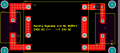
I would not make the PCB symmetrical like that, too easy to flip it and connect it backwards. No need for all the vias and fat traces- on the primary-side even 1A is seen (clearing the fuse, so the PCB traces are not the fuse).
The fuse rating should be on the silkscreen and in North America 300% fusing is OK for small transformers.
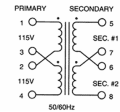
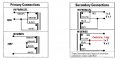
That gives for 240VAC 0.15A max. and around 83-100mA (for 120VAC 0.3A max. and around 0.167-0.2A) for the ball park fuse size.
Also note small VA power transformers have quite poor regulation, their output voltage goes high at light loads.
I see about 35% (Tamura 3FL24) giving close around 32VAC out at no load, for 44VDC at the bridge rectifier.
Your buck-converter needs to be able to take this.
The PCB has been sent for manufacturing as part of a prototype batch, so I can make changes in the next PCB run.
Originally, I was aiming to have a single transformer that would also contribute to the DC voltage, but I now plan to keep both transformers independent.

 Facebook
 Google
 GitHub
 Linkedin