TVS Placement for 24VAC and DC Solenoid Control – Correct Approach?

Thread Starter

DJ_AA

Joined Aug 6, 2021
490
Hi All,

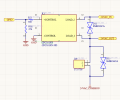
I would like to know whether this is a little overkill, or what the correct way to set this up would be. I need to control some 24VAC solenoids as well as DC solenoids. I will have a power input terminal block, which in this case is 24VAC_IN and 24VAC_COMMON. The solenoids are controlled via SSRs. In the DC setup, 24VAC_IN becomes 12V, and 24VAC_COMMON becomes GND. In the DC case, both static and latching solenoids will be used.

To protect the SSR and the rest of my circuit, I have included some TVS diodes. TVS D11 was recommended (I believe from an application note), but I am unsure whether D35 is also needed for protection. The reason for using D35 was to isolate any transient near the entry point of the PCB, which is connector J19.

I might be wrong, but would D11 be more appropriate for the AC case, and D35 for the DC case?
1774471542741.png
 

vandveuser16776

Joined Feb 21, 2026
121
Think of XXXCA series as two zeners soldered together in parallel but reverse polarity. The only diff is that the TVS acts super fast (I think nano secs) as opposed to sluggish zener. So the bottom line is, if you have a relay, you need to protect the switching component or MCU from high voltage kickbacks.
 

Thread Starter

DJ_AA

Joined Aug 6, 2021
490
Think of XXXCA series as two zeners soldered together in parallel but reverse polarity. The only diff is that the TVS acts super fast (I think nano secs) as opposed to sluggish zener. So the bottom line is, if you have a relay, you need to protect the switching component or MCU from high voltage kickbacks.
So is the circuit correct? Plus the MCU side is protected by the opto isolator in ssr
 

panic mode

Joined Oct 10, 2011
4,864
Think of XXXCA series as two zeners soldered together in parallel but reverse polarity. The only diff is that the TVS acts super fast (I think nano secs) as opposed to sluggish zener. So the bottom line is, if you have a relay, you need to protect the switching component or MCU from high voltage kickbacks.
agree with everything expect the word 'parallel'. should be 'series'. two antiparallel zeners are no different than two antiparallel rectifiers.

as for protection, having both TVS is the the ultimate protection though D35 should be sufficient if considering only kickback from inductive load.
 

Thread Starter

DJ_AA

Joined Aug 6, 2021
490
agree with everything expect the word 'parallel'. should be 'series'. two antiparallel zeners are no different than two antiparallel rectifiers.

as for protection, having both TVS is the the ultimate protection though D35 should be sufficient if considering only kickback from inductive load.

So if I am correct D11 is protecting the SSR and D35 overall even a loose wire
 

vandveuser16776

Joined Feb 21, 2026
121
Yeah, circuit seems to be fine with so much details. The D11 seems redundant tho, but if you have a bunch, wont do any harm to put one, especially if the circuit is near a source of high noise. The TVS does a wonderful job of in protecting circuits from sudden voltage surges
 

vandveuser16776

Joined Feb 21, 2026
121
agree with everything expect the word 'parallel'. should be 'series'. two antiparallel zeners are no different than two antiparallel rectifiers.

as for protection, having both TVS is the the ultimate protection though D35 should be sufficient if considering only kickback from inductive load.
I stand correct, they should be in series.
 

Thread Starter

DJ_AA

Joined Aug 6, 2021
490
Maybe I am wrong D11 protects against transients during the time when SSR turns off, but D35 protects against transients from wire on terminal block or another SSR due to the 24VAC common. So I think both do have a benefit.
 

panic mode

Joined Oct 10, 2011
4,864
it is your circuit and you can do as you please. and i am not saying you are wrong.
we are simply looking at things differently...

you are considering single channel (posted circuit, without scaling up).
i am considering universal solution 1,2, 8, 16, whatever number of channel per board... and possibly many boards (so cheap TVS is not longer so cheap once the scaling kicks in).

if i was building this i would put one TVS per load (like D35). plus one single TVS across power rail (shared) between 24VAC_IN and 24VAC_COMMON. not one more TVS per SSR.
 
Top