12 VDC > 24VAC supply voltage for ecobee thermostat

Thread Starter

Mustang1965

Joined Feb 20, 2013
23
What I need to accomplish is to power my 24VAC, ecobee thermostat in my 12VDC RV while not connected to shore power. You would think that that would be effortless except that the ecobee (or any thermostat) operates on 18-24VAC. I reviewed a few of the posts here, but I did not see a circuit that would meet my needs. The one showed that the output would be 6VAC.

While searching the Internet, I did locate (1) and only one commercial production possibility (see attached info below), but unfortunately I believe that the company may be out of business as the telephone number goes to a telephone company recording and they do not display any email on line. The product was/is manufactured for the CCTV/Security sector. I also think that I remember seen this application used in irrigation systems. Probably the issue may be that CCTV is not in much demand any more.
PowerStream

While on shore power I have (3) 24VAC DPDT relays that will work fine and a 24VAC AC/AC adapter that operates the ecobee and 1 relay (all that is needed at one time) perfectly.

I also thought about finding a small 12VDC > 120VAC inverter and plug in the 120VAC to 24VAC converter to power it. I am not sure as to the size of batteries that would be needed to run this 24/7. My RV's 12 volt batteries, currently have 265Ah, charged by 250Watts of Solar/MPPT and if necessary Shore power (when available), which has not been needed yet. I will need to calculate that load one of these days.

How can I pull this off, or can I pull this off, without using a small 120VAC inverter? I wish that I could get hold of the schematic for the 12VDC > 24VAC CCTV inverters at PowerStream, wishful thinking. Any referals to companies you may know of that produce these products?

Thanks in advance for your assistance
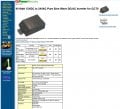
PowerStream - 12VDC to 24VAC Inverter.jpg
 

geekoftheweek

Joined Oct 6, 2013
1,429
It would seem to me that the converter you show would be the best bet for what you want to do. While I'm no expert it would seem that a 110V inverter and transformer combination would have higher losses and draw more power compared to the single unit.

It does list a pretty decent stand by current, but I'd be willing to bet the thermostat probably won't add that much more draw over the stand by current. The only real way to be sure would be to measure it while running. My home thermostat uses four AAA batteries and will last about four months just for an idea...
 

Ian0

Joined Aug 7, 2020
13,097
Does it work from 12V DC? Have you tried it? Clearly it is an electronic device with a microcontroller, so that part of it must run off 3.3V DC or 5V DC, so at some point the 24V AC must be rectified and regulated down to a lower voltage.
It doesn't look big enough to contain any 50Hz magnetic components, so I can't see how 12V DC could harm it even if it didn't function.
 

Thread Starter

Mustang1965

Joined Feb 20, 2013
23
It would seem to me that the converter you show would be the best bet for what you want to do. While I'm no expert it would seem that a 110V inverter and transformer combination would have higher losses and draw more power compared to the single unit.

It does list a pretty decent stand by current, but I'd be willing to bet the thermostat probably won't add that much more draw over the stand by current. The only real way to be sure would be to measure it while running. My home thermostat uses four AAA batteries and will last about four months just for an idea...
I just set up the thermostat and relays on my test bench and the thermostat with (3) 24VAC DPDT relays operate perfectly. I have it powered by a 120VAC > 24VAC adapter that I purchased on Amazon a while back. The thermostat activates the relays (Heat, Cool, Fan) as requested by the thermostat. The relays connect 5VDC (testing voltage) from a battery pack to the LEDs to indicate a proper circuit. At no time will more than 1 relay be operational. I just need to come up with a 24VAC option to be run off of 12VDC while dry camping to power the ecobee. The way I wired the relays allows for both thermostats to operate independent of each other depending if there is 120VAC shore power connected or if not it switches to the crappy analog 12VDC RV thermostat if there is no 120VAC. I can live with this setup until I come up with a solution. Maybe hack the thermostat, no toooooo much work.
 

Thread Starter

Mustang1965

Joined Feb 20, 2013
23
Why would a thermostat operating off 24VAC be installed in an RV with 12VDC power? Certainly there are other thermostats you could use.
Oh there are and I have repaired a number the digital thermostats for fellow RVers. They pretty much all SU.. (leave a lot to be desired). The wife and I have been using ecobee since their day # 1 and really like them. The quest for a 24VAC 60Hz option continues... I like the data logging option the ecobee has, granted I need WiFi for that option, but maybe StarLink will be in the future.
 
Last edited:

JimNX

Joined Sep 6, 2023
2
What I need to accomplish is to power my 24VAC, ecobee thermostat in my 12VDC RV while not connected to shore power.
I have two Ecobee thermostats running in my motorhome:
  • One for the front rooftop AC and furnace
  • One for the rear rooftop AC

I used the Powerstream module you found and it's been working well for approximately two years now. I wrote out everything I did to make it work and posted it to Reddit, a long with a wiring diagram. You can find it at this link:


Hopefully this helps!
 
Last edited by a moderator:

MisterBill2

Joined Jan 23, 2018
27,197
I just set up the thermostat and relays on my test bench and the thermostat with (3) 24VAC DPDT relays operate perfectly. I have it powered by a 120VAC > 24VAC adapter that I purchased on Amazon a while back. The thermostat activates the relays (Heat, Cool, Fan) as requested by the thermostat. The relays connect 5VDC (testing voltage) from a battery pack to the LEDs to indicate a proper circuit. At no time will more than 1 relay be operational. I just need to come up with a 24VAC option to be run off of 12VDC while dry camping to power the ecobee. The way I wired the relays allows for both thermostats to operate independent of each other depending if there is 120VAC shore power connected or if not it switches to the crappy analog 12VDC RV thermostat if there is no 120VAC. I can live with this setup until I come up with a solution. Maybe hack the thermostat, no toooooo much work.
I was going to comment that the 4 volt AC relays should operate adequately on 12 volts DC. And if the thermostat works then you are all set. As for change over, that may not be needed if shore power keeps the battery charged. AND you gain efficiency by not needing to power a transformer. A few years ago I powered the controls for a steam boiler heating system from a 1 volt battery for several days during a winter power outage.
 

JimNX

Joined Sep 6, 2023
2
It looks like a moderator remove the link I supplied in my previous comment. I guess links aren't allowed..? If you search Google for "reddit ecobee motorhome success" it will be one of the first results. Just in case, here's the body of the post:

-------------------------------------------------------------------

mycOazB.jpg

I wanted to upgrade the old analog thermostats in my Class A motorhome to smart thermostats so I did a lot of research on the subject but came to many dead ends. Just about every post I found shot down the idea, mostly because of the differences in electrical standards.

RV thermostats operate on 12vDC while typical household thermostats operate on 24vAC. In addition to the differences in power requirements, the "call for" function (heat, air conditioning, etc) works almost exactly opposite between a household thermostat and an RV thermostat. That is, a household thermostat connects the function being called for to power (for example, connects W to Rh for heat) while an RV thermostat connects the function being called for to ground (for example, W to GND for heat). Further complicating the situation was that each conductor/function in the RV showed a slightly different voltage.

So here's how I did it...

First, I bought a 12vDC to 24vAC innverter from Powerstream for $110.
powerstream.com/inv-12dc-24vac.htm

The input of the inverter is connected to the 12vDC power from the RV and the output of the inverter is connected to Rc and C of the the thermostat.

*** NOTE: If you are familiar with thermostats, you'll want to connect power to Rh instead of Rc. Here's the thing, and it's specific to Ecobee thermostats: Ecobee thermostats will only power up if power is supplied to Rc; they will not power up if power is connected to Rh only. If you are running both heat and air conditioning from this thermostat, put a short jumper wire between Rc and Rh, but know that it needs power on Rc to actually power up.

*** WARNING***
As mentioned above, Ecobee (and most residential) thermostats work by connecting the desired function to 24vAC power (W to Rh for heat, for example). Do NOT connect your RV's equipment wires directly to the Ecobee thermostat!! It will send 24vAC to the equipment in your RV which would most certainly be a bad thing.


This is where relays come in to play.

One relay is needed per function. So, if you your thermostat controls only heat, then you need just one relay. If your thermostat controls heat and air conditioning, then you need three relays (heat, air conditioning, and fan). These are just examples -- you will need to look at your thermostat to figure out how many relays you'll need for your specific system.

I purchased some inexpensive 24vAC relays from the local Grainger.
grainger.com/product/OMRON-24V-AC-2XC01
I chose this particular one because it was in stock for same-day pickup but almost any 24vAC relay will do.

I also purchased the bases for the relays to make terminating the wires easier, along with a DIN rail to mount it all nicely. grainger.com/product/DAYTON-Relay-Socket-1FC13
grainger.com/product/GRAINGER-APPROVED-Mounting-Track-18Z758

As mentioned above, I have one relay per call-for function, so in my case

  • Relay for W (heat)
  • Relay for Y (AC)
  • Relay for G (fan)

My existing thermostat has a FAN HI function as well so if I wanted to use that, I would need a fourth relay to make it work. I didn't do this for now, but more on this later.

Earlier I mentioned the quirky power connection requirements of the Ecobee thermostat (requiring 24vAC on Rc instead of Rh). Here's a bit of expanded information on that:

Typical residential thermostats connect

  • Rh to W for heat
  • Rc to Y for air conditioning

Rh and Rc can share the same power source, but they can also use different power sources. A majority of residential homes' furnaces and air conditioning units operate from the same controller board inside the furncase so they share a similar power source. Thus, many times you'll see a small jumper wire between Rh and Rc in your thermostat. That is, the same single power source goes to both Rh and Rc to operate either W (heat) or Y (air conditioning).

However, sometimes the heat and the airconditioning are separate units (for example, if you have a boiler for heat and a separate air handler for air conditioning). In this case, each piece of eqjuipment would supply its own power to the thermostat -- from the boiler to Rh and from the air conditioner to Rc -- and there would not be a jumper wire between them. This is why the two separate terminals exist.

I called it quirky because in most residential installations you'll find the red conductor (24vAC) attached to Rh instead of Rc. Ecobee just had to be different, I guess. (I question this design choice since plenty of homes have furnaces without any air conditioning at all making Rh the much more used of the two)

All that being said, I placed a jumper wire between Rc and Rh so that both heating and air conditioning will work.

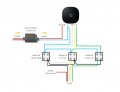
Referencing the wiring diagram above, you see the Ecobee thermostat energizes a relay with its 24vAC which in turn connects the power wire from the respective function (7vDV to 12vDC...they're all different) to ground to activate whichever function is being called for. This configuration completely isolates the two electrical systems. It's kind of a complicated roundabout way of doing things, but it works!

Regarding the rear thermostat in my motorhome, it has just two relays; one for for Y and one for G, since it is not connected to and does not control the furnace. I might change that in the future though, and if I do, I'll add in some diodes to make sure the front and rear systems don't interfere with each other.

Other notes:

  • Using a inverter will draw extra power since some energy is wasted in the conversion from DC to AC. It's negligible, but worth noting. No big deal if you're always plugged in, using a generator, or charging your batteries some other way, but could be a problem if you do a lot of boondocking. Just so you know!
  • I abandoned the FAN HI wire for now, though I may add another relay for it in the future and attach it to Y2 (2nd stage air conditioning).
  • I abandoned the red 12vDC wire which was used to power the old thermostat. It is not needed in this new setup so I capped it off and tucked it inside the wall behind the thermostat. *** I ran a separate fused circuit from my power panel to the power inverter instead of using the existing 12vDC line from the RV ***
  • The reason Rc and Rh need a jumper wire is because the Ecobee thermostat will only ever connect Rc to Y and Rh to W (never Rc to W, for example).
 
Top