2 Pots in parallel to control one dc 12v motor

KeithWalker

Joined Jul 10, 2017
3,608
HI,

My name is stephane..

Sorry if the what was written initially was vague..
The existing knob/potentiometer resistance is : 5252 ohm or 5k
Then the circuit diagram is incorrect. Can you please post the real one, showing the connection and value of your added potentiometer. Without it, everything we have suggested is useless!
 

LowQCab

Joined Nov 6, 2012
5,101
This might be the craziest request ever posted here.

The first Circuit shown is for PWM Control of an Electric-Motor that doesn't exist on
the 23-Horsepower Gasoline-Engine that is supposedly having it's speed controlled.

The Gasoline-Engine does not offer the option of remote Electronic-Speed-Control,
even though it does offer 2 remote selectable, maximum Electronically Governed Speeds,
which are roughly ~3000-RPM, and ~3600-RPM,
these are not selected via a PWM-Signal, but rather a simple switch to ground.

So, it turns out that we are not being accurately informed as to what exactly is going on here,
let alone why this Gasoline-Engine would even need remote Speed-Control in the first place,
and on top of that, Speed-Control from 2 different locations,
and on a Fire-Truck !!!!

Now we have a person, obviously inexperienced in Electronics,
designing a Rube-Goldberg device for a Fire-Truck which peoples Lives may depend upon.

The answer is NO !!!!!
.
.
.
 

crutschow

Joined Mar 14, 2008
38,545
any exmaple of a latching relay thats simple to instal and use
Okay.
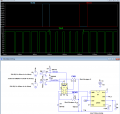
Below is the LTspice sim of a 555 PWM circuit with two pots (U2 and U3), selected by a DPDT, 2-coil, latching relay (U4):
The sim starts with the relay in the reset (Rear) pot position and then changes to the Cab pot at 50ms (blue trace).
After 100ms, it changes back to the Rear pot (red trace).
Note the change in the PWM output duty-cycle (green trace) as it switches between the two pots, which are set for approximately 80% and 20% duty-cycle.

Since you didn't give the value for timing capacitor (C2 below) I used an arbitrary value of 2µF.

S1 and S2 (controlled by V2 and V3) simulate the normally open SPDT or SPST momentary selection (could be push-button type) switches in the Cab and at the Rear of the truck.
The U4 relay is a 12V, 2-coil, latching type (example).

But as LQC noted, what about the gasoline engine?
Does the engine drive a generator which powers the DC motor you mentioned?

1717723728897.png

.
 
Last edited:

KeithWalker

Joined Jul 10, 2017
3,608
Your heading in post No.1 states - to control one 12v motor.
In post No.20 you tell us it is a 23HP gasoline engine.
Thank you so much for completely misleading me and wasting my time!
Have a nice life!
 

MisterBill2

Joined Jan 23, 2018
27,683
OK, a lot has been made clear. First, it is an ENGINE speed that is being controlled by some engine speed control mechanism. I have used such a control for a diesel engine system once.
So here comes a text description of the scheme to make it happen. First, the materials required: First, another control potentiometer with the same mechanical and electrical ratings as the single device just described, Next, a four-pole double throw, 12 volt DC coil. I recommend a Potter and Brumfield /AMF model KHS17D11, This is a hermetic sealed metal case relay in a small package with good reliability and able to live in a rugged environment. It may be used with a socket or wired directly. You will also need a switch to allow the external control to take over. The interconnection cable should be four conductors shielded, with suitable connectors at each end. Three of the poles will be used to switch between local and remote potentiometers, with the common of each pole connecting to the speed controller package, and the normally closed contacts of those poles connecting to the corresponding connections of the control in the cab. The three corresponding normally open contacts will connect to the remote speed control potentiometer. ends and wiper. The remaining wire in the cable will connect between one of the relay coil terminals and the cable shield. At the remote speed control location the fourth wire will connect to one side of the SPST switch, with the other side of the switch connected to the cable shield. Back at the other end of the cable, with the cab mounted control, the remaining relay coil connection will connect to the positive 12 volt supply, while the negative supply connects to the shield.(and ground) maybe. Thus the switch at the remote location will allow control from the remote location, while if the remote is disconnected the control defaults to the cab mounted control. Thus intrinsic reliability adequate for most fire-fighting systems.
 

MrAl

Joined Jun 17, 2014
13,722
HI,

I just put together a 12 volt circuit to test adding another pot for throttle/speed ajustment on a motor.

Ohms law applied to the parallel circuit cuts the amperage/current across the visible resistor, in this case the variable resisors/potentionmeters. Have to have both pots all the way open to get 12 volts on the motor.

However, If i exchange the pot for pot with an on off swtich,and turn on the pot to ''off''... does the resistance get masked or no longer applly in the circut?

So that the other pot that is one gets al the current or amperage?

Another way to put it, of a potentionmeter with a pot that has a real on and off switch integratred, in the off potition subtract le resistance from the equation?

Im pretty sure I can use rocker switch on-off-on to isolate both pots, but the client doesnt want another switch in this circut.
Hello,

Probably a push button system would work better than two pots. You could actually have more than two control locations with this method also. I'll explain below.

It sounds like what you are doing is trying to control one thing with two potentiometers, where only one of the pots at a time is supposed to control the device. So if we call the pots P1 and P2, it might go like this...

You turn P1 to control the device to some low setting.
Next you need to turn P2 to control the device instead of P1, so you want P2 to control the device no longer want P1 to do anything.
Now if you go back to P1 you want only that pot to control the device, no longer P2, so you turn P1 and that controls the device to the correct level.

You can use a micro controller chip to sense when one pot is turned, then the other pot is switched out automatically and the pot that is turned more recently takes over complete control. This isn't that hard to implement really but you need to use a uC chip in order to have automatic sensing. This has problems however.
You can do this with two switches S1 and S2 also, where when S1 is flipped P1 becomes active, and when S2 is flipped P2 becomes active. This, unfortunately, means that when S1 is flipped P2 becomes inactive, and when S2 is flipped P1 becomes inactive. That, also unfortunately, means that when S1 is flipped and P2 becomes inactive and S1 is flipped again, P2 becomes active gain and since you are not near P2 you have no control except for allowing the state to go back to the original state, which may or may not reflect what is really needed at the time. So, there is some danger where if the first switch flipped is flipped back again, the device may get controlled in a way that is undesirable due to the fact that there may be no memory of if the previous state is desirable or not.
This means there has to be a lockout mechanism so that when one pot is being used at that location, there is no way it can switch back to the previous state without the person moving to the other location and using that second pot instead.

What this all suggests is that either a microcontroller chip would work well as a memory element, or a servo system where each pot shaft controls not only the pot it is physically attached to, but the other pot shaft as well. If P1 is turned that means that P2 also turns in the same direction even though in another location. If you then move to location where P2 is at and turn P2, P1 also turns. This keeps both pots perfectly in sync so there can be no error in the selection.
Another way which MAY work is to have both pots mounted physically to the same shaft. The shaft would have to run the entire length between the two pots which may or may not be physically possible.

What else might work is to use something like two 10 position switches each with a full 360 degree rotation. This removes the sync problem because then the setting always relies on the setting of BOTH switches. This would reduce the choices to just a total of 10 possible settings though. This might bring in some unusual setting changes though as each switch is turned, and may be too unintuitive to operate.

Using two pots without any sync'ing method would also result in some unintuitive setting changes. When you go back to the inactive pot location and turn that pot, the system will have to first jump to the previous state before it can change to the newly desired state. This will seem very strange to the operator.

A PUSH BUTTON SYSTEM:
What might be better is to use a push button system. One button for "up" and one button for "down", at each location. The operator pushes "up" for a higher speed (or whatever has to increase) and pushes "down" to lower the speed. This means when the operator moves to the other location the intuitive functionality appears to be the same. This would also allow a simple way to add even a 3rd or 4th operating location.
This would require four momentary push buttons and something to remember the state, such as a microcontroller or digital potentiometer, and only one digital potentiometer not two, but it would be controlled from either location with the push buttons.
I suppose this could work with a motorized potentiometer also instead of a digital pot. At each location one push button turns the pot one way, the other button turns it the other way ("up" and "down", or clockwise and anticlockwise). The main idea being that both locations operate in the same exact manner with no unintuitive changes to the controlled device.

This is of course if I understand exactly what you are trying to do here.
 
Last edited:

MisterBill2

Joined Jan 23, 2018
27,683
I looked at pat of the product literature and I see that external variable speed control is an option.
But that is not mentioned in the 100 page service manual that I just examined.

Hopefully someplace in the thousands of pages the circuit to connect for access to the variable speed option is available.

And I can not imagine that the technical expertise of the TS would support such very complex construction projects as have been mentioned thus far. Nor can I imagine such complex schemes being able to survive in a fire-fighting vehicle, nor even being able to be packaged for use in a vehicle environment.
 

LowQCab

Joined Nov 6, 2012
5,101
If we ever do get informed as to what is really going on here .................
I'm thinking that the whole idea of "completely-variable" with a knob is simply someones
idea of what would be "cool" if it could be done,
and that,
what is really "desired" is to quiet-down that Engine when it's not immediately needed, ( front-control ),
and to easily bump-up the RPM when serious action is required, ( rear-control ).

This makes the whole arrangement a "2-state" deal,
"standby", ( Idle-Speed ),
and "run", ( Full-Governed-Speed ).

The Engine in question is "available-with", ( or maybe standard, who knows at this point ),
an Engine-mounted Speed-Control-Pot with a Knob.
( The Engine is 100% Electronically controlled, including the Electronic-Throttle ).

It should be easy to set up a "Run / Idle" Push-Button set-up with 2 Push-Buttons at each "station".

We may never find-out what the real story is.
.
.
.
 

BobTPH

Joined Jun 5, 2013
11,560
I agree with @LowQCab. The TS is not qualified to be doing any modification of a critical piece of safety equipment.

That said, making this work as naturally as possible is an interesting hypothetical problem.

Here is the way I would do it.

Forget about having pots whose absolute position controls the engine speed.

Instead, use two quadrature encoders and a microcontroller.

When the system is switched on, some default speed is selected. Now, either encoder knob can be turned clockwise to turn the speed up and counterclockwise to turn it down. No switches are required.
 

MisterBill2

Joined Jan 23, 2018
27,683
Consider that any of the incremental control schemes do not provide a means to accurately return to a specific setting. Consider also that every one of them requires many more parts than just switching between two different pots in separate locations. They would all be quite acceptable for controlling the volume level for an entertainment sound system. And in the event that any repair was required, could the hardware be successfully serviced by those less skilled than yourselves???
Aside from those considerations is the fact that exactly what that present control potentiometer is interfacing is rather unknown, at least to me. But with a simple isolated relay change over, it does not matter.

Of course, using a "seventies" relay technology is not state of the art by any means, but it avoids quite a few potential problems.
Besides all of that, the scheme I suggested allows a default to the original single control simply by unplugging, ( disconnecting) the remote control.
 

Thread Starter

stephane peloquin

Joined Jun 6, 2024
11
This might be the craziest request ever posted here.

The first Circuit shown is for PWM Control of an Electric-Motor that doesn't exist on
the 23-Horsepower Gasoline-Engine that is supposedly having it's speed controlled.

The Gasoline-Engine does not offer the option of remote Electronic-Speed-Control,
even though it does offer 2 remote selectable, maximum Electronically Governed Speeds,
which are roughly ~3000-RPM, and ~3600-RPM,
these are not selected via a PWM-Signal, but rather a simple switch to ground.

So, it turns out that we are not being accurately informed as to what exactly is going on here,
let alone why this Gasoline-Engine would even need remote Speed-Control in the first place,
and on top of that, Speed-Control from 2 different locations,
and on a Fire-Truck !!!!

Now we have a person, obviously inexperienced in Electronics,
designing a Rube-Goldberg device for a Fire-Truck which peoples Lives may depend upon.

The answer is NO !!!!!
.
.
.
Why am I being spoken to like I am not part of the thread.

This a is an electronics forun where everyone has different knowledge of electronic.

Supposed to be a place to share and help one another. Or that was my understanding.

The 23 hp vanguard engine is controlled using a potentionmeter.. 5k.
 

Thread Starter

stephane peloquin

Joined Jun 6, 2024
11
To all those to posted to help. I appreceate it ..

What was aked is to control the vanguard motor from two locations by using 2 pots.

I put together a circuit, or bench test to see how the pot would react, rather than just run on ohms theory, to try and got me bearings.

I can to this forum wondering if someone, who is a little mpore experienced with electronics, might have a simple solution.

If it cant be done than thats ok... If there is solution of having a dpdt switch to isolate the 2 pots. That was the initial question being asked.

These are support truck for fire departments all of the states and canada.

Thast why I refered to an electronics forum were you have more experience than I do.

the goal in the end is exactly that, make sure that this circut is the most optimised and safe possible for support fire trucks that use pumps to put out fires.

Controlling throttle on a motor that uses its own electrical power once started to vary the motors speed. Instead of it being only on the motor itslef using qa wire harsness to split one pot into two to be able to control at two seperate locations on a fire truck.

Thanks

Steph
 

MrAl

Joined Jun 17, 2014
13,722
To all those to posted to help. I appreceate it ..

What was aked is to control the vanguard motor from two locations by using 2 pots.

I put together a circuit, or bench test to see how the pot would react, rather than just run on ohms theory, to try and got me bearings.

I can to this forum wondering if someone, who is a little mpore experienced with electronics, might have a simple solution.

If it cant be done than thats ok... If there is solution of having a dpdt switch to isolate the 2 pots. That was the initial question being asked.

These are support truck for fire departments all of the states and canada.

Thast why I refered to an electronics forum were you have more experience than I do.

the goal in the end is exactly that, make sure that this circut is the most optimised and safe possible for support fire trucks that use pumps to put out fires.

Controlling throttle on a motor that uses its own electrical power once started to vary the motors speed. Instead of it being only on the motor itslef using qa wire harsness to split one pot into two to be able to control at two seperate locations on a fire truck.

Thanks

Steph
Hi,

You can use two pots with two switches to control everything, but I do not think it would be that great of an idea.
Hire another operator to work the single pot.

If this is that widespread of an application that it spans TWO WHOLE COUNTRIES, then you better hire a consulting firm. You can't ask for random anonymous help. You need contracts, guarantees, etc. This isn't a hobby project this is some serious s***. Like asking strangers on the street to modify all the elevators in New York City.
 

MrAl

Joined Jun 17, 2014
13,722
Then why is your thread's title about controlling a 12Vdc motor, and then showing a schematic of a 555 PWM circuit?
That led to a great deal of confusion, including mine.
It seems clear to me that was just a quasi-bench test to simulate how two pots could work together.
The real application would presumably need two pots (still under investigation though) so testing a 555 with two pots might be a reasonable test circuit for the real-life circuit which also needs two pots to work together.
The presumption, right or wrong, is that if it works with the 555 it works in the real-life application. That could be a mistake too though because we don't know the actual electronics of the real-life control circuit.

This would mean someone could ask for help with the 555 circuit, then when questioned for more detail might render more directly applicable information.

After the last statements though about the projected widespread use of this thing, I have to hesitate to offer more suggestions. This is a life critical application where even major companies don't like to make any guarantees.

On the lighter side:
"Can someone, somewhere, somehow, by some means, help me design and build my laser eye surgery machine" :)
 
Last edited:

KeithWalker

Joined Jul 10, 2017
3,608
I will not contribute any more to this posting except to say that even a "noob" should be able to figure this out: If you connect the corresponding terminals of two pots together, rotate one fully clockwise and the other counter-clockwise, both pots will be completely shorted out.
 

MisterBill2

Joined Jan 23, 2018
27,683
I DID consider both the "NOOB factor" and the application and delivered a complete description of a simple workable system having adequate reliability for the application. And at no time was I disrespectful to the TS, although I did comment about a lack of information, WHICH SEEMED TO BE ADDRESSED right away. Of course I do have the advantage of creating a similar solution for an industrial client many years ago.
 

crutschow

Joined Mar 14, 2008
38,545
Okay.
So the push-button selection, latching relay circuit I show in post #23 can be used for whatever exactly is being controlled,
A push of the button at either location, will then select the pot at that location for control of the system.
Of course that can cause a jump in the speed, depending on the relative setting of the two pots, as noted by MB2.

An up/down setting using one "up" and one "down" push-buttons at each location to control an up/down pot (digital or motorized) as suggested by MB2, would appear to be the simplest way to avoid the jump problem.
Also would avoid connecting long lines (with possible noise pickup problems) to the pots.
(Edit: Alternately, the up/down control of the digital pot could be with a knob-controlled quadrature encoder at each location, such as used for volume controls. This would allow for faster control of the motor speed, and control speed would seem to be of essence for adjustment of a fire truck pump).

Of course that's assuming our understand of the problem is correct.
 
Last edited:

LowQCab

Joined Nov 6, 2012
5,101
It is my opinion that this "modification" to the Engine must be accomplished in the
simplest, "Rocks & Sticks" manner possible, to reduce the possibility of failure, and
to make any needed maintenance completely "Idiot-Proof", because at some point,
this "modification" WILL BE worked on by an actual "Idiot", with zero Electronics knowledge.
Sorry if this hurts anyone's feelings, but this is just a fact of Life,
and people's actual Lives may depend upon it's bullet-proof performance,
and very "obvious" method of operation.

This eliminates the practical use of any sophisticated Electronic schemes of control,
regardless of how well designed they may be.

Idle-Speed, and Maximum-Governed-Speed, are the only 2 Modes that are needed for this Engine.
This equates to ........ "Zero-Volts", (or very near zero-Volts), and "5-Volts-Reference",
and both must come directly from the Engine's Electronic-Control-Module
by way of replacing the Engine-Mounted-5K-Speed-Control-Pot with a
very heavy-duty "Push-On-Push-Off" Push-Button-Control.

This will make the wiring extremely simple, much like a "3-way" Light-Switch in a Home-Residence.

This type of setup will also mean that simply un-plugging it from the Engine will return
the Speed-Control to the exact original factory designed operation.

This type of setup will also greatly simplify the Bill-of-Materials ( BOM ),
and create a solution that could be installed and diagnosed by any "COMPETENT" Mechanic.
.
.
.
 

MisterBill2

Joined Jan 23, 2018
27,683
OK, LQC, you are close!! I presented the sealed relay switched version because it will default to the local control if the connection is broken. AND with only a single 4 pole relay that has the circuit printed on the top, it is" fairly idiot resistant". And by having the local control connected thru the NC contacts, if the remote link connection fails it defaults to the local control. I have been thru this exact design a few times previously.
 
Top