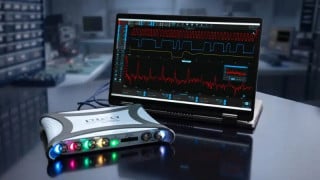
Assuming the "Curr" value represents the number of samples in memory, I'm guessing it took a little over 23 minutes to figure out the frequency. Though, with only 1.4 periods to go on, I'm not inclined to believe the given μHz resolution.
Assuming the "Curr" value represents the number of samples in memory, I'm guessing it took a little over 23 minutes to figure out the frequency. Though, with only 1.4 periods to go on, I'm not inclined to believe the given μHz resolution.

 Facebook
 Google
 GitHub
 Linkedin