BJT Colpitts 1Mhz on breadboard works but ...

Thread Starter

gmv_65

Joined Jan 3, 2025
8
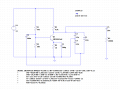
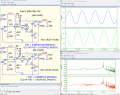
I have made on breadboard the Colpitts oscillator previously simulated.
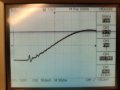
It works but I have some spikes on output signal.
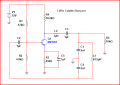
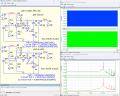
what they are generated by?WhatsApp Image 2025-01-04 at 16.01.08_443babfe.jpgWhatsApp Image 2025-01-04 at 16.01.08_119b8cc0.jpghereby schematics
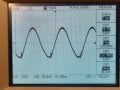
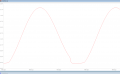
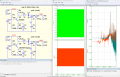
Screenshot 2025-01-04 161152.pngsimulation output
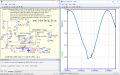
Screenshot 2025-01-04 161259.pngand asc.
 

Attachments

Bordodynov

Joined May 20, 2015
3,430
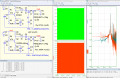
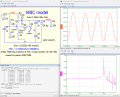
I got PP~4V only by setting the Q-factor of the inductance to 20. Apparently, you didn't use a very good inductance. And the outburst, I think, arose due to the presence of an oscilloscope probe cable and parasitic inductors. Adding a long line to the simulation dramatically slows down the calculation.
1736151764786.png
 
Last edited:

MisterBill2

Joined Jan 23, 2018
27,362
That "spike" at the bottom of the wave is the start of a parasitic oscillation. MY GUESS is that it is related to excess feedback of C2. Also, most of the Colpitts oscillator circuits I am familiar with tend to have one end of the tuned circuit tied to common, and the feedback coming from the emitter. That tends to reduce the stray capacitance coupling to the resonant circuit. In most practical applications, stray coupling is an issue.
 

sparky 1

Joined Nov 3, 2018
1,218
Bordodynov yes, almost ready for nice frequency domain, incredibly helpful, first an update
Increasing the base bias resistors to 67k and 6.8k going for a goal THD 2%
I am intentionally showing a logical course, a progression, guided by simulation measurements.
The first hint was that the rise and fall were unequal. Going lower than .8uH showed problems on the rising edge having
"snow on the mountain" not sure why but adding the 3uH inductor improved the flat bottom of the sinewave.
Maybe it is stray capacitance miller effect, by adding inductance seams give the right amount for balance on the Colpitts oscillator.
The circuit could use more current uA Looking at the base bias to improve oscillator startup. Here is an update.

The load resistance now 30k. The base bias resistors now 67k and 6.8k
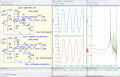
The initial output measurment, less time to reach steady state we are moving adjustments in the right direction.
V(rms) = 1.64V I(rms) = 54.5uA THD 2.6%

By replacing the 2N3904 with an MPSA13 the progress improves enough for filter stage.
V(rms) = 4.98V I(rms) 164uA THD 2.3%
A finely tuned resonant circuit and LP filter should give THD below 2%
 

Attachments

Last edited:

sparky 1

Joined Nov 3, 2018
1,218
Wow that is absolutely incredible! %THD 0.89... Average. I would like to read more about how
C12 Q4 Q6 works. Does a comparison between the before and after adding C12 Q4 Q6 isolate the Fouier component that caused distorsion?

I need to learn to use the Qspice Fourier analysis and find more examples adapting filters within feedback.
THD 0.897...% average between two 2N3904 models. The measurement window on right is great simulation.
Thanks for sharing !
 
Last edited:

MisterBill2

Joined Jan 23, 2018
27,362
Those pesky parasitic oscillations on the waveform tend to be caused by a combination of momentary gain increases and phase shifts during the cycle. Often those are introduced by efforts to assure instant starting of the oscillator, rather then a slower startup before reaching the stable operating amplitude. So there is usually a bit of compromise in an oscillator circuit. That is why some oscillator designs require a lot more filtering of the output wave form than others. Even without the parasitic oscillations, excess feedback adds harmonic distortions.
 

sparky 1

Joined Nov 3, 2018
1,218
Bordodynov choice to reduce parasitic oscillation in Colpitts feedback was correct, my choice in second stage less effective.
The white noise like parasitic oscillations higher than fundimental frequency. The multisim probe measurement I(freq) kept informing me that the current phase noise periodically dominated the fundamental V(freq) when adjusting bias resistors. I had successfully improved
the output current to 54uA. Having sufficient output current in the simulation checking both V(rms) and I(rms)

Ref below; Quoting Haung regarding steady state " First, the average current through the transistor must equal the bias
current lo because the capacitors cannot carry DC current. Second, the fundamental component of the periodic transistor current, ID, must support the amplitude across C1 responsible for setting 0." Haung's effort to advance the teaching paid off, In 2005 graduate students began using this with success. The return of Colpitts took great deal of study at Ultra high frequency it was a challenge to produce at semiconductor level.

Improvements that Bordodynov showed has value in Mosfet Colpitts. The important take away is improvement in filtering feedback.
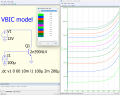
In Attach figure 1 as an example. This could be done in Ltspice .Noise analysis might give a closer look at the feedback filter above also
The attachment was placed in public domain as free preview from the book; High-Purity Oscillators.

In 2000 study, Haung persisted in showing the current model and was granted a study on carrier ratios of Colpitts at 78MHz,
The Colpitts carrier had to be above the board level parasitics, This criteria used for determining component value choices.
After simulation and extensive math the real testing performed on an HP 8563E Spectrum Analyzer, all the SA set up given.
Page. 6 figure 9 shows the test setup. In this document gives the simplified Colpitts equivalent models used.
Phase noise to carrier ratio in LC oscillators - Circuits and Systems I: Fundamental Theory and Applications, IEEE Transactions on
 

Attachments

Last edited:
Top