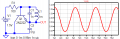
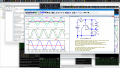
With purpose to decrease β, Q1 is used in reverse mode.
Voltage on B-C is 0.7 V, current through R1 is (1.5 V-0.7 V)/R1 = 8 mA.
Because for reverse biased 2N2222 β=3, then Ib=2 mA, Ie=6 mA.
So DC bias point is 6 mA @ 0.7 V of emitter voltage.
It has some interesting properties not always consistent with Br or Bf.
When you have very high Q CLC components, it doesn't take much to keep the ringing going.
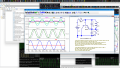
I tried to push up f , at lower mA and tried different NPN's with low Br ( reverse Beta)
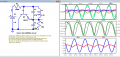
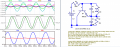
Essentially the R1 powers the inductor with an initial condition with Ve = 0 across the cap. In some cases with different transistors, the ringing decays as if no transistor was connected in a few ms. With very large L1, C1, the Vb is essentially flat , modulated by the output Ve voltage to reach > 0.7V.
Like most Colpitts oscillators it just needs a small nudge of current for each cycle to sustain a nice sine wave from peaking of Vbe (or Vce in this reverse case.)
The caps are C0G and DCR= 0.8 Ohm on L1.
There is no buffering by this transistor. It simply injects some emitter current out of phase with the cap. in the LC tank to keep it running.

 Facebook
 Google
 GitHub
 Linkedin