12v Light Led low consumption and low emission

Tonyr1084

Joined Sep 24, 2015
9,744
I divide by 5 because leds are sharing the total amount of current in the schematics.
OK. Are they in series or in parallel? They CAN be parallel as is proven out by my video. As long as all five LED's are the same forward voltage.

So this is not for lighting, rather for indicating a problem with the circuit. you mentioned a schematic. The only schematic shown is in post #1. But it's not a complete schematic. Hard for us to know the purpose or to offer practical suggestions without having a clear picture of where you're going with this.
 

Alec_t

Joined Sep 17, 2013
15,126
Yes, the 5V is derived from the 12V Batterie.
So if you allow for the inefficiencies involved in converting 12V down to 5V and then down to 3.3V, I suspect the battery power saved, by driving your LED from 3.3V instead of from the 12V battery directly, would be negligible.
 

Thread Starter

DGEDGEDGE

Joined Dec 30, 2024
12
OK. Are they in series or in parallel? They CAN be parallel as is proven out by my video. As long as all five LED's are the same forward voltage.

So this is not for lighting, rather for indicating a problem with the circuit. you mentioned a schematic. The only schematic shown is in post #1. But it's not a complete schematic. Hard for us to know the purpose or to offer practical suggestions without having a clear picture of where you're going with this.
Sorry I miss lead you.
The 5 leds are the leds from your Video.
My schématics from #1, was complete. Only one Led was to be driven.

Thanks in fact you answer to my questions :
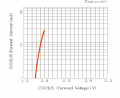
1- The Led provides some light even if 3mA goes through. (More or less depending on the LED but consistently with the data sheet I provided).
2- Having a Transitor taking the 3.3V instead of the simple 12V-> Resistor -> Led -> Gnd could save some energy but not mutch as the 3.3V comes from a step down from the 12V.

Thanks for all for your helps.
 

DC_Kid

Joined Feb 25, 2008
1,242
Where "Lemon-Lime" comes from - makes me curious. Probably not important to this thread.
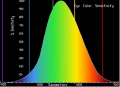
The human eye is most sensitive to that wavelength, around 560nm.
For the eye to see same "brightness" between a yellow vs blue light, the blue needs to have way more lumens output.
So if you choose a yellow to yellow-lime color for LED, you can run it with lowest output lumens and less input power than you can using a blue LED. In other terms, one lumen of blue will appear to eye to be much dimmer than one lumen of yellow-lime.

Red on a sub is likely because they can use little power for the lights, and, your eye is less sensitive to that color, which is ok when you want your eye to adjust to the darkness, allowing you to see instruments better, which may be illuminating in a more eye sensitve color.

It's also why "lumens" spec on a lightbulb box is somewhat deceiving, because brightness to the eye depends a lot on the wavelength of the light. 225 lumens of the "daylight" bulb might not appear as bright as the 200 lumens of warm-white bulb.

I don't think it matters here, but maybe does if this was a NASA mission and every micro-watt matters.
eyesens.PNG
 
Last edited:

MisterBill2

Joined Jan 23, 2018
27,714
The simple and easy way to avoid wasting power in a series resistor or a step down supply, is to put a larger number of LEDs IN SERIES to achieve the required voltage drop at the lower current. A series string of the yellow, or amber, high output LEDs, running at 3 milliamps will consume only 36 milliwatts from a 12 volt supply and not waste ANY power in a resistor. AND the amount of light will be quite a bit more than from a single LED at any current you would choose. Even white light LEDs can be used in a scheme like that.
LEDs DO NOT need to be operated at the maximum allowable current! They can be very useful at much lower current levels.
 

Tonyr1084

Joined Sep 24, 2015
9,744
A series string of the yellow, or amber, high output LEDs, running at 3 milliamps will consume only 36 milliwatts from a 12 volt supply and not waste ANY power in a resistor.
As I understand it, a resistor is needed because the power supply may have a low internal resistance. Or perhaps a high internal resistance. That needs to be taken into account. Otherwise you could have LED's running too hot and can blow them out. At least that's my understanding.

If you have a supply that is not capable of delivering more than 20mA then you can run a single LED directly from that source, such as a coin cell (2032). The battery may have 3V and the LED may have a 2.4Vf, but still, the battery can't push more current than that. Having a 12 volt source that is capable of 1 amp can easily blow LED's out, even if their Vf is equal to the 12 volts. Again, this is how I understand it to be.
 

MisterBill2

Joined Jan 23, 2018
27,714
IF you have a string of LEDs with a total forward voltage drop a at rated current, or a bit more than that, there is no need to add a resistor to limit the current because the actual current will be less than the rated forward current.
 

Thread Starter

DGEDGEDGE

Joined Dec 30, 2024
12
IF you have a string of LEDs with a total forward voltage drop a at rated current, or a bit more than that, there is no need to add a resistor to limit the current because the actual current will be less than the rated forward current.
OK but for the target led (1,8V drop for a 3mA current), that means having a set of 6.666 leds.
If I put 6 leds I have 2V forward tension by Leds => max intensity.
If I put 7 Leds I have a 1,7 V forward tension by led => outside spec.

And anyway, I have a 12Vx3mA current => 36mW power consumption whatever the usage (Led or resistor).
And having a string of LED => more light, which is not what I aim. The aim is to have an indicator of 12V availability that can be seen, with as low power consumption as possible.

I don't understand your point.
1735983589458.png
 

Tonyr1084

Joined Sep 24, 2015
9,744
(12V - 12Vf) ÷ 5mA = um - zero divided by 5mA does not equal zero because zero times zero does not equal 5mA. The whole reason for leaving headroom for a resistor is to be able to control it.
(12V - 9Vf) ÷ 5mA = 600Ω.
(12V - 11Vf) ÷ 5mA = 200Ω.
 

MisterBill2

Joined Jan 23, 2018
27,714
I doubt very much that at 1.7 forward volts there will be zero illumination from the LEDs. That has been my experience. In addition, different colored LEDs will certainly yield different results.
For LEDs intended to serve as illumination, such as the much higher current white LEDs that I have experimented with, the voltage range with some display is large.
 

Tonyr1084

Joined Sep 24, 2015
9,744
The aim is also to have a relatively low light emission but still visible for debug purpose, in case of difficulties.
Here is the schematics :
1735564567783.png


12V to be monitored via the led is connected to the R97 resistor.
TS wants a single LED to monitor 12V. Wants very low current through the LED. Not 6 2/3's LED's. Visible in low light but drawing (if memory serves) 3mA or there abouts to produce an indication but not cast distracting light.
 

MisterBill2

Joined Jan 23, 2018
27,714
It happens on many occasions, in the real world, that an actual solution to a problem is not the same as the original solution suggested. If the original idea were good enough it would have been used.
 

BobTPH

Joined Jun 5, 2013
11,567
somewhat deceiving, because brightness to the eye depends a lot on the wavelength of the light. 225 lumens of the "daylight" bulb might not appear as bright as the 200 lumens of warm-white bulb.
Actually lumens are adjusted to the response of the human eye. A 200 lumen blue light is actually far more intense (in W / m^2) than a green one because the eye is so much less sensitive to blue. They should appear equally bright though.
 

Tonyr1084

Joined Sep 24, 2015
9,744
It happens on many occasions, in the real world, that an actual solution to a problem is not the same as the original solution suggested.
The aim is also to have a relatively low light emission but still visible for debug purpose
TS doesn't want dozens of lights that can be seen by the International Space Station, the TS wants "A Relatively Low Light Emission Still Visible for Debug Purpose". How are several LED's a better solution? The desire is low power consumption.
If the original idea were good enough it would have been used.
I want to validate a schematics.
Wasn't asking for a solution, was asking for validation of a schematic.
 

Ya’akov

Joined Jan 27, 2019
10,262
Welcome to AAC.

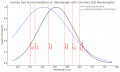
While @DC_Kid is correct about the sensitivity of the human eye, as others have pointed out, the damaging effects of light on night vision is very important to a project involving nighttime activity—and is a constant concern for working with telelscopes where visual observation of the stars is an aspect of the work.

Human Eye Accommodation vs. Wavelength with Common LED Wavelengths.png
comparison of human visual sensitivity vs. eye adaptation for low light with common LEDs indicated

That said, the accommodation curve follows the sensitivity curve very closely—though not at the blue end, which is why bright blue light is so terrible to work under. The bottom line is that if the users of the project will be doing the standard practice of preparing for a session by isolating from light sources to maximize pupil dilation, then the only practical choice for an LED color is red.

As was also pointed out, LEDs produce detectable light at currents that would lead one to believe they shouldn't be producing any output at all. While a red LED driven at the necessary current to produce a usable indication will probably be somewhat higher than a green one, it will be very low.

The next step should be empirical testing of LED candidates using a bench supply to determine which actually produces the best result in the expected conditions. This means preparing the observer's eyes as usual and then checking for disruption of night vision as well as the visibility of the indicator.
 

Thread Starter

DGEDGEDGE

Joined Dec 30, 2024
12
Hi everyone,
Thank you all for your suggestions and constructive criticism, which greatly helped me in making a decision and allowed me to learn a lot and refresh my knowledge.

In the end, another constraint led us to choose the simple resistor solution: the available space on the PCB was too limited to accommodate the schematic I wanted to validate.
Nevertheless, this schematic will surely find a place in another project...

For those interested in the complete schematic of the project I am contributing to, you can find it in its previous version here:
https://oshwlab.com/pololamag/astralim

Thank you to all participants!
 
Top