12v Light Led low consumption and low emission

Thread Starter

DGEDGEDGE

Joined Dec 30, 2024
12
Hi,
For an astronomical opensource electronic equipment, I want to validate a schematics.
The aim is to be low power consumption to save poser on a 12V battery input.
There is a 3.3V power source (for the computing).
The aim is also to have a relatively low light emission but still visible for debug purpose, in case of difficulties.
Here is the schematics :
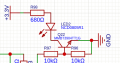
1735564567783.png

12V to be monitored via the led is connected to the R97 resistor.

Datasheets for the led and Transistor are :

https://atta.szlcsc.com/upload/publ...0/C84256_F0A75A43B3EAD75808600A0514C76B99.pdf

https://atta.szlcsc.com/upload/public/pdf/source/20221020/8C70A8ED36C1D333CEA0E7EE045B4434.pdf


My calculation are :
When ON :
1- Led Drop is 1.8V
2- Transitor drop is 0,1V
So the resistor R98 shall be less that 700 Ohm. (680 being fine).

With those values I hope that the LED has a 0.2 Luminosity, or a bit more.
Originally the R98 was 68Ohm which led to too much luminosity.

Thanks for any answer.
 

Alec_t

Joined Sep 17, 2013
15,106
Why do you need the transistor? Couldn't you just drive the LED directly from 12V via a suitable current-limiting resistor?
Welcome to AAC!
 

Thread Starter

DGEDGEDGE

Joined Dec 30, 2024
12
Why do you need the transistor? Couldn't you just drive the LED directly from 12V via a suitable current-limiting resistor?
Welcome to AAC!
I thought that I would save some power by using the 3.3V and avoiding some resistor power consumption on the 12V line.
The Transistor is set to on with a very low power through the R97 10K Ohm.
Note: The schéma is multiplied 6 times.

One improvement could also be increasing the R97 value which will still trigger the transistor and lower power consumption.

May be not a good Idea ?

But anyway, my question was more on the fact that with 2mA should we correctly see the Led light ?
 
Last edited:

ElectricSpidey

Joined Dec 2, 2017
3,313
Your hypothesis is correct on the power consumption assuming the 3.3 source is high efficiency such as a switching regulator and not a linear regulator where the watts would be burned there instead of the resistor.

As far as seeing the LED, that will depend on the LED and conditions...hard to answer.
 

Alec_t

Joined Sep 17, 2013
15,106
A modern high efficiency LED would probably be bright enough as an indicator with only ~100 microamps current. I recently harvested a lot of LEDs from a failed 7W mains bulb. Each one is quite bright at 150 microamps.
 

DC_Kid

Joined Feb 25, 2008
1,242
You have to run the math, but if you add another active device, like 555, to do fairly low frequency and low % pwm, the net power use may be lower than led & resistor.

Another thing to look at is, self blinking led's, because they only conduct for small amount of time.

Does the debug light the LED differently for different debug scenarios? If so then there's a debug signal somewhere, and if that signal can drive an LED directly then I would just try and find a low power LED that matches the output voltage of that signal.
 

Tonyr1084

Joined Sep 24, 2015
9,744
(3.3V - 1.8Vf) ÷ 2mA = 750Ω. That's assuming you want 2 milliamps through your LED. 1.8Vf; I'm assuming that's a red LED. The "SuperBright LED" I have (red) has a Vf of 1.92. So that's pretty bright. Here's a YT video I did showing how parallel LED's can be controlled through a single resistor. While the video is not designed to answer your question, you can see how bright the RED LED is when running at approximately 25mA. You only need to watch the first few seconds of the video to see how bright a SBLED can be. Watch the whole video and you can see how bright other SBLED's can be at approximately the same amperage.
 

Thread Starter

DGEDGEDGE

Joined Dec 30, 2024
12
Quick question: Is your power source a constant 3.3V or is it from a battery?
At the origin we have 12V battery.
In between we construct 5V for a PI (E.g.: PI5) with a switching regulator circuit based on a TPS54531DDAR.
From the PI we get the 3.3V witch is a down stepping power if we trust the documentation.

For the first run of the project we did calculated a simple resistor to have a 25mA current in the LED to comply to the "standard" lightening of the LED without the good idea to bother for power consumption.
But doing the calculation of power consumption we saw that the consumption of the LEDs ends to be "big" when considering the night use of the driven telescope.
As the led is only for debug at the beginning of the night, even if it is important to have it, it's of no use after.

This lead to my initial question.

Complete open source project V1 is here : https://oshwlab.com/pololamag/astralim
 

Thread Starter

DGEDGEDGE

Joined Dec 30, 2024
12
At the origin we have 12V battery.
In between we construct 5V for a PI (E.g.: PI5) with a switching regulator circuit based on a TPS54531DDAR.
From the PI we get the 3.3V witch is a down stepping power if we trust the documentation.

For the first run of the project we did calculated a simple resistor to have a 25mA current in the LED to comply to the "standard" lightening of the LED without the good idea to bother for power consumption.
But doing the calculation of power consumption we saw that the consumption of the LEDs ends to be "big" when considering the night use of the driven telescope.
As the led is only for debug at the beginning of the night, even if it is important to have it, it's of no use after.

This lead to my initial question.

Complete open source project V1 is here : https://oshwlab.com/pololamag/astralim
 

Thread Starter

DGEDGEDGE

Joined Dec 30, 2024
12
(3.3V - 1.8Vf) ÷ 2mA = 750Ω. That's assuming you want 2 milliamps through your LED. 1.8Vf; I'm assuming that's a red LED. The "SuperBright LED" I have (red) has a Vf of 1.92. So that's pretty bright. Here's a YT video I did showing how parallel LED's can be controlled through a single resistor. While the video is not designed to answer your question, you can see how bright the RED LED is when running at approximately 25mA. You only need to watch the first few seconds of the video to see how bright a SBLED can be. Watch the whole video and you can see how bright other SBLED's can be at approximately the same amperage.
Thanks this example shows the the Blue LED produce light with only (4,5−2,82)÷100÷5 = 3mA.
That answer one of my question about having a lower current powered LED.
As I cannot experiment with the Led (too small) of the circuit, and I cannot have one, to go deeper to my question, looking at the datasheet of this particular LED (https://atta.szlcsc.com/upload/publ...0/C84256_F0A75A43B3EAD75808600A0514C76B99.pdf page 4), does the LED lights if I have a 2 milliamps through the LED ?

At least theoretically.
I want to be sure before sending to prototyping.
 

BobTPH

Joined Jun 5, 2013
11,466
Any LED will produce some light at 3 mA. Very efficient ones will produce more light. The figure for current in the datasheet is the maximum current you can run it at continuously. You can always run at lower current. Typical modern high efficiency LEDs are quite visible at 1mA in indoor lighting conditions.
 

DC_Kid

Joined Feb 25, 2008
1,242
Typical modern high efficiency LEDs are quite visible at 1mA in indoor lighting conditions.
The lemon-lime wavelength needs the least lumens output to appear just as bright as a blue LED running much more current for the same lumens output. Engineering "visible" with "least power" starts to go deeper into the engineering forest. Choosing the right wavelength for LED can matter in such design.
 

Thread Starter

DGEDGEDGE

Joined Dec 30, 2024
12
Any LED will produce some light at 3 mA. Very efficient ones will produce more light. The figure for current in the datasheet is the maximum current you can run it at continuously. You can always run at lower current. Typical modern high efficiency LEDs are quite visible at 1mA in indoor lighting conditions.
Thanks.
 

Tonyr1084

Joined Sep 24, 2015
9,744
doing the calculation of power consumption we saw that the consumption of the LEDs ends to be "big" when considering the night use of the driven telescope.
OK, this is for night use. So you don't need a lot of light. Just enough to "debug" your (assuming "setup"). In movies about submarines they show them using red lights to make the human eye adjust to darkness while at the same time Illuminating controls and instrumentation. Where "Lemon-Lime" comes from - makes me curious. Probably not important to this thread.

If you want temporary lighting for debugging your setup why not just get a small pocket flash light with red LED's? (Red based on my submarine comment) With a flashlight you can choke the amount of light using an aperture. Direct your light directly at your setup without casting a lot of light that may otherwise disturb other astronomers. Why create an elaborate system to deliver a spoon full of sugar to your coffee cup? Why not just use a spoon?

I guess this is your project, and you can do it any way you want to.
 

Thread Starter

DGEDGEDGE

Joined Dec 30, 2024
12
I did looked at the video and ended with.
(4.5V - 2.82Vf) ÷ 100? = 16.8? Where are you getting "÷5" and what is the 100 you're dividing 1.68V from?
((4,5V−2,82Vf)÷100 Ohm) ÷ 5 Leds
If I correctly analyse :

4,5V−2,82Vf is the tension on the resistor. (Kirchhoff's Voltage Law)

100 Ohm Is the resistor used in the video as seen on the paper.

((4,5V−2,82Vf)÷100 Ohm) is the current in the resistance. Ohm's law.

I divide by 5 because leds are sharing the total amount of current in the schematics. (Kirchhoff's Current Law ).
 

Thread Starter

DGEDGEDGE

Joined Dec 30, 2024
12
OK, this is for night use. So you don't need a lot of light. Just enough to "debug" your (assuming "setup"). In movies about submarines they show them using red lights to make the human eye adjust to darkness while at the same time Illuminating controls and instrumentation. Where "Lemon-Lime" comes from - makes me curious. Probably not important to this thread.

If you want temporary lighting for debugging your setup why not just get a small pocket flash light with red LED's? (Red based on my submarine comment) With a flashlight you can choke the amount of light using an aperture. Direct your light directly at your setup without casting a lot of light that may otherwise disturb other astronomers. Why create an elaborate system to deliver a spoon full of sugar to your coffee cup? Why not just use a spoon?

I guess this is your project, and you can do it any way you want to.
Note: Seeing the differrent answers, we will end up with more simple because of place availability. (A resistor serial with 12V).
But with higer value to limit the current to 3mA as.

But for your current suggestion, I did not understand. The aim of the Led is like for Ethernet Leds to see if tension is there on the output of a "power" distribution.
The led can be help full in case of short circuit of the output (which is protected), or other connectivity issues while conecting all the astronomical stuff.
 
Top