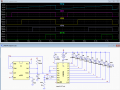
My suggestion is to tie the Ser input (pin 14). ) to Vcc.
Then send a clock signal with a period equal to the delay between lighting the individual LED segments. This signal will be input to the Clk (pin 12).
Finally, use the unused outputs to create the desired pause. The pause can be calculated as n * clock period. The nth unused pin would connect to the Clr
Input (pin 11).
One chip solution! And you could use @crutschow ’s clock circuit.
There are several 74xx 8-bit shifters that would work, including some with 24 mA output stages to drive single LEDs directly, but given that the TS has 12 V for the LEDs, I went with all 12 V logic.
For even fewer parts, look into a 1-transistor oscillator that uses the Q in avalanche breakdown mode. Unijunction - ish.
That would have been messy. Binary output to a 3-bit to 8-line decoder, each of the first 4 outputs clocking latches to hold the LEDs on, and the 5th output resetting the latches and the counter.
Or a 4017 with each of the first 4 output setting flipflops to drive the LEDs and the 5th output resetting everything.
You can save a chip in both approaches by using a quad S-R flipflop, a CMOS part that (I think) does not have a 74xx equivalent. Still, I think the shift register approach is cleaner; plus, fewer parts.
My idea is a sawtooth at input to 4 paralleled comparators. Given that only 12 V is available, I'm not sure that a suitable sawtooth oscillator could be devised. If unijunction transistors are still available, the unijunction transistor configured as an oscillator has a sawtooth at one point in the circuit. In one of my texts, there is a schematic diagram of a sawtooth oscillator that is a configuration of a 741 and 301 op amps, one of each. This might be a quite simple solution but lacking in being able to independently control time on/ time off.
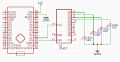
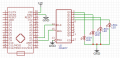
Since we’re using an Arduino I would use a 4017, one digital pin for clock out and have a reset pin connection. LED would be on 0-3. The loop would just advance the state (count pulses then reset based on count stage). You can stall on final state as long as you want. I’ll draw it out later if I’m not busy. You can add mosfet array ADL810027 if you need more than 5-10mA per LED and need to run them from 12v. I’m still amazed with you guys with your CMOS solutions. In some ways I like the CMOS solutions better. It’s instantaneous and doesn’t take any resources away from the uP depending on what else you’re doing.
The circuit is really simple... you can add the mosfets if required.
Again, this circuit does not do what is spelled out in post #1.
ak
ps. The ENA input must be grounded for the counter to count.
Never leave CMOS inputs floating.
There is no current limiting for the LEDs.
AND - Once you have an Arduino in the project, why bother with an external counter/shifter/whatever? There is nothing in post #1 about the Arduino doing any other tasks.
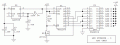
Here is another version using 5 V logic, with a single 8-bit shifter instead of a dual 4-bit. The 164 has a negative-true Reset input, so Q1 is needed to invert the reset signal. The circuit function and chip count are identical, but the schematic looks prettier, less busy.
Here is another version using 5 V logic, with a single 8-bit shifter instead of a dual 4-bit. The 164 has a negative-true Reset input, so Q1 is needed to invert the reset signal. The circuit function and chip count are identical, but the schematic looks prettier, less busy.
That’s the kind of circuit I’ve been suggesting! Haven’t been able to get to my installation of LTSpice. But, I’m working on a schematic using an 74HC595 that’s very similar.
So the correct termination for unused Q4-Q9 and CO is pull down resistor? Is 10K ok? They will never activate due to counter won't be allowed to get that high. But if floating pins create capacitance issues then is that the right termination or just ground directly?
@Wolframore , outputs can be left open on CMOS circuits.
Also use some currentlimiting resistors on the leds.
This would cause less stress on the CMOS chip.
@bertus could you please explain the stress you're talking about? I thought that the outputs were buffered with clamping circuits and would limit the current itself within the recommended voltage ratings of the chip... especially the CD variety... Maybe I've been abusing them for a while but they seems to robust and tolerant of this... HC version is another story.
When you look at the datasheet, at a powersupply of 15 Volts, an output voltage of 13.5 Volts will appear when 6.8 mA is drawn.
How much current will be drawn when a led of say 3 Volts is connected on the output?
I just found something interesting... there's a difference between the B and the UB ... the voltage doesn't matter because it's a current mirror type circuitry in the Buffered versions. http://www.ti.com/lit/an/scha004/scha004.pdf
And except for the HC chips all the CMOS I've used have been TI "B" versions...
I believe you have to do a power calculation and you will see that it's under the power limit of the LED in the buffered cases.

 Facebook
 Google
 GitHub
 Linkedin