12V input to 180V 160 mA output boost using LM5155

Thread Starter

Boundary_A_La_Mode

Joined Jul 4, 2024
64
Another discussion thread

https://forum.allaboutcircuits.com/...5155-boost-convertor-in-ltspice.179564/page-2

hooked my interest in two ways:

1) It provided a good working LTSpice model for the LM5155. I am happy to use that IC model! I have had one hardware experience with the LM5155 and it all went quite well.

2) The original poster was looking to boost to a high voltage such as 180V. One poster declared that this was (more or less) not possible. I wanted to show otherwise. Strictly speaking an ordinary boost converter ought to be able to do this if running in discontinuous conduction mode (DCM), although the efficiency would not be so great.

I was happy to take this model and use it in what I call a SEPIC Multiplied boost converter to convert 12V input to 180V @ 160 mA. When I built similar years ago (but using an ADP1621 and producing higher power) I achieved a peak efficiency > 91%.

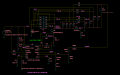
Rather than going on at length here I will post my LTSpice simulation here. It includes a dynamic load on the output for a rough indication of feedback loop stability. This simulation runs nicely but there is probably room for some tweaking. The simulation run time on my laptop was greater than one hour. I am open to any questions.
1724210855351.png
 

Attachments

Thread Starter

Boundary_A_La_Mode

Joined Jul 4, 2024
64
what will be the used case for this type of booster.
As a power circuit designer, I am far away from knowing all of the possible uses for a given power converter. If you follow my link above you will see that someone wanted similar. I think that (for me) one original use was for driving an LED display backlight. It is true that buck down-converters are more common, but SFAIK all of the manufacturers of power conversion ICs make boost ICs. We can only guess at the possible uses. High boost ratios did not work as well for the basic boost design. This method provides better performance for high boost ratios.

By the way: For a few days I was unable to find my original post above, and I am glad that it is now visible. Was it quarantined for some reason?
 
Last edited:

Thread Starter

Boundary_A_La_Mode

Joined Jul 4, 2024
64
Thanks for your interest.

Basically; to go from 12V input to 180V output you need 168V of boost. But I divide this 168V among 5 stages so 34V each. With 12V input you get 34 + 12 = 46V peak on the 60V rated MOSFET and schottky diodes. 46V DC out of D1-C1. 12V input to 46V boost output through a 60V schottky is reasonably efficient, and that is what you get. The output stages are in parallel AC wise but stacked in series DC wise. You could do similar with multiple outputs of a flyback, but the SEPIC coupling capacitors here pretty much swamp out any leakage inductance. As a result, any overshoot or ringing are almost negligible, and you do not need a clamping snubber for the MOSFET drain. The major tradeoff is that all the windings need to be 1:1:1. I am using a Wurth model for the (coupled inductor-transformer) because the Wurth coupled inductor models are built into LTSpice. But if I were to build this I would probably go to higher power with a different magnetic component. Coilcraft "Hexapath" goes bigger or I would wind my own.

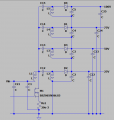
D1 and C1 are the first boost stage while D2-C2 thru D5-C5 are SEPIC outputs stacked in series, so each one adds another 34V on top of that 46V. This is not resonant.
 

Thread Starter

Boundary_A_La_Mode

Joined Jul 4, 2024
64
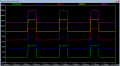
Here is waveforms observed at the 5 diode anodes. All of them are pretty much the same but with different DC offsets. Nothing very mysterious, and nothing resonant. I made coupling capacitors C1-C5 all = 1 uF because that was big enough. If you made them each 100 uF it would not dramatically change the operation but startup would be slowed.
1724548244962.png
 

Thread Starter

Boundary_A_La_Mode

Joined Jul 4, 2024
64
I down loaded the zip file. I cannot get LTspice to start. It set there for 4 hours and could not get going.
Hmmm. Will your LTSpice run other .asc files?
Any error messages?
I did not mention that the .asc and .lib and .asy files all need to be in the same folder, unless you know more than I do about running LTSpice. I am not an expert with any simulator, so that is certainly possible.
If you follow my link to the other thread, there was a different sim using that same LM5155 model. That would be another thing to try.

I am using Gear integration as selected in the box below Simulate>Settings>Spice. I do not know if that setting travels with the .asc file.
1724552213673.png
 
Last edited:

Thread Starter

Boundary_A_La_Mode

Joined Jul 4, 2024
64
I am using 24.0.12 Maybe version incompatibility is the problem.

FWIW; I found last night that trapezoidal integration runs in 2447 seconds compared with 4426 seconds for gear integration, at least on my laptop.

Does anyone know whether LTSpice files are backwards compatible?
 

BobTPH

Joined Jun 5, 2013
11,463
If I understand you,

Your first stage boosts by a factor of four (12 to 48)

Why not use a second one with the similar factor of 3.75 to get to 180V?
 

Thread Starter

Boundary_A_La_Mode

Joined Jul 4, 2024
64
Why not use a second one with the similar factor of 3.75 to get to 180V?
The design does not allow me to vary the amount of boost between stages. That is sort of a fundamental property of this design. Every winding has the same waveform but they are all at different DC levels. It is unlike a tapped winding for example. Remember that we are starting with 12V input, so 12V input + 34V boost = 46V output from the first stage. Each following stage adds another 34V of boost.

Looking at it another way: We are adding voltage with each stage; not multiplying voltage. The duty cycle is set by equalizing volt-seconds in the first stage boost winding. All of the other stages have the same waveform but the low portion of those higher voltage waveforms are not going to ground.

When this is running on the bench, the waveforms are pretty close to what you see in my simulation. If I were to use multiple taps out of a transformer (for example; completely different design) you would get a lot of ringing which increases noise and voltage stress on the FET and diodes. That ringing can be snubbed but doing that wastes power.

By the way, the outputs of these intermediate stages could certainly deliver output current to some other load if you want to do so. But like any multiple output power converter, only one output can be tightly regulated.
 
Last edited:

Thread Starter

Boundary_A_La_Mode

Joined Jul 4, 2024
64
Why not use a second one with the similar factor of 3.75 to get to 180V?
Looking at this again; doing that straightforwardly would require a second boost converter. This would certainly not win based on simplicity.

It may be possible to control two FETs (operating with different voltages) with the same gate drive timing, but (holy smokes) that could be difficult to manage. I would not see any compelling advantage to this idea either.

One other thing is that the best/most available schottky diodes are silicon types rated for 100V or less. These work very well in many high frequency power converters. They work well for Continuous Conduction Mode (CCM) which is our operating mode.

If the second stage were a conventional boost to 180V, it would not be able to use a silicon schottky diode. Believe me when I say that "ultrafast" diodes are not fast enough (I have been there and done that). Ultrafast diodes have enough reverse recovery time to create significant problems; big current spikes when the FET tries to turn on. That leaves us with silicon carbide schottky diodes which may be rated at 650V. That is probably OK; but for some reason I have not found SiC schottky diodes in small packages. It is true that we would only need one of them.
 

ronsimpson

Joined Oct 7, 2019
4,647
hooked my interest in two ways:
I am interested in you schematic because it reminds me of days gone by.

Many years ago, I had the job of making high frequency power supplies and transformers. We made 20KV to 40kv power supplies and also low voltage supplies. Many people were switching at 15 to 17khz because the HV transformers could not run faster.
I needed to do 32khz then 64khz soon, then later 120khz.
On the low voltage side of things, here is a supply with multiple outputs that ran very fast.
This is not like your supply but there are many things the same.
Note C1,2,3,4,5 are in a very small loop. (PCB layout)
C21,22,23,24,25 can be in a larger loop.
C12-15 can be external capacitors but can be winding to winding capacitor in the transformer.
Normally M1 has a ring that rings to a high voltage. People build snubbers to eat up the ring. The diodes also ring when they are turned off. Because of C12-15 the MOSFET ring energy is pushed out to the load and the diode ring is clamped by M1.
The capacitance between windings was normally reduced by adding layers of tape between windings but that increases the leakage inductance which causes problems. (more ringing and bad cross regulation)
In this circuit all the capacitors inside the transformer have DC across them and no AC so they do not have current flow. (less heating)
The first 10,000s of these we made; I ordered Litz wire where half the wires were red, and the rest made of four different colors. All the red wires were pulled out and connected as L1 and each color was a different secondary. Because the wires were twisted together, the leakage inductance was very low and the winding to winding capacitance was very high. (no tape)
Variations of this theme was sold to many companies. I know we made 20 million/ month for a long time. Many companies copied this and did not understand how it worked.
1724782714415.png
I drew the schematic in an odd way to help show how it works.
I am not saying I (we) were the first to use this, or that we invented something new. (I want to think we were the first) The engineering manager told me this was a very bad idea, and he fought me for a while.
6xTransformer Link to CoilCraft transformers that are 1:1:1:1:1:1. They have a very good white paper on how to use them. (volt seconds, and amp turns) They are made using the Litz wire idea. (or at least the different wires are all pulled through the transformer at one time as one wire)
I have used the 1:1 transformer idea to 2mhz in some low voltage supplies.
 

Thread Starter

Boundary_A_La_Mode

Joined Jul 4, 2024
64
I am interested in you schematic because it reminds me of days gone by.

I do not see a lot of difference between what you have and what I did. Let me post this link...I will write more later...

https://www.how2power.com/newsletters/1205/articles/H2PToday1205_design_AnalogDevices.pdf?NOREDIR=1

I like the Coilcraft Hexa-Path. Those are available in a bigger size than the Wurth, but the Wurth has models built into LTSpice.

My design may considered to be placing some known "bricks" (Boost and SEPIC outputs) in a combination that I had not seen before. But it does not surprise me that someone might have done similar, and I never claimed to be an original inventor.

Your schematic posted above appears to be edited from mine(??). When using the magnetic component as a coupled inductor (as I am doing) the magnetic component is no longer part of what LT calls the "hot loop" which is where layout is critical. Referring to my schematic, the FET, Rs, the diodes, C1-C5 and C12-15 are all part of the "hot loop(s)" and should be tightly laid out in the PCB. I BELIEVE that the complexity of these hot loops causes some complicated circulating high frequency currents which tend to dissipate whatever ringing might depend on stray inductance. The magnetic component can be placed after laying out and connecting the other components. I did not use any snubber and I do not believe it is necessary.

Schottky diodes are essential (same as for an ordinary boost converter) because this is running in continuous conduction mode. Ultrafast diodes have too much problem with reverse recovery (Trr).
 
Last edited:

Thread Starter

Boundary_A_La_Mode

Joined Jul 4, 2024
64
Your circuit starts out as a boost. The output cannot be lower than the input.
My circuit is a flyback, the output can be lower than the input, or higher or the same. It could be isolated.
It is easy to change the boost aspect, but that will cause some reduction in efficiency. As you drew it, I do not see isolation in the usual sense. But if you mean DC isolation (with significant capacitance across the isolation barrier) that can be useful. When I think of a flyback, I do not think of all of that capacitance bridging input-output although they can have a common ground.

I have done several variations in different situations, such as a doubled SEPIC/Cuk combination....
[/QUOTE]
 

ronsimpson

Joined Oct 7, 2019
4,647
It could be isolated; it is not drawn as isolated.
I like the 1:1 transformer power supplies. I made some Cuk where the input ripple and output ripple are very small, using the 1:1.
I fight transformer capacitance and leakage inductance because they are not the schematic. Most people don't know they are there. There are some kinds of noise that is caused by P to S capacitance. Some noise comes from energy stored in leakage inductance when it gets unloaded.
I want to encourage you to keep up the good work. You are thinking.
 
Top