120VAC to 24V DC

MisterBill2

Joined Jan 23, 2018
27,504
First we get a required output of 24 volts at maybe 5 Watts. Then I see a statement that most of the ICs operate on 3.3 volts. And there is the size consideration. Getting from 24 volts to 3.3 volts takes additional effort.

It is very challenging to hit a moving target specification.
So let us know when there is a definite specific voltage and current requirement.
AND, will a ready made one be suitable??
Do not even consider one with the output connector "center negative".
 

Papabravo

Joined Feb 24, 2006
22,082
Yes. it is!


We are guilty. It is progress, in which we participated (participate) too.
It is also apocryphal that Nvidia devices are so complicated that they cannot be disassembled and copied by even the best counterfeiters. Take that all you thieves and pirates! Arrrrrgh me hearties.
 

Thread Starter

Neal97

Joined Jun 12, 2024
11
I don't have the option to use that type of per-made module.

Well I have everything else figured out for the most part I have a regulator that takes the 24V down to 5VDC then a switching Reg for the 3.3VDC.

The connector is small DIN
 

Papabravo

Joined Feb 24, 2006
22,082
I don't have the option to use that type of per-made module.

Well I have everything else figured out for the most part I have a regulator that takes the 24V down to 5VDC then a switching Reg for the 3.3VDC.

The connector is small DIN
Good luck with debugging all of that.
 

Tonyr1084

Joined Sep 24, 2015
9,744
WOW!
65VAC to 135VAC source
THAT down to 24VAC
24VAC to 24VDC
24VDC to 5VDC
and
24VDC to 3.3VDC
or 5VDC to 3.3VDC.

That's a whole lot of losses along the way. And if you're rectifying the 24VAC to DC Filtered, you're looking at roughly 34VDC down to 5VDC (and so on).

A better approach (maybe the best approach) is to go from your widely variable AC input down to 5VDC. You'll eliminate a ton of inefficiencies. And from 5V to 3.3V is a short and easy regulation with a mere 1.7V loss. The other way you're losing 34VDC to 5VDC is 29 volts right off the top. Then another 1.7 volts. 29 + 1.7 = 30.7 volts. Do you really want to convert all that energy into heat? Maybe so - if you're working in Alaska or a northern providence in Canada. Or elsewhere in the frigid regions.

{{ Wait a minute while I correct my math errors }}
[[ OK, correct now ]]
 
Last edited:

schmitt trigger

Joined Jul 12, 2010
2,085
That is the modern electronic reality. We might as well tear up our diplomas and go into real estate.
Real estate?
I was thinking a job with real class, along the lines of a used car salesman, or a Title Loan agent.

NOW SERIOUSLY, to the TS: with all the project constraints and selected voltage ranges, you have painted yourself into a corner.
Why can’t you use the Aliexpress module? If you are required to show an original design, you may always reverse engineer the module and/or customize it. As we have only half-joking discussed, even the seasoned engineers find that many times it is far better to purchase pre-made modules, specially plain vainilla functions. And only design the actual circuity that adds value or originality to the project.
 

MisterBill2

Joined Jan 23, 2018
27,504
Danko, it seems that, no matter what circuit one requires, there will already be something ready-to-use on Ebay or Aliexpress, and at a far cheaper price than the cost of the individual components.
Would YOU stake any part of a career or reputation on the availability or quality of an ebay offering?? I certainly would not. I have seen the production line sitting with a couple of part stations empty. Good thing I was not involved until asked to do the rescue redesign.
I learned to love the folks at Analog Devices!! A.D. proved to be a reliable organization indeed! The "2B31-J" was a massive lifesaver for the project.
 
Last edited:

schmitt trigger

Joined Jul 12, 2010
2,085
MB:
I mentioned that ordering such a module and reverse engineering it, will many times shed light on useful solutions to the problem at hand.

Many times the modules are basically complete, one only requires to change to brand name components and with higher derating, redraw the board with appropriate design rules and/or include the protection components which the original module has deleted.
 
Last edited:

DickCappels

Joined Aug 21, 2008
10,661
This sounds like a good application for a custom off-line switcher, though you may have to spend a bundle on getting it to conform to conducted and radiated emission requirements.

Be careful if your market requires meeting interference specifications, much of what you find in bargain component websites will not meet those requirements.
 

Orson_Cart

Joined Jan 1, 2020
110
Hello there - the company I work for does these sort of designs all the time - 60Vac to 120Vac input, no problem, 24VDCout at 5 watt no problem, we use a quasi-resonant ( valley switched ) flyback with discrete control - very EMC quiet, very efficient for its small size - we get transformers made in volume to meet UL, TUV, CE, C-tick, CSA safety specifications.
Are there any pulse load requirements ?
 

Thread Starter

Neal97

Joined Jun 12, 2024
11
Hello there - the company I work for does these sort of designs all the time - 60Vac to 120Vac input, no problem, 24VDCout at 5 watt no problem, we use a quasi-resonant ( valley switched ) flyback with discrete control - very EMC quiet, very efficient for its small size - we get transformers made in volume to meet UL, TUV, CE, C-tick, CSA safety specifications.
Are there any pulse load requirements ?
It cannot have a inrush current more than 2A on start up and must be operational withing 500mS

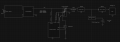
I attached a rough idea of what I'm doing now.

PS-Block.PNG
 
Last edited:

mhubert

Joined Jun 10, 2020
1
It cannot have a inrush current more than 2A on start up and must be operational withing 500mS

I attached a rough idea of what I'm doing now.

View attachment 326815
If you go with the above plan, then I would use a switching regulator to go from 24VDC to 5VDC. You could use a dual switching supply to get both 5V and 3.3V from the same chip. We've used the LT8650S many times at my work for a similar application. It's overkill for what you need but it's a great chip. It also has a soft start function to limit current on startup. LTPowerCAD and LTSpice are both excellent tools for helping design a suitable supply.

Another option. Let's go back to what others have been discussing:
- Small transformer to get you down to 12-24VAC.
- Rectify and filter that.
- Delete the flyback switcher
- Use a dual switching regulator to convert down to both 5V and 3.3V.
 
Top