12 VDC Inductive Ignition Timing Light: Need Help Diagnosing

Thread Starter

cadman777

Joined Dec 23, 2022
39
Thanx Bill.
It's an RCA 6889.
I tried finding one online but couldn't.
I also tried finding a cross-over chart online but couldn't.
I also don't recall what the numbers mean, so couldn't make my own match-up.
Maybe you can help me with this?
Thanx...
 

shortbus

Joined Sep 30, 2009
10,050
If the rivet is brass then drilling with a fairly sharp bit
Can tell you've never drilled much brass especially if it already has a smaller hole in it. Brass has a high tendency to grab in the bit, slightly dulling the cutting edges of a drill used on brass is the correct way of doing it. Here is a link to what I'm saying, but it was something they taught us in 7th grade shop class.
https://handycrowd.medium.com/drilling-brass-the-easy-and-safe-way-f1494d449d3a
 

MrChips

Joined Oct 2, 2009
34,828
Thanx Bill.
It's an RCA 6889.
I tried finding one online but couldn't.
I also tried finding a cross-over chart online but couldn't.
I also don't recall what the numbers mean, so couldn't make my own match-up.
Maybe you can help me with this?
Thanx...
I suspect that transistor 6889 is a Sears part number, not RCA number.
 

MisterBill2

Joined Jan 23, 2018
27,571
The process for removing brass rivets is quite different from the process for drilling brass in a machine shop. I fact it is extremely different because the whole purpose is different. My "cheating trick" is to use a very sharp drill bit with a hand chuck, so that I have complete control. The second part is to not bear down on the drill bit in an attempt to ram it through the material being drilled. When it works perfectly it will take most of the rivet material away in the first revolution after it bites in. With slow speed and the gentle push that is often all that is required, just a very few turns. It can also be done with a power drill motor able to turn at very slow speeds. Totally different from production machine shop work.
 

Thread Starter

cadman777

Joined Dec 23, 2022
39
Hey guys...rest assured that I'm going to use a method that won't trash the PCB board.
I've done so many repairs on things over the course of the past 50 years that I should know better (but nobody's perfect!).
So let me allay your fears by saying that I'm taking measures to not trash the PCB board.
However, I'm glad you all expressed your concerns, as this was good for me and will be good for others to read.

One thing I learned in my years as a mechanic is, you can re-sharpen a drill bit with a very shallow cut angle and cut into just about anything without gouging the life out of it. You need shallow angled bits for sheetmetal work and other thin metal work.

Also, I have 'pin vises' (Bill's 'hand chuck') that make such work painless.

However, I will probably approach this by first de-soldering and then grinding w/a dremel cut-off disk. I've done that countless times using a right angle grinder w/a cut-off wheel on cars and trucks to remove flanges (esp. for rubber bushings that needed pressing out) where nothing else worked. Once the flange is removed, I'll heat it up and push it out. I might have to pinch-in the sides a bit, but...no big deal. I'm debating on re-installation, but probably I'll solder the mount flange to the board, finish drill it out (like a reamer) to remove excess solder and also create a tight hole, then clamp it w/a small screw and nut backed by 2 flat wshers and blue thread-lock. No big deal.

Thanx for all your input, as it got me to thinking in more detail about how I wanna approach this!
 

Thread Starter

cadman777

Joined Dec 23, 2022
39
I suspect that transistor 6889 is a Sears part number, not RCA number.
I did find that number in a couple of my searches, but couldn't find a cross-over, so no telling what it really is, so you're probably right.
Besides, it goes along with the sequences in the Sears parts list.
So I'm just going with a TIP31@40V like you said on page 1 of this thread, unless you have other ideas I should go with?
That's why I was making a schematic in 5Spice, but got stuck b/c I couldn't find any components for the flash tube and coil pickup, and I don't know how to make them (fake them in).
 
Last edited:

shortbus

Joined Sep 30, 2009
10,050
My "cheating trick" is to use a very sharp drill bit with a hand chuck, so that I have complete control.
So then my post got you to do what you are constantly lately be telling new members, Explain better what your doing. None of what you just posted was included in you original post about using a very sharp drill bit.
Also drilling brass and the bit grabing happens out side of a machine shop, especially when using a hand held electric drill.
 

Thread Starter

cadman777

Joined Dec 23, 2022
39
To whom it may concern : the statute of limitations is eight(8) years not 18 months. Section 3286 of Title 18, United States Code, the grift continues starboard. We're living the book, "It Can't Happen Here", today.
Mine elaborating?
Just curious is all.
 

MisterBill2

Joined Jan 23, 2018
27,571
So then my post got you to do what you are constantly lately be telling new members, Explain better what your doing. None of what you just posted was included in you original post about using a very sharp drill bit.
Also drilling brass and the bit grabing happens out side of a machine shop, especially when using a hand held electric drill.
For drilling out a brass rivet I would not ever consider using an electric hand drill. The feel and control response is not nearly adequate for the situation where things grab or suddenly bite in. Either a hand chuck or else a hand cranked drill are the preferred tools.
In this thread it appears that the TS is rather skilled in the mechanical field and has a good handle on the various mechanical aspects of the project. But my explanation was lacking some details that a beginner would need.
 

Thread Starter

cadman777

Joined Dec 23, 2022
39
There ya go Bill...I got the mechanical stuff down, but the electronics stuff...not so much! That's why I'm in here, which is helping me get back into it.

Incidentally, yesterday I purchased the 2 offending caps and the NPN transistor that they smoked. So when they arrive I'm going to install them, do some tests, and 'report back' on my findings.
 

MisterBill2

Joined Jan 23, 2018
27,571
There ya go Bill...I got the mechanical stuff down, but the electronics stuff...not so much! That's why I'm in here, which is helping me get back into it.

Incidentally, yesterday I purchased the 2 offending caps and the NPN transistor that they smoked. So when they arrive I'm going to install them, do some tests, and 'report back' on my findings.
I suggest the first tryout to use a used 9 volt battery, because it will not deliver nearly as much power. So if things do not work then there should not be smoke right away. A cheating trick to avoid damage sometimes.
 

Thread Starter

cadman777

Joined Dec 23, 2022
39
Thanx for the reminder.
I'll make a mental note of that so I don't release the 'magic smoke' next time around!
 
Last edited:

Thread Starter

cadman777

Joined Dec 23, 2022
39
The parts arrived today.
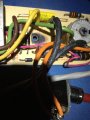
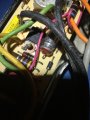
I'm still working on it but figured I'd post a couple pics to show what's going on.
Notice how burnt the PCB board is under the power transistor.
I'm sure that didn't just happen b/c it hardly smoked when I smelled it happen.
And a few years ago when I used it, it worked and didn't smell like it was frying.
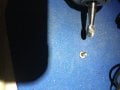
It took all of about 45 seconds to 'drill-out' the brass rivet.
As you can see in the pic, I used a carbide burr that ate through it like butter.
The star and flat washers dropped right off.
I'm going to use a brass screw and nut to replace it.
No big deal.
Also, I de-soldered one lead on each of the 3 Resistors and tested them and they all tested OK.
Can a Resistor test OK w/a DVM but fail under load?
Also if you look at the schematic, you see 2 grounds: battery and the other one.
Thing is, the other one goes to the timing light housing with a screw.
I don't see how the B- ground connects to the housing.
So is the housing it really grounded?
My neighbor told me a story: when his timing light failed he got shocked.

1672958987185.jpeg

1672959003054.jpeg
 

MisterBill2

Joined Jan 23, 2018
27,571
Those timing lights that use the high voltage from the plug to trigger, or have the neon flash tube that has an orange flash, both types bring the ignition pulse into the light, and so you can get a big shock, as much as a plug wire. and really that can happen even if the light works. The inductive pickup is not likely to shock when it is assembled, but it does have some DC HV inside for the flash tube. A few hundred volts.
The transistor got hot because of excessive current, I need to look at the circuit again to see what resistances to check. And what capacitors to replace, although that has been done already.
 

Thread Starter

cadman777

Joined Dec 23, 2022
39
I eliminated the 2 washers and made my own copper nut to go with the brass screws (from a valve seat).
Soldered the head to the PCB board, then tacked the CU nut it to the collector w/solder. Finished.

Regulator sings like it's supposed to!
Will test it out tomorrow in the light.

1672963960632.jpeg
 

Thread Starter

cadman777

Joined Dec 23, 2022
39
Those timing lights that use the high voltage from the plug to trigger, or have the neon flash tube that has an orange flash, both types bring the ignition pulse into the light, and so you can get a big shock, as much as a plug wire. and really that can happen even if the light works. The inductive pickup is not likely to shock when it is assembled, but it does have some DC HV inside for the flash tube. A few hundred volts.
The transistor got hot because of excessive current, I need to look at the circuit again to see what resistances to check. And what capacitors to replace, although that has been done already.
Thanx for the info.
I tested the old capacitors that I removed w/the DVM, and they both tested OK. However, I didn't test them w/the scope and BKFG, so no telling if they're really any good. The yellow cap is a film type and may not have needed changing, but since it was only 3 bux, I did it. I think the AL cap was the bad one. In any case, it only cost about 14 bux to get all the components. I also got the other film cap, only they didn't have it in 200v, so I got it in 1200v. Way overkill I know, but it was only 3 bux.
 

Thread Starter

cadman777

Joined Dec 23, 2022
39
First thing this morning I tested the light out on my truck.
Works like new.
Now I can time that guy's '63 283ci engine!
Thanx for all the help.
It got me back into electronics more than one level deep.
Got me motivated to take a refresher course and learn how to build circuits again.
Cheers to all who helped!

PS: That glob of solder on the last pic...I re-soldered it so it stuck on the collector metal better.
 

DuinCZ

Joined Aug 3, 2023
2
Hello, I am diagnosing very similar timing light. I just got pretty old one made by company Optilux in Germany and wanted to check timing on my old Honda CB550 Four.

Timing lamp seems to be dead, there are no flashes at all.

When I connected 12V DC I heard tiny sound “ouiiiiiiiiii” similar to xenon flash light on old cameras.

My suspicion is faulty xenon lamp but it is quite hard to find similar in size here in Europe. These lamps are already obsolete.

Where do you get the spare lamps from?
Regards Pavel
 

Attachments

Top