12 VDC Inductive Ignition Timing Light: Need Help Diagnosing

LesJones

Joined Jan 8, 2017
4,511
Measure the voltage across C5. If the inverter part of the circuit is OK there should be a high voltage across this capacitor. (Between about 300 to 600 volts DC.) If you get a high voltage here than the fault is on the trigger circuit part that generates a very high voltage pulse (1000 to 2000 volts.) to the trigger electrode on the flash tube.

Les.
 
Last edited:

Thread Starter

cadman777

Joined Dec 23, 2022
39
Hi Les,
Yeah, I did that and there was 0v.
I think the caps are trash, and also the power transistor that I cooked after fixing the bad connection.
This is turning into a career!
 

Thread Starter

cadman777

Joined Dec 23, 2022
39
Another question:
Is the pickup considered an Inductor?
If so, how would I go about calculating the voltage that it sends down the wire?
Input voltage is btw 15k-20k (from the distributor/sparkplug wire).
I have no idea how many winds it has, what gauge wire or what the H value is.
 
Last edited:

LesJones

Joined Jan 8, 2017
4,511
As the pickup is inductively coupled the voltage does not matter. It is the current pulse that it senses. Until you you have a few hundred volts on C5 there is no point in looking for faults in the trigger circuit. Your approach of randomly testing components is a very slow way of fault finding. As you have no voltage on C5 you know the fault is before that point in the circuit.

Les.
 

Thread Starter

cadman777

Joined Dec 23, 2022
39
Thanx Les, I figured that.
But I don't have time right now to probe the traces.
I finally studied the traces and now have an idea where ground and power are and compared that to the circuit diagram.
But still, I forget how things work in circuits, so forget what to test where...
 

MisterBill2

Joined Jan 23, 2018
27,563
For checking the pickup, aside from a visual inspection to see that the core pieces close properly, the important check is to verify that the connections are still connected. Taht check would be done at the timing light end, using an ohm meter. It will verify continuity of the connection cable and the pickup cable. So almost any resistance reading below 10, 000ohms (10K) is OK. But a reading of ZERO ohms on a low resistance scale will suggest inspecting for a short circuit in the cable.
 

MrChips

Joined Oct 2, 2009
34,826
For checking the pickup, aside from a visual inspection to see that the core pieces close properly, the important check is to verify that the connections are still connected. Taht check would be done at the timing light end, using an ohm meter. It will verify continuity of the connection cable and the pickup cable. So almost any resistance reading below 10, 000ohms (10K) is OK. But a reading of ZERO ohms on a low resistance scale will suggest inspecting for a short circuit in the cable.
I would not do that yet.
I would get the transistor and capacitors replaced then look for >300VDC on C-5.
 

MisterBill2

Joined Jan 23, 2018
27,563
The pickup integrity check is very simple and easy to do if the Timing light is opened for any other purpose. It only requires a resistance measuring meter, probes, and the skill set needed to make a resistance measurement. And the meter does not need to be very accurate, either.

AND if the pickup connection has failed the timing light will not trigger, which was listed as the symptom.
 

Thread Starter

cadman777

Joined Dec 23, 2022
39
Thanx for the explanation, MB2.
I'm going to do a few tests w/the DVM when I have time (maybe this Sunday).
Your check will be quick and easy.
My main goal right now is to find the components that MrChips referenced and replace them, b/c that's where all roads seem to lead to at this point. I found the .47k cap locally for about 50 cents! The other cap I'm not finding locally. Mail order puts a huge kink in the process.
 
I have a similar timing light and add that the pickup is polarized - if you clamp it on backwards it triggers once in a while. The housing has "engine side" marked on it.
Also, the clamp jaws must have no gap when closed, due to dirt or the mechanism jamming. I lent mine to a friend and the exhaust manifold melted the plastic.
The pickups get dropped and broken, so check the ferrite core is not cracked on the clamp.
 

Thread Starter

cadman777

Joined Dec 23, 2022
39
Thanx for the good info, prairiemystic.
Yes, I did all those checks already.
The problem is, I don't hear the humming that you're supposed to hear, so I believe the charging circuit needs troubleshooting.
 
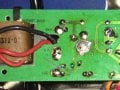
The PC board is filthy, it needs a cleaning, especially at high voltage. I use Q-tips and isopropyl alcohol or flux remover. It looks like a near solder bridge where the red wire comes in.
You have to be careful with old 70's products, bumping a terminal or wire can make it short-circuit to something next to it.

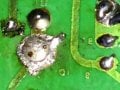
You drilled out the rivet and replaced the power transistor with a TIP31? Found a way to connect the tab to the PC board?

I would outright replace the antique electrolytic cap C3 4uF 16-25V. It's too old and I'm surprised your multimeter says it checks out OK. Is that a 1970 date code?
Be very careful the big cap C5 can give you a shock and damage test equipment. Always ensure it has no stray charge on it before going in.
 

Thread Starter

cadman777

Joined Dec 23, 2022
39
Thanx for the tips, prairiemystic.
Yes, I intend to replace both C1 & C3, as well as the power transistor that cooked.
I haven't done that yet, so no drilling, etc.
I am sure there is no bridging, but I will clean the pcb board.
I always short caps before doing any testing, so I never get shocked.
Yes, these are very old components from the 70's mostly.
I just got that goddamned federal bio-weapon COVID again (7th time!), so I have to recover before having enough energy to doing the testing. So my testing will be pushed into next week some time.
 
I think drilling out the rivet is really hard, too much torque and the PCB pad will get ripped and spun off and make a disaster.
I've learned to use to quite gentle force and the right size (bigger) drill bit until the power transistor tab comes off. It's not easy and a drill is too strong.
youtube video for Sears 244.213801 is a slightly different circuit, same RCA power transistor but it's got a heatsink.

In your pic I didn't like the wire stub, not sure if it's solder but close to a bridge. You can GENTLY scrape between close pads, to push off solder balls but I prefer to use IPA and Q-tips. Around the SCR it looked not so great.

pcb_pic.jpg
A 1963 '283 can have a rough power system. I worked on a C10 and it was points plus electromechanical regulator which made a lot of transients. That might have damaged the original transistor (or connecting power backwards) but just a guess.

OT - I can't imagine such a health battle. My buddy had troubles shaking it and his doctor advocated a colonoscopy cleanse (fasting+polyethylene glycol) and it helped him right away. I'm not giving you any medical advice but something to ask your doctor. Apparently it can take up residence in the colon as one cause for long covid.


MisterBill2

Joined Jan 23, 2018
27,563
Grinding of the portion of the rivet above the transistor tab,using a Dremel tool, is a non-stress way to remove the rivet. But it does require an installation different from what I see in the photo near the start of this thread. It looks like an aluminum cup washer clamping the transistor tab. But it might actually be threaded onto a screw. That would be handy. It looks like the head end of the screw is soldered on the other side of the board.
 
I'm not sure of the best plan of attack. Not a lot of room there. To my eyes, it's a brass rivet with an aluminum washer.
If you're drilling, then there must be support at the backside of the rivet. But the PC board gets trashed either from torque or pushing through.
I have cut a rivet rim up with sharp side cutters and pried and squished it in, so it's a smaller diameter.

rivet2.jpg
rivet.jpg
 

Thread Starter

cadman777

Joined Dec 23, 2022
39
I agree, drilling won't work and is too destructive.
My thought was as Bill's, use a dremel tool w/a grinding disk after desoldering.

Mod: Off Topic Rant Deleted.

Anyway...when I get back up to my semi-normal self, I'll dive into this. But first I need to purchase components C1, C3 & Q1 and install them. Then I can do further testing.

Thanx for the video, prairie. I had already watched that one and some others before coming in here.
 
Last edited by a moderator:

MisterBill2

Joined Jan 23, 2018
27,563
If the rivet is brass then drilling with a fairly sharp bit and not much pressure should be able to remove the top part that is above the aluminum washer, which is used to avoid damaging the transistor during the crimp. Then remove the washer and very gently drill out more rivet until reaching the transistor tab. At that point it should work to unsolder the transistor leads and remove it. THEN the rivet should be able to unsolder and remove.
But if the rivet is steel then the work will be slower.
And for all of the drilling the rivet needs solid support on the back side of the PCB.
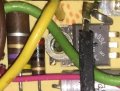
It looks like we might see an actual type number iif that black wire were not blocking the view. An actual number would be useful, probably.
 
Top