1.3 GHz amplifier design

Thread Starter

TravisW

Joined Jul 23, 2017
4
Hi everyone,
So for a project I need a 1.3 GHz signal amplifier with the lowest distortion possible. I had an analog circuit design class with a professor that did not really know what he was doing so I did not get too much out of it. I have a circuit which works in the 1 MHz range but I need a circuit centered around 1.3 GHz. I believe part of my issue is not knowing what transistor to use as many fall to unity gain far before the GHz range. I will post pictures of what I have so far. Thanks in advance for your help.
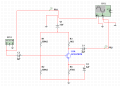
upload_2018-2-4_11-50-15.png
upload_2018-2-4_11-50-48.png
 

RichardO

Joined May 4, 2013
2,270
You need a transistor that has an F_t greater than 1.3GHz. Next, you will have reduce the values of most of the resistors so they are not effected (as much) by stray capacitance. Capacitors must be low inductance. Resistors and inductors must be low capacitance.

Finally, the circuit layout is part of the circuit because of stray capacitance and inductance. Because of this you _must_ use a PCB with a ground plane. A prototyping board is not going to work.

Finally, you must have good power supply bypass at high frequencies. Let me be more precise... Bypass, Bypass, Bypass.

Mini-Circuits may sell an amplifier that will make your job a little easier.


I have attached an example of a high frequency transistor. Study it until you understand every line and graph of the data sheet.
 

Attachments

Janis59

Joined Aug 21, 2017
1,894
My 5 cents: start with scanning the component shop shelves what them has, other-how many nice bjt has no any offer in the shelves. Start with those You may have.
The shops having rather good parameter search engines are Farnell, Digicom, and many more.
If You want to use a CE or CE circuitry, then You will need a beta times larger F(T) than Your 1,1 GHz, thus condemn those circs. Use a CB instead, and then the 1,5...2 GHz is good enough. Thus, press the http://lv.farnell.com/webapp/wcs/st...34&pf=110037878,110022678,110096293,110415654 where activate filters, so the subcat 1,6...2,5 GHz gives 12 choices what You may stack in the order of price.
Voila, candidates are chosen!
 
Hi everyone,
So for a project I need a 1.3 GHz signal amplifier with the lowest distortion possible. I had an analog circuit design class with a professor that did not really know what he was doing so I did not get too much out of it. I have a circuit which works in the 1 MHz range but I need a circuit centered around 1.3 GHz. I believe part of my issue is not knowing what transistor to use as many fall to unity gain far before the GHz range. I will post pictures of what I have so far. Thanks in advance for your help.
Try BFG135 or BFG591
 

Janis59

Joined Aug 21, 2017
1,894
RE:""You need a transistor that has an F_t greater than 1.3GHz.""
Or be more precise, F(T)>>K(u)*F(work). In Your case at least 10-20 GHz. The only way around this is the common base, but then there is no current amplification at all, just the voltage.
 

Janis59

Joined Aug 21, 2017
1,894
RE:""Because of this you _must_ use a PCB with a ground plane. A prototyping board is not going to work.""
My 99 cents: The "normal" PCB at such frequencies makes a full short-circuit, as the glass fibre and epoxy resin have different epsilon, thus the wave is scattered zillion times from each thread, where every time at mirroring act the losses are unavoidable. I have personally measured one old store shelves, only some 2% of all there kept pcb was useful for high freq applications.
The best material, specially designed for GHz range and having ultimate low loss factor (0,0004 to 0,0015 instead of "normal" 0,05) is teflon core pcb of Rogers inc, name duroid-TC350™ as the extremely well cooling material, but semi-matt surface, mirror-shiny duroid-6035HTC having permitted high-temperature conditions, and duroid-5880® what is most less lossy material but the most expensive.
If still using the FR-4 or FR-2 pcb, the great half of the gain will evaporate in the heat, so sad. The only way around it is old but very wise system where on the lossy pcb stays only some needed support patches exploited in DC (feeding points) and all the hi-freq parts stays hanged by wires 3-D in the air. Need to admitt, if the well planing is made, this method gives significantly shorter wire lengths, thus the less parasythics.
For the exercising the immagination, roughly each centimeter of wire length has parasythic inductance of 10 nH, but through pcb capacitance ca 2 pF/cm2. Its detrimental in most cases.
 
Top