It is an assumption, or perhaps more of a hope. But I think that at least THIS misunderstanding has been resolved. Let's resolve any others as they come up and try to do so civilly on all sides. I would hate to see an interesting thread get closed.
I like the approach and think that it is well reasoned. I have another idea for taking your insight and seeing if it works out a bit cleaner. I'll get to that when I can.
The only thing that I am a bit unsure of (primarily because my background in prob/stats is extremely limited and several decades in the past) is how to properly tie this to the expected value. But I think that can be done by just doing a weighted sum over the number of tosses.
Yes, that was what I was thinking would need to be done to get the necessary weighted sum.
Here's my slightly different angle.
The probability that we need MORE than t tosses is the probability that at least one of n coins has landed tails up on every one of the t tosses. If the probability of landing heads is p, then the probability of coming up tails t times is
p(all tails after t tosses) = (1-p)^t
Thus the probability that a coin comes up heads at least once is
p(heads at least once after t tosses) = 1 - p(all tails after t tosses) = 1 - (1-p)^t
To not require an additional toss, all n coins must come up tails at least once.
p(not needing another toss after t tosses with n coins) = [1 - (1-p)^t]^n
Therefore the probability of needing one more toss is
p(another toss is needed after t tosses with n coins) = 1 - [1 - (1-p)^t]^n
Therefore expected number of tosses for n coins should be
I may have made a goof along the way. I've just had some cadets come in and they need me to do something right away, so I'll come back and check things out later. But I'm bothered by that leading 1 in a sum with an infinite number of terms.
Yes, that was what I was thinking would need to be done to get the necessary weighted sum.
Here's my slightly different angle.
The probability that we need MORE than t tosses is the probability that at least one of n coins has landed tails up on every one of the t tosses. If the probability of landing heads is p, then the probability of coming up tails t times is
p(all tails after t tosses) = (1-p)^t
Thus the probability that a coin comes up heads at least once is
p(heads at least once after t tosses) = 1 - p(all tails after t tosses) = 1 - (1-p)^t
To not require an additional toss, all n coins must come up tails at least once.
p(not needing another toss after t tosses with n coins) = [1 - (1-p)^t]^n
Therefore the probability of needing one more toss is
p(another toss is needed after t tosses with n coins) = 1 - [1 - (1-p)^t]^n
Therefore expected number of tosses for n coins should be
I may have made a goof along the way. I've just had some cadets come in and they need me to do something right away, so I'll come back and check things out later. But I'm bothered by that leading 1 in a sum with an infinite number of terms.
Assuming it is correct, this is a nice general solution for E given p and n.
I am comparing on my spreadsheet. So far, your E's are exactly one toss greater than my E's for any n and p=0.5. I am trying to discover where I (likely) erred.
Assuming it is correct, this is a nice general solution for E given p and n.
I am comparing on my spreadsheet. So far, your E's are exactly one toss greater than my E's for any n and p=0.5. I am trying to discover where I (likely) erred.
If I perform your sum from 0 to infinity (instead of 1 to infinity) our answers agree. I think this is because you are summing the odds of (not success) whereas I am summing the odds of (success). Does this make sense?
Edit: If this is the case, I find it interesting that the problem can be approached from "either end" with identical results. Not surprising...just interesting.
MOD NOTE: Gentlemen, please let's not let this degenerate. A misinterpretation was made, it took a bit of back and forth to identify what it was and to clear it up. It has been cleared up. Let's move on with the discussion of the problem now that everyone is on the same page.
OK, I can agree that I misinterpreted the, apparent, initial intent. As I re-read the thread, it is clear that I was not the only one who misinterpreted - and that occurs all the time in a forum. Specification of terms such as "toss" and "flip" is important and maintaining civility is even more important. So, yes @WBahn, I am fine with moving on.
Given my "new" understanding, I would like to respond again to the initial questions.
Take n coins. Assume P(0.5) when tossed (no bias). Re-toss all heads-down (as a group) until only heads-up remain.
What is the average number of tosses required until all coins are heads up, and what does the distribution look like?
For the example of n=100 coins and counting the number of tosses until all coins end up heads. Again, any coin that is not heads is tossed as a group, regardless of the number. Thus, a toss continues with as many coins are not heads up until all coins are heads up.
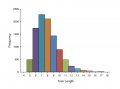
Based on an n=100 coins and 10000 trials, where a trial consists of the number of tosses required to achieve a result where all coins are heads up, I see the following distribution.
Edited graph to remove density function because it insisted on padding something or not using the column I told it to or otherwise being annoying and I am too lazy to do in SAS
To address one part of the question, that is what the distribution of tosses looks like from a simulation as described.
To address the other part of the question, the average number of tosses required is observed, in this simulation, to be 8.01 with the 95% CI as 0.038.
OK, I can agree that I misinterpreted the, apparent, initial intent. As I re-read the thread, it is clear that I was not the only one who misinterpreted - and that occurs all the time in a forum. Specification of terms such as "toss" and "flip" is important and maintaining civility is even more important. So, yes @WBahn, I am fine with moving on.
Given my "new" understanding, I would like to respond again to the initial questions.
Take n coins. Assume P(0.5) when tossed (no bias). Re-toss all heads-down (as a group) until only heads-up remain.
What is the average number of tosses required until all coins are heads up, and what does the distribution look like?
For the example of n=100 coins and counting the number of tosses until all coins end up heads. Again, any coin that is not heads is tossed as a group, regardless of the number. Thus, a toss continues with as many coins are not heads up until all coins are heads up.
Based on an n=100 coins and 10000 trials, where a trial consists of the number of tosses required to achieve a result where all coins are heads up, I see the following distribution.
To address one part of the question, that is what the distribution of tosses looks like from a simulation as described.
To address the other part of the question, the average number of tosses required is observed, in this simulation, to be 8.01 with the 95% CI as 0.038.
there is a 25% chance that it will happen on the first throw - a run of 1, a 50% chance that you will have to rethrow one coin, so the expected value for this strand is \((1+E_1)\) and a 25% chance that you will have to rethrow both, with an expected value of \((1+E_2)\) (as you have already thrown once). This gives
\(E_2 = 8/3\)
going on I get \(E_3 = 22/7 = 3.14\) and \(E_4 = 384/105 = 3.65\)
Assuming it is correct, this is a nice general solution for E given p and n.
I am comparing on my spreadsheet. So far, your E's are exactly one toss greater than my E's for any n and p=0.5. I am trying to discover where I (likely) erred.
I believe so. At first blush the series looks suspiciously like that for the natural log. Since we are pretty sure it should be a base-2 log of something close to n, that's probably a good place to start.
And I think my sum NEEDS to start from 0, since there is a 100% chance that, after 0 tosses, another toss is required. That would increase my result by 1.
Yes. But I have been trying (for fun) to find the form of the equation that exactly matches the predicted E(p,n). I figured if I could find the form, then working backwards to an equivalent Taylor series would be easy -- and from there I should arrive at @WBahn's generalized solution.
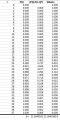
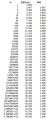
This is the table for E(0.5,n):
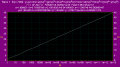
Clearly, for large n, each octave adds one additional t to E, therefore, log2(n). But the non-linearity for small n is turning out to be a major headache. I've got a nice curve matching program that maps the data against thousands of possible forms, but there is apparently no simple function that exactly matches the expected result.
And I think my sum NEEDS to start from 0, since there is a 100% chance that, after 0 tosses, another toss is required. That would increase my result by 1.

 Facebook
 Google
 GitHub
 Linkedin