0-15V 3A Variable Power Power Supply

MrChips

Joined Oct 2, 2009
34,827
Perhaps we can find some common ground here to agree on.

Let us suppose the efficiency is 80%.
Let us suppose the transformer is rated at 10V rms x 1A rms = 10W
Hence the power delivered to the load is 8W at 80% efficiency.
If the output voltage is 14V, the current = 8/14 = 0.57A

If we take two diode forward drop into account, the current = 8/12.6 = 0.63A

In either case, we derate the transformer from 1A rms to 0.6A DC.

This has nothing to do with the claim that 1A rms equals 1.4A peak.
It also agrees with the assumption that you can multiply rms voltage with rms current to give power rating.

According to the Hammond design guide, the DC voltage is derated from 10V to 9V.
The current is derated from 1A to 0.62A.
Power = 9V x 6.2A = 5.58W
That equates to an efficiency of 56%.

This was my original post #2 to the TS:
For starters, put a bigger transformer, one that can deliver 3A and more.
The TS wanted 3A output. What I had failed to identify was how much "more" the transformer has to be rated for. I stand corrected.
 

MrChips

Joined Oct 2, 2009
34,827
For the benefit of readers following this discussion, I just had an Aha! moment coming to understand the knowledge that @crustchow was trying to convey.

What he was alluding to was the heat losses in the transformer and how much to derate the power loading on the transformer when using a reservoir capacitor as filter.

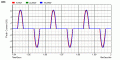
If we were to omit the filter capacitor, the current through the transformer, rectifiers and load follows the expected half sine wave.

upload_2017-10-27_17-6-47.gif

When the reservoir capacitor is added, the current waveform changes dramatically because the diodes conduct for only a fraction of the cycle.

upload_2017-10-27_17-11-2.gif

The peak value of the diode current increases multiple times greater than the average current.

I have performed this experiment and observed the shape of the current pulse as the capacitance is increased. Interestingly, the ON period stays the same and so does the peak amplitude. What does change is the shape of the pulse. It is as if the transformer reaches a point of saturation and the current pulse spends more time at higher values.

Power loss in the transformer is directly proportional to the square of the current.
Hence, more power is lost owning to resistive heating at high peak currents.

The conclusion is to derate the transformer power rating to about half the stated values when using a capacitor filter.
 

ronsoy2

Joined Sep 25, 2013
71
Mr. Crutschow, please remember the duty cycle also is in effect here. A million amps at 1 uSEC will heat the same as 1 amp at 1 sec.
Even though the current is 1.7 times the average, the time is much shorter so the heating effect is likewise shorter. Indeed, it will calculate out to be exactly what the formula says when the effective duty cycle is included!
The place where the peak current is serious is where it drives the core of the transformer into saturation. All bets are off then, and the heating can easily overheat the transformer. The example from the fellow that built up the circuit shows that the transformer was not driven to saturation so it didn't tend to overheat.
Grizzley, also look up the national LM350 and consider using that instead of the power transistor. They are available on ebay for under 3 bucks and are a very good regulator. The same heatsink considerations are of course necessary.
 

MaxHeadRoom

Joined Jul 18, 2013
30,672
This was part of lab report paper originating from the U of Maryland, unfortunately I no longer have the complete report, but this section shows some detail on the effects of transformer size when increasing Capacitor value in order to reduce ripple for a certain load.
Max.
 

Attachments

crutschow

Joined Mar 14, 2008
38,526
please remember the duty cycle also is in effect here. A million amps at 1 uSEC will heat the same as 1 amp at 1 sec.
Even though the current is 1.7 times the average, the time is much shorter so the heating effect is likewise shorter. Indeed, it will calculate out to be exactly what the formula says when the effective duty cycle is included!
What formula?
The place where the peak current is serious is where it drives the core of the transformer into saturation.
A normal power transformer does not saturate due to high currents, it saturates due to a high input voltage.
 
Top