High Power Variable Resistor vs L Pad

Thread Starter

Jsprite7660

Joined Jan 9, 2024
40
Hey All,

I have a Fender Excelsior (Tube amp). I've been using a fixed high power wire-wound resistor between the amp and the speaker so I can get the same overdrive at lower volumes.

BEFOFE I REALIZED AN L-PAD IS RECOMMENDED, I bought this rheostat high power variable pot so that I can vary that volume (Still in the same place between the amp and the speaker.)

My one question is; What will happen if I use THIS VARIABLE POT between the amp and the speaker instead of the recommended L-Pad?

WIll I ruin the amp? Or does the L-Pad just work more efficiently

Thanks
 

meth

Joined May 21, 2016
298
How do you achieve overdrive adding resistors?
You try to lower the impedance of the load so more current goes to the speaker? Why cant you simply buy a pedal that costs 50$ instead of improvised pot of 25$?

I see nothing wrong with the pot but I think it will act as a volume knob instead of an overdrive.
 

MisterBill2

Joined Jan 23, 2018
27,182
Certainly a series resistor will reduce the speaker sound level. BUT the amplifier will be delivering less power, so the overdrive distortion will not be quite the same. An L-Pad is intended to present a constant load impedance, Connecting the RHEOSTAT as a voltage divider instead of a series resistor will come closer to providing a constant load to the amplifier.
An interesting alternative would be substituting a pair of weak-emission output tubes in the amplifier and see if that will provide the kind of over-driven distortion you are seeking.
 

Thread Starter

Jsprite7660

Joined Jan 9, 2024
40
How do you achieve overdrive adding resistors?
You try to lower the impedance of the load so more current goes to the speaker? Why cant you simply buy a pedal that costs 50$ instead of improvised pot of 25$?

I see nothing wrong with the pot but I think it will act as a volume knob instead of an overdrive.
No. The amps tubes naturally distort when the amp is turned up. BUT it’s loud, so I’m turning the amp up to get the tubes distorting but cutting the overall volume down so I can not anger the neighbors.

I was just curious about the L-pad vs the high powered pot that I bought.

Thanks
 

crutschow

Joined Mar 14, 2008
38,321
The rheostat will reduce the value of the speaker damping-factor as you reduce the sound level, which can cause muddy bass, but that may not be a concern for your application.
 

MisterBill2

Joined Jan 23, 2018
27,182
You could slash the speaker cone with a razor blade, which was how it was originally done by the Kinks.
Damaged speaker distortion is way different from output stage clipping distortion. PLUS, much worse, a damaged speaker stays damaged until EXPENSIVE replacement work is done. So set your high power resistor to the correct value and then connect the speaker across it with a series resistor to adjust your listening level.
Normally "L-Pads" are used by audiophiles to reduce the level and not cause distortion.
 

meth

Joined May 21, 2016
298
Sorry but I fail to understand how you want to utilize this L-Pad. You say you want to achieve overdrive effect. Overdrive has to do with the GAIN of the amp, the way you are saying you gonna mount the L-Pad to me it just seems like a volume pot ... ?!
 

MisterBill2

Joined Jan 23, 2018
27,182
Sorry but I fail to understand how you want to utilize this L-Pad. You say you want to achieve overdrive effect. Overdrive has to do with the GAIN of the amp, the way you are saying you gonna mount the L-Pad to me it just seems like a volume pot ... ?!
The "L-PAD" is exclusively used to reduce the voltage to the load while presenting a constant impedance to the source.
The TS clearly stated that the requirement is to reduce the power to the speaker while operating the amplifier at a high output. That makes sense to me, although it is inefficient.
I thought that was made clear in post #1. The intention is to reduce the power to the speaker. Certainly connecting a series resistor will do that, since all the power dropped across the resistor is wasted as heat, not sound.
The TS was concerned that it might possibly damage the amplifier. My understanding is that the possible damage to a tube-type amplifier by operating with NO LOAD would be the chance of insulation breakdown in the output transformer because of high voltage due to no load.
THAT does not seem likely in an amplifier designed by the FENDER folks. Those amps are built to withstand occasional abuse.
In fact, I have not ever even heard of it actually happening.
I did, once, see arcing between pins #3 (6L6 Plate) and pin #2(Grounded heater pin) in a surplus tube type SERVO AMPLIFIER being converted to a PA amplifier. THAT fault was caused by running NO LOAD along with high frequency oscillation caused by an incorrect feedback connection. There was no permanent damage.
 
Last edited:

nsaspook

Joined Aug 27, 2009
16,251
Sorry but I fail to understand how you want to utilize this L-Pad. You say you want to achieve overdrive effect. Overdrive has to do with the GAIN of the amp, the way you are saying you gonna mount the L-Pad to me it just seems like a volume pot ... ?!
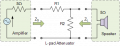
A transformer coupled tube PA amp is designed for X AC load impedance from the tube curve data for X power and clipping point (overdrive). The speaker secondary impedance is transformed to that tube load impedance. So it seems the OP wants to simulate that X
tube impedance with actual lower speaker volume. For that you need some sort of impedance matching level-control network, a L-Pad does this.
1762536253274.png

1762536120355.png
https://www.amazon.com/Parts-Express-Speaker-L-Pad-Attenuator/dp/B0002KR1EQ
 

MisterBill2

Joined Jan 23, 2018
27,182
REALLY, the TS wants to reduce the power to the speaker while allowing the amplifier to operate at some maximum distortion producing level. THAT is simple to do if the speaker is connected thru a series resistor.
Now there is a question: IS the high power a three terminal device, so that it can simply function like a voltage divider, with a POTENTIOMETER connected as a voltage divider, with the end terminals like the left end of R1 and the bottom of R2 and the junction of R1 and R2 being the wiper? and the speaker being effectively in parallel with R2?
What I do not know is the resistance of the item the TS has, possibly I missed that part.
What I do understand is that the understanding of the "coloration" of tube amplifier is lacking in this discussion. A "good" amplifier distortion might be simulated by one of the higher priced pedal, while the less expensive ones will deliver an entirely different "color" of distortion. Many folks hear no difference, but certainly it is fairly large to the ears of a musician familiar with that sound realm. ( Like the cheap noise-gate simulation of a snare drum, which is obvious to even my ears.) The TS is aware of what they want, A substitute is not the same.
 
Last edited:

nsaspook

Joined Aug 27, 2009
16,251
Who knows that the TS really want's because this is music, not hi-fi sound reproduction.

If the TS want's to emulate (a close approximation) the tube amp output distortion characteristic at X drive point with the normal speaker power load, but, to have the speaker at a lower volume because of a lower net power to the speaker, then the L-Pad is a solution. Pretty easy technically. Will it give the sound the TS want's from X music, nobody knows.
 

MisterBill2

Joined Jan 23, 2018
27,182
The question asked was not about what is the "ideal device" for reducing the speaker volume, but rather, would not using one damage the amplifier. Certainly an adequate L-Pad, which would be able to dissipate much of the amplifier output power as heat, while providing a close to correct output load impedance.

The specific benefit of keeping the load impedance at some specified value, as opposed to presenting a higher impedance, has not been presented yet. Nor has the possible in theory result of having a higher impedance been explained.
So really, what would happen??. What sort of damage to the amplifier might be caused??
The issue that I see is possibly shortening the life of the power tubes. Vacuum tubes do seem to wear out eventually.
 
Last edited:
Top