A 3A transformer is not large enough.
You need to derate the transformer due to the high peak RMS currents that a rectifier-capacitor supply draws, so for 3A DC, the transformer should be rated for at least 5Arms.
Q1 will also need a hefty heat-sink that can dissipate about a 100W.
A 3A transformer is not large enough.
You need to derate the transformer due to the high peak RMS currents that a rectifier-capacitor supply draws, so for 3A DC, the transformer should be rated for at least 5Arms.
Q1 will also need a hefty heat-sink that can dissipate about a 100W.
Thanks for the reply.
Actually i don't understand what does 5Arms mean? So explain me little please.
Then Q1 must be higher than 3A and looks like need heat-sink that can dissipate about 100W.
Also bridge must handle more than 3A right?
It's due to the high peak currents drawn by the rectifier-capacitor.
Since the RMS value is proportional to the square of the current, the high peak current has a much higher RMS value (causing heating in the transformer windings).
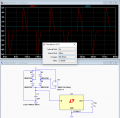
Below is an LTspice simulation of such a circuit.
You can see that for a 1A DC output, the transformer [I(V1)] RMS current is nearly twice the 1A DC output.
It's due to the high peak currents drawn by the rectifier-capacitor.
Since the RMS value is proportional to the square of the current, the high peak current has a much higher RMS value (causing heating in the transformer windings).
Transformers are rated for RMS current.
"Since the RMS value is proportional to the square of the current..."
That doesn't sound right.
Also, if the transformer is rated for RMS current, it would appear that 5A rms is sufficient for 5A DC.
Also, what is important to remember is that the peak rectifier current can be as much as 10 or 20 times the average DC current. That is because the rectifier diodes conduct for a small fraction of the sine-wave cycle. During this time the diode has to replenish all the charge that is consumed during the entire cycle.
Power is proportional to the square of the instantaneous current (through a resistive load).
RMS is the power (heating) value of a waveform.
Thus RMS is proportional to the square of the current.
Not true.
Appearances are deceiving.
Did you not look at the simulation in post #9?
The RMS transformer current is almost twice the DC current at the output.
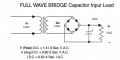
Here's snip from the Hammond reference you posted for a bridge-capacitor rectifier.
They derated to transformer to 62% of it's RMS value
Absolutely not.
I didn't say it was equal or directly proportional to, I said it was proportional to, in the same way you can say the current through a diode is proportional to the voltage across it.
I was trying to emphasize that the heating in a transformer is determined by the square of the instantaneous current out of the transformer, not the average DC value, which you did not see to understand, by your suggesting in posts #2 and #10 that the the DC output of a transformer rectifier-filter can be equal to the RMS rating.
Bigger diodes. The 1N400x series is rated for 1 A continuous DC or RMS AC current. For a 3 A output current, you need a minimum of 5 A rated diodes. 10 A would be much better for long term reliability.
The transformer is rated to deliver 31.5VA
Transformer output at no load = 14.58VAC rms
Transformer output with 5Ω load = 13.0VAC rms
With unregulated DC supply components added
No load output = 19.06V DC
With 5Ω load, output = 13.08VDC
Current = 2.73A
Ripple = 1.44V peak to peak.
DC power output = 13.08V x 2.73A = 35.7W
The transformer rating is 12.6VCT @ 2.5A = 31.5VA
Conclusion: the transformer lives up to rated specifications and exceeds the rating.
It is spec'd at 2.5A rms and delivers 2.7A at 13VDC in a bridge rectifier circuit with capacitor filtering.
That proves nothing other than the transformer will deliver more RMS current than its rating since transformers don't limit their output to the RMS rating.
Most transformers will operate beyond their ratings until they burn up.
But (repeating again) the RMS output current for that DC output with the rectifier-capacitor filter will be about 1.7 times the DC current or 4.5Arms and will overheat the transformer.
No one is talking about overheating the transformer.
In the example I have shown, the transformer is designed to deliver 12.6VAC @ 2.5A
When asked to do so, it did and it did not burn up. And it delivered 13VDC @ 2.7A.
As far as I can see, 2.5A rms was sufficient for 2.5A DC at the rated voltage.
No one is talking about overheating the transformer.
In the example I have shown, the transformer is designed to deliver 12.6VAC @ 2.5A
When asked to do so, it did and it did not burn up. And it delivered 13VDC @ 2.7A.
As far as I can see, 2.5A rms was sufficient for 2.5A DC at the rated voltage.
Ac voltage and current are specified in rms values..after rectification and filtration they tend to go higher in magnitude and direction cause the waveform tends to attain maximum amplitude..so to my own opinion if a transformer is rated 2.5A rms after rectification it should be able to deliver more than that..althouugh I Understand perfectly what u meant by the transformer burning out since there is no limiter there..

 Facebook
 Google
 GitHub
 Linkedin