Zero crossing with 4n25 issue

WBahn

Joined Mar 31, 2012
32,847
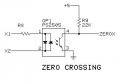
Hey guys, i'm trying to do zero crossing with the 4n25 but to no avail. Here's the circuit:

For the bridge i'm using four 1N4001 diodes, and i'm trying to see the output signal with an oscilloscope. Any ideas?
thanks
Look at the specs for the 4N25. You will see that the absolute maximum reverse voltage is 5 V. Assuming no leakage current, you are asking it to withstand over 320 V reverse. You've likely destroyed the 4N25, although the 22 kΩ resistor might have limited the current to a survivable level.

Put a zener diode (somewhere in the 3 V range) in anti-parallel with the LED to clamp the reverse voltage.

If you are using 1N4001 diodes, then you are likely damaging them, as well since they are only rated for 50 V peak reverse voltage. Look at using 1N4007 diodes.
 

be80be

Joined Jul 5, 2008
2,395
Look at the specs for the 4N25. You will see that the absolute maximum reverse voltage is 5 V. Assuming no leakage current, you are asking it to withstand over 320 V reverse. You've likely destroyed the 4N25, although the 22 kΩ resistor might have limited the current to a survivable level.
That's my thinking too I no I killed the led in one and I was just using 120 volts with a stepdown transformer.
I changed setup to a 6 volt transformer and a 4n35 It worked fine but the 4n25 never worked and showed a bad led
 

JohnInTX

Joined Jun 26, 2012
4,787
Leakage current aside, doesn't the full wave bridge fix the reverse voltage issue (assuming all the diodes are OK)?

If you're changing optos, I've used this circuit with success. Eliminates the bridge.
ZeroCrossDet.jpg
I sometimes put a small resistor across the LEDs sized to require something higher than the leakage current to reach Vf. Useful when driven by a solid state device.

Just my .02
 

ian field

Joined Oct 27, 2012
6,536
Leakage current aside, doesn't the full wave bridge fix the reverse voltage issue (assuming all the diodes are OK)?

If you're changing optos, I've used this circuit with success. Eliminates the bridge.
View attachment 132340
I sometimes put a small resistor across the LEDs sized to require something higher than the leakage current to reach Vf. Useful when driven by a solid state device.

Just my .02
The 4001 diodes mentioned by the TS wouldn't have been OK for long - and they probably blew the resistor open.

This thread violates the TOU by being a transformerless supply and a working circuit can be tacked onto a LV secondary with very little effort.
 

JohnInTX

Joined Jun 26, 2012
4,787
In post #9 TS says they are 1N4007 so that's what I was going on.

As shown, the circuit is a line connected detector by function which IMO is different than a transformerless power supply. The hazards are apparent. It would be advisable to use an isolation TX for testing, I'd agree.
 
Last edited:

WBahn

Joined Mar 31, 2012
32,847
The 4001 diodes mentioned by the TS wouldn't have been OK for long - and they probably blew the resistor open.

This thread violates the TOU by being a transformerless supply and a working circuit can be tacked onto a LV secondary with very little effort.
The TS apparently is actually using 1N4007 diodes (made a mistake in the initial post).

While using a transformer with a low-voltage secondary is preferable, it may not be feasible for a variety of reasons.

This is a detection circuit and not a supply circuit, but it is very arguable borderline as far as the prohibitions are concerned. But the intent is clearly to provide isolation from the mains to the bulk of the circuit, so it meets the spirit of the guidelines.
 

ian field

Joined Oct 27, 2012
6,536
The TS apparently is actually using 1N4007 diodes (made a mistake in the initial post).

While using a transformer with a low-voltage secondary is preferable, it may not be feasible for a variety of reasons.

This is a detection circuit and not a supply circuit, but it is very arguable borderline as far as the prohibitions are concerned. But the intent is clearly to provide isolation from the mains to the bulk of the circuit, so it meets the spirit of the guidelines.
If it detects something - there's probably some equipment that uses the information.
 

Thread Starter

irmanao

Joined Apr 29, 2017
87
Ok thanks for the replies..
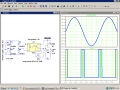
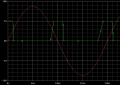
I had some 4n38 lying around so i tried it with them with the same results(it didn't work). Nothing changes with the addition of the resistor across base and emitter. Here is the schematic (i used a step down transformer at 17.5V) which works in spice:
 

Attachments

Last edited:

ericgibbs

Joined Jan 29, 2010
21,442
hi ir,
You are not showing a current limiting resistor in series with the opto emitter.?

E

Please post your LTSpice file.
 

Thread Starter

irmanao

Joined Apr 29, 2017
87
I wasn't using one.. I connected a 10k one two a different 4n38 and it now works perfectly but only without the 10k across base and emitter. So i burned the other because i wasn't using one?

Thanks eric and everybody else for their kind help and patience.
 

Thread Starter

irmanao

Joined Apr 29, 2017
87
Yeap, you're right using a smaller resistor minimizes the rise and fall times but gets hot quickly... i'm using a 1/4 Watt resistor
 

ian field

Joined Oct 27, 2012
6,536
The TS apparently is actually using 1N4007 diodes (made a mistake in the initial post).

While using a transformer with a low-voltage secondary is preferable, it may not be feasible for a variety of reasons.

This is a detection circuit and not a supply circuit, but it is very arguable borderline as far as the prohibitions are concerned. But the intent is clearly to provide isolation from the mains to the bulk of the circuit, so it meets the spirit of the guidelines.
There are circumstances where 4001 diodes would be perfectly fine.

The resistor in series with the mains feed drops most of the voltage, so the voltage at the bridge AC terminals will only be a couple of volts more than you end up with under loaded condition.

As long as the load holds the voltage down; the diodes are safe - *ANY* break on the DC side will allow the voltage to rise and damage the rectifier.
 

WBahn

Joined Mar 31, 2012
32,847
Is it steam powered?
What does it matter? The output side of the optocoupler is powered from a 5 V DC supply. Maybe it's batteries. Maybe it's a solar panel. Maybe it's a properly isolated DC supply. If the 5 V DC supply is a transformerless supply, THEN we have a clear ToS violation. But all we have here is a 5 V DC supply. No violation.
 

WBahn

Joined Mar 31, 2012
32,847
There are circumstances where 4001 diodes would be perfectly fine.

The resistor in series with the mains feed drops most of the voltage, so the voltage at the bridge AC terminals will only be a couple of volts more than you end up with under loaded condition.

As long as the load holds the voltage down; the diodes are safe - *ANY* break on the DC side will allow the voltage to rise and damage the rectifier.
I would argue that it is very poor design to rely on that LED never failing.
 

cmartinez

Joined Jan 17, 2007
8,763
A little late to the thread, but here's an extremely reliable circuit that I've been successfully using for at least 5 years.

As a side note, I found that using a 100K value for R1 and R2, and 470Ω for R4 significantly improved its performance for 110 VAC operation.
 
Last edited:
Top