YouTube vid: Circuit can't work. Can it?

Thread Starter

B-JoJo-S

Joined Jan 3, 2026
250
The maker of this device at first made it look like applying heat to the diode would cause the motor to spin up. I know better than that. In the comments section I accused him of trying to trick us into thinking he's creating energy from a match to power a small motor and fan.
Here:
Makes it look like free energy.
He responded to my accusation and posted this:
From his crude drawing I made this:
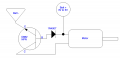
2-13-2026.png
So now he's claiming that heating the diode will allow current to flow in reverse when heated, thus turning the transistor on. When the transistor conducts the motor runs. Now he's calling it a heat sensor. Originally he called it something else but has since edited the title.

Since I don't want to build this to investigate - what's your opinion on this?
 

crutschow

Joined Mar 14, 2008
38,423
The reverse bias diode would have a small reverse leakage current that increases with temperature.
The data sheet shows about 50 µA of leakage at a diode temperature of 150°C (max junction temperature).
The transistor has a nominal current gain of about 150, so the motor current would then be about 7.5mA, not likely enough to run the motor.

Conclusion: He must be heating the diode well above its maximum temperature limit to get the motor to run.

Edit: Making the transistor into a 2-transistor Darlington or Sziklai stage would allow motor operation at a much lower diode temperature.
 
Last edited:

0ri0n

Joined Jan 7, 2025
167
Use a Schottky diode (e.g. 1N5817...1N5819) instead of the 1N4007. The reverse leakage current at 100°C is at least 1mA. The 2SD882 transistor has a current gain > 150, which is plenty to start a small motor.
 

Thread Starter

B-JoJo-S

Joined Jan 3, 2026
250
It is like attempting to convince a flat-earther about the earth’s spherical shape. No amount of facts, data or evidence will sway their views.
You mean - - - ?
That would explain why the sun rises 3 hours earlier in the east coast than it does on the west coast. Why China is dark when we're light. Relatively speaking.
Use a Schottky diode (e.g. 1N5817...1N5819) instead of the 1N4007. The reverse leakage current at 100°C is at least 1mA. The 2SD882 transistor has a current gain > 150, which is plenty to start a small motor.
I have no intention of building this. I saw it and figured there must be some trick. behind something. If the temperature rose at X rate then the transistor should conduct X+? And the motor speed should start out slowly and gradually increase.

Seems I saw a 9V battery, not the one he glued the motor to. Or maybe he did afterwards, who knows.

I watch YT for entertainment. When I see something goofy like this I generally ignore it. But it piqued my interest so I had to ask.
And who knows?! Wires go off screen. Perhaps there's a variable power supply hidden. To make it look like the circuit is reacting as claimed he adjusts a pot.

I just had to know.
 

WBahn

Joined Mar 31, 2012
32,777
Everything is a temperature sensor.
The maker of this device at first made it look like applying heat to the diode would cause the motor to spin up. I know better than that. In the comments section I accused him of trying to trick us into thinking he's creating energy from a match to power a small motor and fan.
Here:
Makes it look like free energy.
He responded to my accusation and posted this:
From his crude drawing I made this:
View attachment 363419
So now he's claiming that heating the diode will allow current to flow in reverse when heated, thus turning the transistor on. When the transistor conducts the motor runs. Now he's calling it a heat sensor. Originally he called it something else but has since edited the title.

Since I don't want to build this to investigate - what's your opinion on this?
Just about everything is a temperature sensor. Diodes are often used as temperature sensing elements.

Conceptually, there is no problem with the circuit -- its a matter of where various parameter curves cross.

As silicon diodes are heated, their reverse leakage current increases. That provides the base current, which is amplified by the transistor to provide motor current. If the leakage current at very high temperature (like when it is in a flame), is high enough and if the current gain of the transistor is high enough and if the current needs of the motor are low enough, then there is nothing at all to prevent the circuit from working.
 

WBahn

Joined Mar 31, 2012
32,777
Here's some really rough numbers that might be in the ballpark. Small hobby motors like this often pull something like 30 mA to 100 mA under light load conditions.

At these currents, the transistor likely has a DC current gain of close to 200, which means that we would need a base current of 200 µA to 500 µA to get into that range.

The base leakage current of a 1N4007 is about 5 µA at room temp and 50 µA at 100°C. Leakage current increases exponentially with temperature, so if a 75°C increase results in a 10x increase, then another 75°C would get it up into the 500 µA. I think the doubling temperature change it generally in the 10°C to 15°C, which is reasonably consistent with this. Plus, to get to that 200 µA region, you would only be talking about getting the junction temperature into the 150°C vicinity.

So, I would not be surprised at all to see this work as shown.
 

MisterBill2

Joined Jan 23, 2018
27,361
Is it possible that "the diode" is not what it really IS?? AN NTC thermistor, possibly??OR is the whole thing a fake??
WHY do you think that I call it "the cartoon channel"???
 

Thread Starter

B-JoJo-S

Joined Jan 3, 2026
250
Since retiring I have a lot of time early in the morning and in the evening. Unfortunately I watch a lot of YT, or "The Cartoon Channel." As such, I see a lot of stuff that clearly is fake. Especially "Free Energy" machines. I know better than that. There's also a lot of click bait with some provocative image just to get you to take a closer look. When you do you might see a flash of what attracted your attention but you're going to see a whole lot of unnecessary stuff too.

I actually got into an argument with the guy who made those video's. Basically I accused him of having something off screen we're not allowed to see. That was after the first short video. Then I guess he had a longer version and posted it just to prove it does work the way he showed. So I made a copy of his schematic so I could follow it a little closer and that's when I began to wonder if it might actually work and not be dependent on something off screen. And so I asked here because you guys and gals know a whole lot more than I do. And in this thread I learned a lot. For that I'm grateful.

Is it possible that "the diode" is not what it really IS?? AN NTC thermistor, possibly??OR is the whole thing a fake??
Can't really tell from the poor quality video. That's another thing that makes me wonder if something is legitimate or not.
 
Top