Are you powering the motor directly from the Arduino pin? (I hope not), do you have a Mosfet to switch the PWM signal. If your resistor value between Arduino pin and mosfet gate is too high, your mosfet may be switching slowly and power to your motor is limited by the switching losses.
Show your whole setup with part numbers as a schematic.
And show your code.
The overall end result that You are looking for is going to dictate,
at least to some degree, the approach taken to get to that end result.
It would appear that You have quite a few misconceptions about
what is required to accomplish that result.
Describe the final product that You want, and why, in detail, so that we
can all get on to the same page.
.
.
.
The system works very well. Except for the noise at the motor being caused by the PWM signal that is being used to control the 24v portion of the circuit. The motor spends it's time between a neutral state and a stalled state, with a varying level of PWM duty cycle that creates "pressure" on the pedals. As I mentioned earlier, 15.6 kHz is above hearing range but too weak. 7.8 kHz is strong but too noisy.
I need to determine a method to eliminate the noise while remaining true to the easy, off-the-shelf, DIY nature of this project. So no complicated hardware or expensive parts (stepper or brushless DC motors).
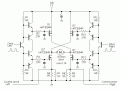
Microsoft had a FFB joystick about 20 years ago using regular DC motors. My current flight yoke uses the electronics and hardware from one of these joysticks ( FRB yoke - Imgur ) . Once the pedals are finished, I will be creating a DIY yoke from scratch. Here is the MS circuit design. I could build this but the average DIY flight sim builder could not. Regardless, MS might frown on me ripping off their design.
I see those 4 caps and can't help but think that is noise control. Thee has to be a way for me to add caps to the hardware i'm using to quiet things down. It was stated that I can't place a floating (nonpolarized) cap between the 2 motor wires. I don't understand why. I'm a diagnostic mechanic for Peterbilt. It's my job to understand all of the various systems of the trucks. So when someone tells me something won't (doesn't) work, I need to know why it won't (doesn't) work.
Sorry to be so long winded but you did ask for it ;D
Since the precision of the motor is not critical on the forced feedback, you can adjust the PWM down to sub-audible frequencies and see if the rumble is less annoying. Say, 40 to 50 Hz range. On-board PWM software may not facilitate such low PWM but you may be able to bit-bang the sub-audible PWM instead of the analogWrite function on Arduino.
Since the precision of the motor is not critical on the forced feedback, you can adjust the PWM down to sub-audible frequencies and see if the rumble is less annoying. Say, 40 to 50 Hz range. On-board PWM software may not facilitate such low PWM but you may be able to bit-bang the sub-audible PWM instead of the analogWrite function on Arduino.
It didn't occur to me to go the other way. I can adjust the Arduino PWM down to 30, 15, and 7.5 Hz. Going to try these frequencies right now. I'll report back if about an hour.
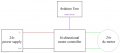
And I just finished a cool (crude) drawing of my setup to share...
Sadly, it did not work. I tried 7.5, 15, 30, 60, and 120. It went from feeling like a Huey idling to a foot massager. Above that and the whine starts in.
Here's that crude drawing I mentioned.
Is there some sort of capacitor, diode combo that can smooth out the green lines? If there is, I would like to run this at 4 kHz. It seems like the sweet spot between vibration and strength.
In a search for bi-polar caps I found this. bi-directional capacitors | All About Circuits
Trying to do this by using a relatively small-Motor,
then using a gear-box to get the desired Torque,
is going to be unavoidably NOISY !!!
To make this mechanism "quiet",
I would start by finding or making a Gear-Box that has
a ratio of no more than about ~10 to 1.
( Actually, a small "Cogged-Belt" drive would probably be a better choice )
That equates to ........
360-degrees, divided by 10 equals 36-degrees of Rotation for one complete Motor-Shaft Rotation.
You will probably need around ~20-pounds-feet of Torque on the Output-Shaft,
divided by 10 = 2-pounds-feet of Torque generated at the Motor's shaft.
It looks to me like You need a Large-ish Stepper-Motor with Encoder-Wheel-Positioning.
This arrangement would be quiet, and very capable of providing a realistic "feel" in the Pedals.
Trying to do this with any kind of "Brushed-Motor" is going to be disappointing.
Currently, I'm guessing that You are trying to run
your Motors in a perpetually "close to stalled" condition,
and to make it worse, constantly reversing them as well.
Most Motors won't put up with this kind of abuse for very long,
unless they were specifically designed to do so, and seriously "over-built".
Now add to that, that they must do it silently as well !!!
.
.
.

 Facebook
 Google
 GitHub
 Linkedin