Would this analog motor control work?

Thread Starter

Thick8

Joined Sep 16, 2017
30
I;m trying to get my PWM bi-directional motor control to work silently. The motor driver I have isn't working at its rated frequency. Cheap Amazon seller... I was playing around I was wondering if this analog device would work to drive a bi-directional motor. It seems too simple, so I'm guessing no.
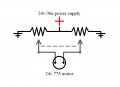
Analog bi-drectional control.jpg
 

crutschow

Joined Mar 14, 2008
38,503
Functionally it might work, but with poor performance from the motor and generate a huge amount of waste heat.
So your guess is mostly correct.

What is the PWM driver and what frequency is it supposed to operate?
 

Audioguru again

Joined Oct 21, 2019
6,826
A resistor in series with a motor limits its current. Its current is high when it starts and when it is loaded then it does not work properly with a series resistor. PWM produces full power for each pulse but it averages the voltage for a low speed with lots of torque.
 

Thread Starter

Thick8

Joined Sep 16, 2017
30

LowQCab

Joined Nov 6, 2012
5,101
A Brushed-Motor is never going to be totally quiet, ( until You get into the BIG-Money ).
For quiet You need a BLDC-Motor, and it won't necessarily be all-that quiet either.
It also depends on your definition of "quiet".
.
.
.
 

Thread Starter

Thick8

Joined Sep 16, 2017
30
Got it running at 15.6 kHz. which is above both mine and my wife's range of hearing. I was entering the Arduino code incorrectly. No whine will full power at a dead stall.
 

Audioguru again

Joined Oct 21, 2019
6,826
When I was a teenager some "ultrasonic" burglar alarms were too loud. Now at my age of 76 my hearing aids produce the high audio frequencies. Maybe I should add woofers to my smoke detectors.
 

Thread Starter

Thick8

Joined Sep 16, 2017
30
As it turns out, running at 15.6 kHz, the motor is too weak. I have been looking into solutions. I was wondering if I could place a ceramic, non-polarized, capacitor between the motor terminals to absorb the PWM generated frequency in the motor circuit. Then I could run it at 7.8 kHz. Would this work?
 

Audioguru again

Joined Oct 21, 2019
6,826
You do not want to short-circuit the PWM pulses with a capacitor which will overload the PWM source.
When the pulse widths are wide then they are almost the same as the power supply DC that might have a voltage that is too low for the amount of power you want.
 

LowQCab

Joined Nov 6, 2012
5,101
You need a "Freewheeling-Diode" attached to the Motor-Terminals.
It must be able to handle the Full-Load-Amps of the Motor.

A small Capacitor, ( 0.1uf ), ( 100nf ), won't make it any quieter, but it might help to keep down
the normally generated RFI-hash, which could smoke parts.
.
.
.
 

Thread Starter

Thick8

Joined Sep 16, 2017
30
You need a "Freewheeling-Diode" attached to the Motor-Terminals.
It must be able to handle the Full-Load-Amps of the Motor.

A small Capacitor, ( 0.1uf ), ( 100nf ), won't make it any quieter, but it might help to keep down
the normally generated RFI-hash, which could smoke parts.
Freewheeling-Diode. Never heard of that before. But would it work with a bi-directional motor? I though diodes were one-way devices.
 

Thread Starter

Thick8

Joined Sep 16, 2017
30
You do not want to short-circuit the PWM pulses with a capacitor which will overload the PWM source.
When the pulse widths are wide then they are almost the same as the power supply DC that might have a voltage that is too low for the amount of power you want.
Not sure I understand what you're saying. The 5v PWM source controls the H-bridge. What I'm trying to do is smooth out the 24v circuit that is controlled by that PWM signal.
 
Top