Workshop Dynamometer using BLDC motor

LowQCab

Joined Nov 6, 2012
5,101
"" Ok so ideally I'd like to control the load the mosfets generate via a PWM signal from an Arduino. Do boards capable of this come pre made or would i need to build one? I could try to build one if its simple i just have limited electrical knowledge as you can probably tell. ""

You don't seem to have a grasp on just how much HEAT You are proposing to Dissipate.
This will require probably ~3- very large Heat-Sinks, each with it's own Fan, (~$150.oo),
and at least ~6-Huge MOSFETs at ~$40.oo-each, (~$240.oo), for a total of around ~$390.oo,
then You need a Generator that can absorb at least ~150% of the Power You want to measure.

This is not practical.
.
.
.
 

Thread Starter

ElNormo123

Joined Nov 17, 2021
29
I'm not yet convinced about PWMing for generators as opposed to a power supply. The best (expensive) electronic loads use linear MOSFETs as variable resistors rather than just shorting the windings to give an average loading.

I'm not aware of pre-made boards that can handle the peak currents/wattages you need.
"" Ok so ideally I'd like to control the load the mosfets generate via a PWM signal from an Arduino. Do boards capable of this come pre made or would i need to build one? I could try to build one if its simple i just have limited electrical knowledge as you can probably tell. ""

You don't seem to have a grasp on just how much HEAT You are proposing to Dissipate.
This will require probably ~3- very large Heat-Sinks, each with it's own Fan, (~$150.oo),
and at least ~6-Huge MOSFETs at ~$40.oo-each, (~$240.oo), for a total of around ~$390.oo,
then You need a Generator that can absorb at least ~150% of the Power You want to measure.

This is not practical.
.
.
.
Would it be that hot? The current wont be very high if im using a high voltage motor
 

Thread Starter

ElNormo123

Joined Nov 17, 2021
29
I'm not yet convinced about PWMing for generators as opposed to a power supply. The best (expensive) electronic loads use linear MOSFETs as variable resistors rather than just shorting the windings to give an average loading.

I'm not aware of pre-made boards that can handle the peak currents/wattages you need.
What do you think thr best solution would be?
 

Thread Starter

ElNormo123

Joined Nov 17, 2021
29
I'm not yet convinced about PWMing for generators as opposed to a power supply. The best (expensive) electronic loads use linear MOSFETs as variable resistors rather than just shorting the windings to give an average loading.

I'm not aware of pre-made boards that can handle the peak currents/wattages you need.
Do you think something like this (skip to 2:30) would work?
 

LowQCab

Joined Nov 6, 2012
5,101
Would it be that hot? The current wont be very high if im using a high voltage motor
Horsepower and Watts are both measurements of Power,
and can be exchanged via a mathematical formula.
All built-in Computer-Calculators that I know of have a "Unit-Conversion" feature
which will do the conversion for You.

2.2 Horsepower = 1640.54 Watts.

Electrical Watts are calculated by multiplying Volts X Amps, it's part of "Ohms-Law".
If You are measuring a "lower" Voltage, the Amperage will increase by a corresponding amount,
the higher the Amperage goes, the larger the cross-section of the Wire must be ( Wire-Gauge ).

1,640-Watts, at ~40-Volts = 1,640 divided by 40 = 41-Amps,
this equates to 12-Gauge-Wire, MINIMUM,
or the Wire insulation starts to melt from the HEAT build-up.

The Wiring inside of any Motor/Generator that You select must be able to dissipate ~1640-Watts.

The average 2-Horsepower Industrial-Motor weighs about ~25 to ~40-Pounds for a really good reason.

Use a ~100-Amp Car Alternator,
they are designed to take the abuse,
and are easy to control without elaborate, and expensive, high-Current Circuitry,
they are also compact, readily available, relatively cheap, and come with a Cooling-Fan built-in.
.
.
.
 

Irving

Joined Jan 30, 2016
5,118
Do you think something like this (skip to 2:30) would work?
That's the basic approach... but it gets more complex...

A 2Hp treadmill motor will generate 130v @ 12.5A, about 1600W with a torque loading of 3Nm at 4800rpm. Whatever solution you use you still have to dump 1600W somewhere. Its easier to do this at 12A than 60-90A but MOSFETs are still limited in the amount of power they can dump and the main limitation is the size of the heatsink.

A typical MOSFET in a TO-247 case (the best option) has a thermal resistance from junction to heatsink of about 0.3degC/W. Assuming a heatsink temperature of 75degC and a max junction temperature of 135degC you can operate at (135-75)/0.3 = 200W per MOSFET, or 1.5A per MOSFET @ 130v. So you need at least 9 or 10 MOSFETs. At 25degC ambient, each MOSFET requires a heatsink with a thermal resistance of (75 - 25)/200 = 0.4degC/W. This is a chunky heatsink even with forced air cooling; to put that into perspective a typical top of the range Intel/AMD processor requires 135W of heatsinking and look how big a PC heatsink is.

Battery testers can alleviate this by using PWM whereby they effectively short the battery through a 100mOhm of cabling (eg 240A @ 24V) for 1.4mS every 5mS. Because there's no or little inductance involved, purely resistive losses, this works though care has to be taken not to overheat the battery - it needs fewer MOSFETS and limited heatinking as the switching losses are relatively low (but beware of the current limit on certain packages). But that becomes problematic for inductive loads such as motors/generators.
 

Thread Starter

ElNormo123

Joined Nov 17, 2021
29
That's the basic approach... but it gets more complex...

A 2Hp treadmill motor will generate 130v @ 12.5A, about 1600W with a torque loading of 3Nm at 4800rpm. Whatever solution you use you still have to dump 1600W somewhere. Its easier to do this at 12A than 60-90A but MOSFETs are still limited in the amount of power they can dump and the main limitation is the size of the heatsink.

A typical MOSFET in a TO-247 case (the best option) has a thermal resistance from junction to heatsink of about 0.3degC/W. Assuming a heatsink temperature of 75degC and a max junction temperature of 135degC you can operate at (135-75)/0.3 = 200W per MOSFET, or 1.5A per MOSFET @ 130v. So you need at least 9 or 10 MOSFETs. At 25degC ambient, each MOSFET requires a heatsink with a thermal resistance of (75 - 25)/200 = 0.4degC/W. This is a chunky heatsink even with forced air cooling; to put that into perspective a typical top of the range Intel/AMD processor requires 135W of heatsinking and look how big a PC heatsink is.

Battery testers can alleviate this by using PWM whereby they effectively short the battery through a 100mOhm of cabling (eg 240A @ 24V) for 1.4mS every 5mS. Because there's no or little inductance involved, purely resistive losses, this works though care has to be taken not to overheat the battery - it needs fewer MOSFETS and limited heatinking as the switching losses are relatively low (but beware of the current limit on certain packages). But that becomes problematic for inductive loads such as motors/generators.
Ok I think I see why it starts to get expensive now.

I'm thinking of buying an old treadmill to get the motor so would I not be able to use some of the motorcontroller components that come with the motor? Surely the motorcontroller that comes with the treadmill will be designed to handle these temperatures and heat dissipation youre talking about?
 

Thread Starter

ElNormo123

Joined Nov 17, 2021
29
Horsepower and Watts are both measurements of Power,
and can be exchanged via a mathematical formula.
All built-in Computer-Calculators that I know of have a "Unit-Conversion" feature
which will do the conversion for You.

2.2 Horsepower = 1640.54 Watts.

Electrical Watts are calculated by multiplying Volts X Amps, it's part of "Ohms-Law".
If You are measuring a "lower" Voltage, the Amperage will increase by a corresponding amount,
the higher the Amperage goes, the larger the cross-section of the Wire must be ( Wire-Gauge ).

1,640-Watts, at ~40-Volts = 1,640 divided by 40 = 41-Amps,
this equates to 12-Gauge-Wire, MINIMUM,
or the Wire insulation starts to melt from the HEAT build-up.

The Wiring inside of any Motor/Generator that You select must be able to dissipate ~1640-Watts.

The average 2-Horsepower Industrial-Motor weighs about ~25 to ~40-Pounds for a really good reason.

Use a ~100-Amp Car Alternator,
they are designed to take the abuse,
and are easy to control without elaborate, and expensive, high-Current Circuitry,
they are also compact, readily available, relatively cheap, and come with a Cooling-Fan built-in.
.
.
.
Im not using a 40 volt motor anymore, im planning on using a 180V one so the current wont be that high.
Ive tried using a lower voltage motor before like an alternator and I found that all the motorcontrollers for the high currents involved were very expensive.
 

LowQCab

Joined Nov 6, 2012
5,101
A Car Alternator does NOT require any "special" Controller.
The Rotor-Winding draws ~60-Watts-max, ( 12-Volts @ ~5-Amps).
Varying the Voltage on the Rotor-Winding from zero to ~12-Volts is all that is required.
This can be done with a generic Bench-Power-Supply.
.
.
.
 

Thread Starter

ElNormo123

Joined Nov 17, 2021
29

LowQCab

Joined Nov 6, 2012
5,101
I think what Im confused at is if you say the rotor only draws 60W how is the alternator going to hold a nearly 2kW engine?
The Rotor is simply an Electro-Magnet.
If it does not create a spinning Magnetic-Field, ( by being energized and rotated),
then the Alternator does nothing.

When the Rotor is spinning,
and the Rotor starts creating a Magnetic-Field,
Voltage is induced into the surrounding Field-Windings,
if there is a Load attached to the Field-Windings, causing Current to flow,
then a corresponding increase in Torque input to the Rotor-Shaft
is required to keep the Rotor spinning.

The stronger that the Magnetic-Field of the Rotor becomes,
the more Voltage is induced into the Field-Windings,
causing more POWER to be required to spin the Rotor,
( that is, if the Field-Windings have a Load attached,
which in this case is a direct Short-Circuit to Ground,
so the Load is actually the Resistance of the Field-Windings,
with no outside Load needed or wanted ).

A 100-Amp Car Alternator can easily stall a small engine running at wide-open throttle,
probably with only ~6 to ~8-Volts applied to the Rotor-Winding.

The only thing to watch-out for is over-heating of the Alternator with extended periods of heavy Load.
.
.
.
 

Thread Starter

ElNormo123

Joined Nov 17, 2021
29
The Rotor is simply an Electro-Magnet.
If it does not create a spinning Magnetic-Field, ( by being energized and rotated),
then the Alternator does nothing.

When the Rotor is spinning,
and the Rotor starts creating a Magnetic-Field,
Voltage is induced into the surrounding Field-Windings,
if there is a Load attached to the Field-Windings, causing Current to flow,
then a corresponding increase in Torque input to the Rotor-Shaft
is required to keep the Rotor spinning.

The stronger that the Magnetic-Field of the Rotor becomes,
the more Voltage is induced into the Field-Windings,
causing more POWER to be required to spin the Rotor,
( that is, if the Field-Windings have a Load attached,
which in this case is a direct Short-Circuit to Ground,
so the Load is actually the Resistance of the Field-Windings,
with no outside Load needed or wanted ).

A 100-Amp Car Alternator can easily stall a small engine running at wide-open throttle,
probably with only ~6 to ~8-Volts applied to the Rotor-Winding.

The only thing to watch-out for is over-heating of the Alternator with extended periods of heavy Load.
.
.
.
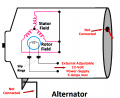
Ok I think I understand you. Just to check my understanding of your idea, is this attached drawing correct? The top drawing is a diagram I found of a regular alternator then the bottom one is what I think you mean, with the 3 pink wires shorted together. If its wrong could you please correct it?
Thanks
 

Attachments

shortbus

Joined Sep 30, 2009
10,050
A Prony Brake using a load cell is looking simpler and easier all the time for what your doing. The load cell will take the place of a regular weight scale making it adaptable to your other electronics, if that was the reason not to use a Prony in the first place.
 

LowQCab

Joined Nov 6, 2012
5,101
Ok I think I understand you. Just to check my understanding of your idea, is this attached drawing correct? The top drawing is a diagram I found of a regular alternator then the bottom one is what I think you mean, with the 3 pink wires shorted together. If its wrong could you please correct it?
Thanks
Alternator Dyno FLAT .png
 

Thread Starter

ElNormo123

Joined Nov 17, 2021
29
A Prony Brake using a load cell is looking simpler and easier all the time for what your doing. The load cell will take the place of a regular weight scale making it adaptable to your other electronics, if that was the reason not to use a Prony in the first place.
I want to eventually be able to do repeatable transient run
Thank you I think I get it now, do you think this one will work? goes up to 150A so should be capable? https://www.ebay.co.uk/itm/32406868...A%3D|ampid:PL_CLK|clp:2047675&epid=1859127970
 

LowQCab

Joined Nov 6, 2012
5,101
It will probably be fine, but keep an eye on the Temperatures.
~200C Internal-Temp is probably at the Wire-Insulation failure range.
I personally would go for the "Large-Frame" GM or Ford Alternators
since I am more familiar with them, and I know they can take a beating and survive.
Bigger is better, ( physically larger ).
I would pick one up from an Auto-Junk-Yard, from a large Truck, ~$35.oo.
.
.
.
 
Top