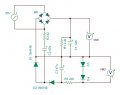
I am still not getting this. How does the negative cycle of an AC push the -ve plate of C2 below ground? Also, how can an electrolytic capacitor take negative cycle on the positive plate? Will it not harm the capacitor?On the negative half cycle on the input AC, both ends of C2 go down. This pushes the - end of C2 below GND.
Does it mean that the -ve end of C2 goes negative on both the +ve and -ve halves of an AC signal after the first charging cycle?So now on each half-cycle the - end of C2 goes negative (below GND).
Very interesting circuit. AnalogKid has already explained it thoroughly, and I agree with Bordodynov, you should download LTspice and sim it. It's an extremely useful program for this sort of exercises. And it's also very easy to learn. Drawing your circuit in it should only take a few minutes. After that, you can probe it in whatever node you're curious about, and start adding or removing or changing component values to see what happens... that sort of playing around will improve your understanding significantly.I am still not getting this. How does the negative cycle of an AC push the -ve plate of C2 below ground? Also, how can an electrolytic capacitor take negative cycle on the positive plate? Will it not harm the capacitor?
Does it mean that the -ve end of C2 goes negative on both the +ve and -ve halves of an AC signal after the first charging cycle?