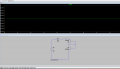
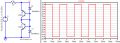
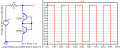
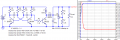
this clamp circuit not working why

Thread Starter

hhsting

Joined Apr 25, 2024
395
The emitter-base breakdown is not modelled so no clamping in simulation. It works in real life. What works is the leakage current (~5pA @ 5V), take a look at that.
How to add it so that it can simulate real
World in LTSpice?
 

0ri0n

Joined Jan 7, 2025
160
How to add it so that it can simulate real
World in LTSpice?

BVcboCollector-base breakdown voltage-
nBVcboCollector-base breakdown voltage coefficient-
BVbeBase-emitter breakdown voltageV
IbvbeCurrent at base-emitter breakdown voltageA
nbvbeBase-emitter breakdown coefficient

These parameters are part of the modified Gummel-Poon model. Try adding BVbe and Ibvbe to your transistor model.
 

Thread Starter

hhsting

Joined Apr 25, 2024
395
Ok.
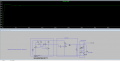
All: I added the clamper circuit to the circuit below. I have astable oscillator that generates square wave and feeds it to a boost converter that I do not want to run away so much that it gets overvoltage, so I added the clamper circuit to clamp the voltage. However, it does not clamp the voltage at OUTPUT_N009 to 6.9VDC. Why? Can you all help edit it so that it does? I have attached the astable_vibrator_1_3.7.asc LTspice as well. See the circuit below:

1757884114658.png
 

Attachments

Danko

Joined Nov 22, 2017
2,135

Attachments

Last edited:

Thread Starter

hhsting

Joined Apr 25, 2024
395
Now output voltage is clamped exactly to 6.9 V.
BTW, current, consumed from battery V1 equal 31.3 A!
View attachment 355871
I would like a solution involving discrete components only: resistors, capacitors, inductors, diodes, transistors etc. No ics, no microcontroller etc. What you show U1 is ICs. Can you do it without that and only with discrete components only?

With that said, That's a lot of current. The battery would die out quickly. Its a typical 9VDC battery. Also, the battery voltage would vary from 0V to 9V. I want 6.9VDC output between 3V to 9VDC. Can't lower the amps consumed and still get 6.6VDC at 100mA? I want the battery to last more than 11hours.
 
Last edited:

Sensacell

Joined Jun 19, 2012
3,768
You might have started this thread with the desired outcome, rather than the tail-end of your thought process.

Google buck-boost regulators.
 

Thread Starter

hhsting

Joined Apr 25, 2024
395
You might have started this thread with the desired outcome, rather than the tail-end of your thought process.

Google buck-boost regulators.
I have battery 9vdc voltage will drop below 6vdc and so i just did boost converter and boost the voltage no matter if battery has less than 6vdc or not. Can't just use linear regulator and also i don't do any ics , like regulator, no microcontroller, built everything from discrete components only. Is there a circuit where one can build buck-boost regulator from discrete components only where it can switch between boost and buck in my situation?
 
Last edited:

Danko

Joined Nov 22, 2017
2,135
I have battery 9vdc voltage will drop below 6vdc and so i just did boost converter and boost the voltage no matter if battery has less than 6vdc or not.
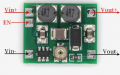
Exactly what you want, but never can DIY:
$0.59
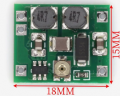
DC-DC buck-boost Converter module 3V~15V to 1V~15V 700ma/5W Automatic Adjustment Step Down/UP Power Voltage
1757907255745.png1757907018389.png
ADDED:
Really tempting, but I like to build things from discrete parts and apply engineering. So it's not the solution I was looking for.
Well, seems circuit of this module is very simple, so you can buy module,
but not use, only reverse engineer it, replace the only one integral chip
witch discrete parts and you will have unique circuit, designed yourself!
 
Last edited:

Thread Starter

hhsting

Joined Apr 25, 2024
395

Rf300

Joined Apr 18, 2025
72
A clamping circuit is the worst way to regulate a voltage. In your sample circuit it would waste (20 V - 6.9 V)/100 Ohm = 131 mA, resp. 904 mW. Does this make sense if you have a battery powered device?

Also the clamping voltage is not specified. The onsemi datasheet simply says the minimum breakdown voltage is 6 V, no typ. or max. value. So it might be 6.1 V or even 9 V - who knows. This would lead to an unsymmetrical output voltage.

I didn't watch the video in the EEV-blog, but from the comments I assume ths circuit is used as an overvoltage protection for an input pin in case of a temporary overvoltage event. The BE- junction of the transistor is reversed biased only for a short period of time, not continuously as in your circuit. Continuous reverse biasing the BE-junction will cause degradation of the transistor because it is not designed for that use case.
 
Top