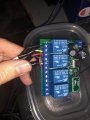
Wiring a relay board

LesJones

Joined Jan 8, 2017
4,511
From the datasheet on the relays from the component side of the board with the connector strip at the bottom and starting from the right hand terminal the NO contact is the first, the common is the second and the the NC is the third. The layout for the other three relays is the same. With NOTHING connected to the board you confirm this by measuring the resistance between the second and third teriminal from the right. It should measure close to zero ohms. You can then connect power to the board and send the command to actuate the relay nearest to the right. The meter should then indicate an open circuit. (The meter should indicate over range which is what it would display with the test leads not connected to anything and NOT touching each other. ) You can repeat this test for the other three relays.
Try swapping over the two leads from the load (Which I assume is the actuator). Does the actuator retract when the relay is actuated ?

Les.
 
Last edited:

Thread Starter

quique123

Joined May 15, 2015
405
If it really is connected as shown in your drawing, the supply negative and one side of the solenoid are connected together, making it circuit common.
It is not connected as in the diagram because when the relay is open, there should be full supply voltage between C and NO. Check your wiring.
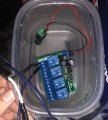
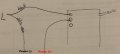
Here is a picture and diagram:
07482F0E-DF54-4EAD-823B-7A719E400085.jpeg

wiringmod.jpg
 
Last edited:

geekoftheweek

Joined Oct 6, 2013
1,429
Assuming your actuator is the type that you reverse the wires to reverse direction (I think I saw that above):

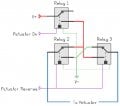
It will take three SPDT relays to operate the actuator. The first relay when turned on will be the main power supply to the actuator. The second and third relays are reversing relays. You could actually combine the two into a DPDT relay, but to stick with what you have it will take two relays to handle the reverse stroke.

Unlike air actuators that just stop when they hit the end of stroke with electricity they will try to keep going and burn up the motor. You will have to turn the power off at the end of the stroke. Easiest way is setting up some limit switches and monitoring them (unless the actuator has some built in already then someone else would have to guide you there.)

A little drawing to show what I have in my head.
actuator-relays.jpg
 

LesJones

Joined Jan 8, 2017
4,511
In the schematic in post #24 if you use relay 2 to drive an external DPDT relay you can save the channel for relay 3 for something else.
If my interpretation of the relay data seet is correct your connections are to the NC contact and the common contact so without power to the relay board there should be power to the actuator. Did you do the resistance check on the contacts that I suggested in post #21 ? I suggest that you try using a 24 volt bulb or voltmeter in place of the actuator for initial testing to avoid the actuator being at the end of it's travel with one of it's limit switches being open. (Assuming it has internal limit switches.)
I agree with Keith that you need to do some basic trouble shooting.

Les.
 

Thread Starter

quique123

Joined May 15, 2015
405
Here are the results:

10 MOhms between 2 pairs of terminals and 0.3Ohms between 1 pair:
8DBD54F2-55F9-499F-81DB-BA05E41435EC.jpeg
Of course I tested between the 3 terminals of the same channel. I just wrote the results on different channels on the image so it would be easier to "see"
 

geekoftheweek

Joined Oct 6, 2013
1,429
It may also be possible to purchase, build, or whatever a H bridge motor controller to run the actuator. That would free up relays. What are the actuator voltage and current ratings?
 

Thread Starter

quique123

Joined May 15, 2015
405
I just tested again with the multimeter. When the relay activates I get about 0.35V across the same terminals where I tested 0Ohms resistance.

I know there are 24V coming in because I put the terminals to the power source leads (the outcoming cables not just the power unit terminals) and I get 24v solid.

Here are the marked leads where I tested the 24V:
34FB9999-A5A3-4D02-B909-976AF8CE5FF7.jpeg
 

LesJones

Joined Jan 8, 2017
4,511
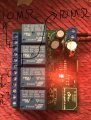
To be sure you should repeat the above test WITH NOTHING CONNECTED TO THE BOARD (As instructed in post #21.) so that we are sure that the relays are de-energised. I can see from the LED that you have power to the board so we do not know the state of the relays.

Les.
 

geekoftheweek

Joined Oct 6, 2013
1,429
Another thought...
Delete relay 1 and use a mosfet to switch the ground connection. Google mosfet as a switch and you'll get the idea. 'N' or 'low side' switching is what you are after.
 

geekoftheweek

Joined Oct 6, 2013
1,429
What happens if you switch the black and white wires?

What if you measure voltage between white and black?

The reason your meter is only showing a .35 volt drop is because you are only measuring the drop between the relay contacts if you are measuring at the screw terminals.
 

Thread Starter

quique123

Joined May 15, 2015
405
When I made the ohms testing i didnt have the board energized.

I just did more testing:

1. Unplugged the actuator and ran it directly from the 24v cables. It retracted and extended as expected, when reversing the polarity. So the actuator still works.
2. Replugged everything as before (24V+ to common & - to load & Load to NC) and activated the relay board and the actuator extended again. So the relay board works.

Ok so Id like to try a different option because its just seems inefficient that other way. What other controller could I use? I would like something simple to operate like a relay based mechanism that I can use with ble.
 

geekoftheweek

Joined Oct 6, 2013
1,429
Ok so Id like to try a different option because its just seems inefficient that other way. What other controller could I use? I would like something simple to operate like a relay based mechanism that I can use with ble.
You could use one relay to turn on the actuator power and use a second relay to run a DPDT reversing relay. It will free one relay. Not ideal, but one better.

Unfortunately beyond wiring I don't have anything else to offer. It wouldn't be very hard to build a board based on a module like one soldered on the back and program it. I haven't worked with bluetooth yet, but I have a couple wifi modules I played with that were fairly easy to learn.
 

Thread Starter

quique123

Joined May 15, 2015
405
OK I could easily add the bluetooth functionality. Is there a component board somewhere that I could control via an Arduino or raspberry in order to control the actuator and then just add ble to that?

Kinda like an l298 driver board but for 24vdc?
 

LesJones

Joined Jan 8, 2017
4,511
If the actuator has built in limit switches (Or you are prepared to add limit switches.) You could drive the actuator in both directions using 2 relays on the existing board or using by using one relay on the board driving a DPDT relay. You can test if the actuator has built in limit switches by monitoring the actuator current. If it does not have limit switches the current will increase when it reaches the end of travel. If it has built in limit switches then the current will drop to zero (Or very close to zero) at the and of travel. I was under the impression that the existing relay board was controlled by Bluetooth and you plan to control it via an app running on an Android or ios device. Can you tell us clearly what you are trying to do ? If we understand what you are trying to do we are much more likely to be able to solve your problems.

Les.
 

Thread Starter

quique123

Joined May 15, 2015
405
If the actuator has built in limit switches (Or you are prepared to add limit switches.) You could drive the actuator in both directions using 2 relays on the existing board or using by using one relay on the board driving a DPDT relay. You can test if the actuator has built in limit switches by monitoring the actuator current. If it does not have limit switches the current will increase when it reaches the end of travel. If it has built in limit switches then the current will drop to zero (Or very close to zero) at the and of travel. I was under the impression that the existing relay board was controlled by Bluetooth and you plan to control it via an app running on an Android or ios device. Can you tell us clearly what you are trying to do ? If we understand what you are trying to do we are much more likely to be able to solve your problems.

Les.
OK I'm replacing my spst ble relay board with this spdt BLE relay board

the relay board is controlled by my RPi via python scripts that sendble commands to the relay board.

I changed from my spst board which actuated a pneumatic cylinder via a solenoid because it was too noisy, to a linear actuator. What I do is simple lift a platform for any of 2 reasons :

1. Show and hide a Christmas tree from inside a crate.

2. Open the door to a done that flows out to inspect roofs and what not.

In either case the idea is to operate a platform that moves up or down. In the case of the Christmas tree that platform moves straight up and down. In the case of the drone door it hinges open and closes.

I actually thought of moving to the actuator was a double win because I would get rid of the noise and gain a free relay since the compressor used one and the solenoid-pneumatic used another. But it seems I might actually lose a relay.
 

LesJones

Joined Jan 8, 2017
4,511
Before the design can proceed you need to find out if the actuator has internal limit switches. Report back when you have done that.

Les.
 
Top