Wires through a pipe

nsaspook

Joined Aug 27, 2009
16,322
Since we're talking PVC we're not talking about potable water (drinking / cooking water). At least I HOPE we're not. If we are then that changes things a little. A CPVC pipe can be used on potable water.
That's actually a good idea. You can pre-seal one side. But the other side will have to be sealed after installation.

A couple concerns with this approach, since the thickness of the PVC is fairly thin a long bolt may interfere with the opposite side. Use of a Tee (or a 4 sided Tee with slip fit joints all four's) may work better. {{ Is this Tee thing vague? }}
I would use SCH80 pipe for direct threaded connections like was used with these SWAGELOCK fittings for a test pipe.

As for vented screw length they can be pretty small.
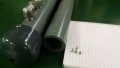
IMG_20190512_100319904.jpg
 

ebeowulf17

Joined Aug 12, 2014
3,307
I know the intended use is secret, but knowing whether it's for drinking water or not is kind of important. Many of the products discussed in this thread are NOT suitable for contact with potable water.

As for sealants holding under pressure in that beveled/chamfered hole, I'm a little skeptical. I've tried similar tricks and found that pressure variations allow a sort of pumping action, and the plug will work incredibly well for a short time before working it's way loose.

I only tried a few materials, including silicone sealants, red RTV, and a few others I can't remember. I was also dealing with higher pressure swings (0-130psi) and temps (200F,) so maybe in a milder setting it will be easier to accomplish.

Still, I think a compression fitting system of some sort is more likely to last over time.
 

Thread Starter

cmartinez

Joined Jan 17, 2007
8,762
As for vented screw length they can be pretty small.
Still, I think a compression fitting system of some sort is more likely to last over time.
I'm currently considering using a conical plastic (which could also be PVC) set screw, to which I would drill a hole in its center, and then cut a couple of lengthwise slots to allow for radial compression as it's screwed in place. Then I'd add a few drops of sealant to it when passing the cable through the hole, right before installing.

Anyway, I've still got a little time to consider all available options. Thank you all for all your input.
 

Ya’akov

Joined Jan 27, 2019
10,235
I think I would drill larger holes and use an epoxy based product with the wire in the center of the larger hole so that the epoxy forms a "plug" with the wire passing though the center.
 

djsfantasi

Joined Apr 11, 2010
9,237
I think I would drill larger holes and use an epoxy based product with the wire in the center of the larger hole so that the epoxy forms a "plug" with the wire passing though the center.
Just being anal, I’d be sure to lay a fillet of epoxy on both sides of the hole, created a rivet-like joint. Then, the epoxy plug cannot slide in either direction.
 

ian field

Joined Oct 27, 2012
6,536
I need to run a couple of 32 ga (0.009" diam) magnet wires through a 1-1/4" schedule 40 PVC pipe (wall thickness about 3.56mm, or a little more than 1/8"). Any ideas as to what is the best way to do it? Should I use a single hole for both wires and then seal it? What kind of sealing technique should I use? Or should I use a couple of screws/rivets acting as pass-through electrodes through the wall and use sealant on them? I would really like to make it work with the wires through a hole only, though.

The pipe is for domestic water use. Indoors conditions. Average pressure would be 35-40 psi, maximum 60 psi. Never as far up as 90 psi.
Most electricians call the pipes "conduit" and you can get a flat tape style springy steel thingy that you can weedle through all the bends and then pull the wire through with it.
 

Ya’akov

Joined Jan 27, 2019
10,235
Just being anal, I’d be sure to lay a fillet of epoxy on both sides of the hole, created a rivet-like joint. Then, the epoxy plug cannot slide in either direction.
I agree. I so wish there are more information, though. It's very hard to understand the constraints.
 

Ya’akov

Joined Jan 27, 2019
10,235
OK, here's a possibility. Take some pyrex tubing with an ID somewhat larger than the wire. Pull the (heated, melted) tubing so it forms a passthrough with a glass-metal seal. Use the glass to penetrate the PVC instead of the wire directly.
 

Tonyr1084

Joined Sep 24, 2015
9,744
The difference between PVC and CPVC is dimensional. PVC pipes follow the schedule numbering standard, while CPVC's dimensions are based on standard copper tubing.
Because I didn't agree with your statement I just had to look up the difference between both. I thought I heard CPVC was rated for potable water whereas standard PVC wasn't. I was wrong. However, as for dimensional matters - https://www.differencebetween.com/difference-between-cpvc-and-vs-pvc/

Honestly, I learned something here.
 

MisterBill2

Joined Jan 23, 2018
27,516
After the wires are passed through the holes and sealed with whatever sealant is selected, RTV should work, to avoid any chance of leakage flowing, use one of those external emergency pipe leak stoppers, which is a piece of soft rubber over the opening held in place by one or more stainless hose clamps, often called "Breeze clamps" by old timers, because Breeze company made them first. I have used this approach to stop a half-inch hole in an 1 1/2 inch water line in an emergency and it can work well. It will help to put a small amount of the RTV sealer on the wire before putting the rubber on top of it. No need for all of the complex and expensive methods. AND, this approach can be done quite discretely, if that matters. Drilling the holes would be the only noisy part of the operation. But if there is already water in the pipe then pulling wire that fine any distance will be very difficult, and there is no simple way to grab it with a steel fish tape. If the pipe is dry and both ends are open then you can use a shop-vac to pull the skinny wires through.
 

shortbus

Joined Sep 30, 2009
10,050
Flexseal products are great! I was also going to suggest them.
I'd probably use the seal tape. fold the wires over the outside of the pipe for a few inches and tape from that point to a few inches past the hole in all directions.

@cmartinez , Can the wire run along the outside of the pipe? And only enter where it is terminated? I guess what I'm asking is why run it through any more water than needed.
 

Thread Starter

cmartinez

Joined Jan 17, 2007
8,762
I'd probably use the seal tape. fold the wires over the outside of the pipe for a few inches and tape from that point to a few inches past the hole in all directions.

@cmartinez , Can the wire run along the outside of the pipe? And only enter where it is terminated? I guess what I'm asking is why run it through any more water than needed.
My goal is only to insert the wire through the pipe's wall. And it will be immediately connected to a device inside of it, and to a control board on the outside. So no, the wire won't run lengthwise on either side of the pipe at all. But a perfect seal is needed so as not to wet the board on the outside.
 

Ya’akov

Joined Jan 27, 2019
10,235
My goal is only to insert the wire through the pipe's wall. And it will be immediately connected to a device inside of it, and to a control board on the outside. So no, the wire won't run lengthwise on either side of the pipe at all. But a perfect seal is needed so as not to wet the board on the outside.
Does this have to be installed in an existing pipe? Does it have to be very low profile?
 

Thread Starter

cmartinez

Joined Jan 17, 2007
8,762
Does this have to be installed in an existing pipe? Does it have to be very low profile?
It has to be very low profile, but no, it will be installed in a short new pipe in which I'm assembling some things. So I have total control on where and how to arrange things.
 

MisterBill2

Joined Jan 23, 2018
27,516
Wire as thin as was originally described is both mechanicaly very fragile and additionally it can not handle very much current. So unless the assembly in the pipe is well anchored and very low powered I predict a lot of problems.
 
Top