Wires through a pipe

Thread Starter

cmartinez

Joined Jan 17, 2007
8,759
I need to run a couple of 32 ga (0.009" diam) magnet wires through a 1-1/4" schedule 40 PVC pipe (wall thickness about 3.56mm, or a little more than 1/8"). Any ideas as to what is the best way to do it? Should I use a single hole for both wires and then seal it? What kind of sealing technique should I use? Or should I use a couple of screws/rivets acting as pass-through electrodes through the wall and use sealant on them? I would really like to make it work with the wires through a hole only, though.

The pipe is for domestic water use. Indoors conditions. Average pressure would be 35-40 psi, maximum 60 psi. Never as far up as 90 psi.
 

SamR

Joined Mar 19, 2019
5,487
You're going to run magnet wire through a water pipe full of flowing water!?!? I don't think it would stay insulated very long if you did... I would at least look for a twisted 2 wire cable with an underground rated PVC jacket and I don't think you will find that in 32 AWG.
 

Thread Starter

cmartinez

Joined Jan 17, 2007
8,759
You're going to run magnet wire through a water pipe full of flowing water!?!? I don't think it would stay insulated very long if you did... I would at least look for a twisted 2 wire cable with an underground rated PVC jacket and I don't think you will find that in 32 AWG.
Yeap, that's what I plan to do. But the wire won't be carrying more than 9V through it, so we're safe on that side. Also, I'd think the wire's lacquer should protect it for quite a while, don't you agree?
 

SamR

Joined Mar 19, 2019
5,487
No because the water flow will cause the wires to move and strike each other and erode the lacquer coating shorting it out. Which is why I suggested a cable. Individually insulated wires jacketed in a waterproof outer jacket.
 

Thread Starter

cmartinez

Joined Jan 17, 2007
8,759
No because the water flow will cause the wires to move and strike each other and erode the lacquer coating shorting it out. Which is why I suggested a cable. Individually insulated wires jacketed in a waterproof outer jacket.
Thanks, but the wire won't be subjected to that sort of conditions. Direct flow of water won't be hitting it directly, as it will be protected by a small barrier. Unfortunately, I can't disclose the full details of what I'm planning to do. My only concern so far is that the chlorine in the water might attack the lacquer over time somehow, but I doubt it.
 

SamR

Joined Mar 19, 2019
5,487
I'd be more concerned about acidic pH than chlorine but chlorine is horribly corrosive also. All depends on the lacquers properties which I have no clue about. I was also going to mention the fittings that the spook pointed to. Never used them on PVC but have used them on stainless steel piping and tank walls. You will need a good tight pressure seal on the pipe wall. I would insert a tee at the insert and removal points with a fitting screwed into it.
 

SamR

Joined Mar 19, 2019
5,487
We were talking about conformal coatings on another thread and painting the magnet wire with that before insertion would improve its reliability.
 

Thread Starter

cmartinez

Joined Jan 17, 2007
8,759
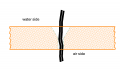
Here's what I plan to do. I'm going to drill a 1/32" hole through the pipe's wall, and run the wires through it. I'm also going to drill a small cone halfway through its wall on the water side (don't ask me how, I'll figure it out) to make it as positive a seal as can be. And then I'll fill it with as fluid a compound as I can find, to make sure that it permeates the whole thing properly.

See following illustration, which has its elements drawn to scale.

upload_2019-5-11_20-36-39.png
 

SamR

Joined Mar 19, 2019
5,487
The biggest issue other than leakage and insulating the wire is going to be snaking it into and out of existing pipes if that is where you're headed. That may be the deal breaker. Good Luck.
 

Thread Starter

cmartinez

Joined Jan 17, 2007
8,759
The biggest issue other than leakage and insulating the wire is going to be snaking it into and out of existing pipes if that is where you're headed. That may be the deal breaker. Good Luck.
I'm not worried about that, actually. This assembly is going to be used in a device I'm designing, so I' have full control on how and where to install it.
 

wayneh

Joined Sep 9, 2010
18,104
Here's what I plan to do. I'm going to drill a 1/32" hole through the pipe's wall, and run the wires through it. I'm also going to drill a small cone halfway through its wall on the water side (don't ask me how, I'll figure it out) to make it as positive a seal as can be. And then I'll fill it with as fluid a compound as I can find, to make sure that it permeates the whole thing properly.

See following illustration, which has its elements drawn to scale.

I'd be very nervous about that approach unless you find an adhesive system meant for the application. I'd use fittings to get me down to a narrow cap, put the wires through the cap using as small a hole as possible, and then fill the cap with an epoxy or suitable sealant. The net result isn't hugely different than what you've drawn but isolates where a leak might occur to a replaceable fitting and it does not damage the larger pipe.

Part of the answer to your problem is seriousness of a failure. If it's merely bad and not catastrophic, you can risk a shortcut here and there. If your upstairs hot tub is going to crash through and land on your dining room table, flooding your home while you're on vacation, that warrants a more robust solution.
 

Thread Starter

cmartinez

Joined Jan 17, 2007
8,759
Part of the answer to your problem is seriousness of a failure.
If this thing fails, it will not be too serious. I'd expect it to "weep" noticeably for a few days before it becomes a full blown runaway leak ... through a tiny 1/32" hole. The secret, I think, lies in finding a compound that effectively adheres to PVC and lacquer, simultaneously. While also remaining somewhat elastic, so as to resist changes in pressure.

As I said before, the application will be indoors. So drastic temperature changes won't happen. And that, I think, is a sealant (in the form of a paste, or caulk) worst enemy.
 
Top