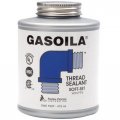
That won’t seal a hole it’s for thread. Look into an epoxy designed for pvc. I’ve had luck potting and sealing wiring for underwater use but this was sealed completely in a capsule not relying on just the insulation. Research into material used to run wires in swimming pool. It would be tolerant of chlorine and water ph. A lot of material does not last long in water. Some of it is from micro cavitation which occurs from low pressure not high pressure. High pressure just causes vacuums to occur more.
It probably won't, that's why I'm keeping my options open. I'm considering it because thread sealant would most likely be fluid enough to go through a 1/32" hole through which two 0.009" wires run through. I guess this is one of those challenges in which one has to experiment in a very structured way to find the best answer.
Thread sealant seals off by staying soft and squeezing between the thread of a screwed in joint. That’s why Teflon and plumbers putty (non hardening clay) does the same job. It’s not a glue. You need something that will hold some pressure and seal around the wires.
Is there a reason you want to put wiring through a water pipe?
Temp changes in piping mostly affect pipe length and except for long runs where expansion/contraction bends are needed is not a problem, except for freezing. Pressure/flow change is the biggest problem which in turn can cause explosive cavitation forces. PVC joints use a glue that actually dissolves and bonds the PVC. Pipe thread/dope compounds (usually Teflon) are thread fillers to seal any cavities/defects in the threads to completely fill the gap between male and female threads. Or lead based compounds to prevent thread corrosion from binding the threads making the joint impossible to unscrew. They are not pressure sealing compounds. That is the threads job. Cutting PVC to add a tee for a threaded insert such as the one NSAspook pointed to is not difficult if there is room for it to be done. Those inserts have a compressible material that the wire is fed through and then a cap to screw down that will compress the material and seal the opening. I had a water leak in my house one night that cost thousands of dollars in loss overnight. Carpets ruined, sheetrock damage, plumbing repairs, remediation, cleaning, property damage, etc. You do not want to ever experience that so be very careful.
I like threaded T with compression fitting idea if you must for some top secret reason run wires in your pipes. Even a brass insert threaded and epoxied into pvc would be better.
Maybe the wires are flow sensors... anyhow good luck and don’t make a mess
Was not familiar with "are-tee-bee", my friend, you made me google that one up ... remember you're talking to a non-native english speaker here!
Anyway. Of course I'm considering using Room Temperature Vulcanizing silicon! ... it's just that it sounds too easy to be true! ... that's why I'm (probably) getting ahead of myself, here. I want to be prepared and try different options when I finally dig my hands into this thing.
If the wire doesn’t actually have to come in contact with the water, I would drill holes in the pipe and run a piece of rigid PVC tubing through the holes and use regular PVC primer and glue.
RTV clear silicone is great for fixing leaks in aquariums and such where there is no or very low pressure. Particularly when it can be applied on the inside of the leak. Also white 3M 5200 marine sealant, but not for pressure applications. Great for fixing leaky drain pipes under the sink, not pressurized supply pipes.
No after inserting the copper or thermocouple wire the inside is injection molded with a rubberlike compound plug. It is a fixed device that you have to order with type and length of wire custom specified and molded into place.
RTV clear silicone is great for fixing leaks in aquariums and such where there is no or very low pressure. Particularly when it can be applied on the inside of the leak. Also white 3M 5200 marine sealant, but not for pressure applications. Great for fixing leaky drain pipes under the sink, not pressurized supply pipes.
I'm thinking it would depend on how you apply the RTV. If one designs a proper sealant cavity, that is, one in which the pressure actually helps make the seal stronger, it just might work.
I'm thinking it would depend on how you apply the RTV. If one designs a proper sealant cavity, that is, one in which the pressure actually helps make the seal stronger, it just might work.
The only issue with RTV is it doesn't bond to a surface very well, especially to a slick nonporous surface. It is also messy as hell to use but that is just its nature. Most of those types of compounds are messy especially on fingers and are not water soluble so lots of fun cleaning up after using. Yep that sealing gland is the ticket for wires. There is another similar one for tubing tradenamed Swagelok and it has a knockoff named Parker. Much better seal than the old flared fittings.
The only issue with RTV is it doesn't bond to a surface very well, especially to a slick nonporous surface. It is also messy as hell to use but that is just its nature. Most of those types of compounds are messy especially on fingers and are not water soluble so lots of fun cleaning up after using. Yep that sealing gland is the ticket for wires. There is another similar one for tubing tradenamed Swagelok and it has a knockoff named Parker. Much better seal than the old flared fittings.
I'm considering using a polyurethane compound instead of silicone. Such as the "No More Nails" brand. It seems to have better adherence properties. Only problem I see with it is its higher viscosity before curing, which might make it more difficult for it to flow through the small orifice.

 Facebook
 Google
 GitHub
 Linkedin