Wire garage door transmitter to car battery

Thread Starter

mikey5791

Joined Mar 2, 2025
3
Hi all forum members,
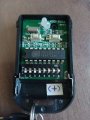
Got a 330mhz garage door transmitter which operates on 12v battery type A23 but the battery doesn't lasts. So i am planning to hard wire the transmitter to my truck 12v battery thru the cigarette lighter socket.
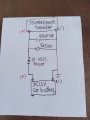
I did a rough sketch of my plan on using a 470uf 16v electrolytic cap, SR5200 (200v 5A diode), and a 50-100 ohm resistor. The resistor is to bring down the unstable 13.8-14.1 dcv battery during car running which may damage the transmitter circuit board. Fyi, my truck battery is type NX120, 90Ah with cca cranking 700 amperage. Is it necessary to add a fuse to protect from short circuit?
Kindly advice and comment to amend or improve the planned circuit. Any help will be greatly appreciated.
 

Attachments

DickCappels

Joined Aug 21, 2008
10,661
Your 50 ohm to 100 ohm resistor will only drop voltage when the transmitter is drawing current. This means that the 470 uf capacitor will charge to the voltage on the car's electrical system (more than 12V) and that is what the transmitter will see when it is turned on. To guard against the over-voltage condition, I would place a 10 volt zener (or other favorite shunt regulator -TL431 etc.) in parallel with the transmitter to assure that the 470 uf capacitor does not charge up to too high of a voltage.
 

crutschow

Joined Mar 14, 2008
38,316
I would place a 10 volt zener (or other favorite shunt regulator -TL431 etc.) in parallel with the transmitter to assure that the 470 uf capacitor does not charge up to too high of a voltage.
That's with a resistor (try 100Ω) in series with the voltage source from the lighter (after the remote switch if possible).
I would use a 12V Zener (why 10V?).
 
Last edited:

DickCappels

Joined Aug 21, 2008
10,661
That's with a resistor (try 100Ω) in series with the voltage source from the lighter (after the remote switch if possible).
I would use a 12V Zener (why 10V?).
It is likely that the transmitter will work fine at 10 volts or a little less, while the tolerance of a 12 volt zener might be a bit stressful. Just trying to stay on the safe side.
 

Thread Starter

mikey5791

Joined Mar 2, 2025
3
Your 50 ohm to 100 ohm resistor will only drop voltage when the transmitter is drawing current. This means that the 470 uf capacitor will charge to the voltage on the car's electrical system (more than 12V) and that is what the transmitter will see when it is turned on. To guard against the over-voltage condition, I would place a 10 volt zener (or other favorite shunt regulator -TL431 etc.) in parallel with the transmitter to assure that the 470 uf capacitor does not charge up to too high of a voltage.
Thanks for reply. Fyi, i connect the positive dc power side to a 10 ohm resistor and a zener diode (marking 40A,unsure what is the spec). The transmitter didn't seem to work as the dc voltage reaching the transmitter is about 9.46vdc.
 

Thread Starter

mikey5791

Joined Mar 2, 2025
3
That's with a resistor (try 100Ω) in series with the voltage source from the lighter (after the remote switch if possible).
I would use a 12V Zener (why 10V?).
Fyi, i tried with a 10ohm resistor in series with the positive voltage source from the lighter socket, but didn't put any zener. The output is about 12.3vdc, and transmitter is now working. Just need to find a suitable spot to stick on the modded transmitter.
Thank you all for kind response.
 

DickCappels

Joined Aug 21, 2008
10,661
The transmitter normally used a 12 volt battery.

That's with a resistor (try 100Ω) in series with the voltage source from the lighter (after the remote switch if possible).
I would use a 12V Zener (why 10V?).
This is after trying a 10V Zener and it not working (I still don't understand this, but ok.) Score one more for @crutschow.
 

prairiemystic

Joined Jun 5, 2018
419
I would not use a low V zener because it makes a parasite drain. At rest you get 12.5-13.2V from a car battery and you want a zener doing nothing then.
The IC SMC5326 is rated 5-15V operation and seems to use 10-25mA TX current.
I would use fuse or PTC, reverse-polarity diode and a 15V zener for transient protection, and the capacitor even 10-100uF is plenty.
I also hate the A23 batteries because they have gone cheap quality now, cells leak inside corrode poor connections etc.
 
Top