Wilson Current Mirror

Thread Starter

Сергей999

Joined Jun 9, 2022
63
And is this unrelated to the fact that Vbe depends exponentially, a small voltage change corresponds to a larger current change and therefore should be considered from the voltage position?
 

atferrari

Joined Jan 6, 2004
5,012
The reason for the duality is that the base-emitter junction looks like a forward-biased diode, so you can look at the change in collector current as being proportional to the current-change through this junction, or proportional to the log of the voltage change across the junction which generates an exponential change in junction current.
Wow! First time I read such a simple, clear summary. Thanks.
 

crutschow

Joined Mar 14, 2008
38,520
And is this unrelated to the fact that Vbe depends exponentially, a small voltage change corresponds to a larger current change and therefore should be considered from the voltage position?
Yes, to understand the current-mirror circuit you must use the voltage-to-current model of the BJT.
 
Last edited:

crutschow

Joined Mar 14, 2008
38,520
Wow! First time I read such a simple, clear summary. Thanks.
Glad it helped.
Sometimes the understanding of a device gets lost in the mathematics, which quantifies a device's operation but does not always help explain it.

There have been numerous discussions (arguments) on these forums about whether the BJT is a current or voltage controlled device.
It reality, from a black-box point-of-view, it can be looked on as either.
 

WBahn

Joined Mar 31, 2012
32,862
And is this unrelated to the fact that Vbe depends exponentially, a small voltage change corresponds to a larger current change and therefore should be considered from the voltage position?
That the relationship between Vbe and Ic is exponential is completely immaterial in terms of whether Vbe should be considered. The reason that it MUST be considered is because the first transistor communicates information to the second transistor by means of forcing the second transistor's Vbe to match it's own (that is imposed by the topology of the circuit). At the end of the day, the second transistor has no knowledge of what the current in the first transistor is -- in fact, it has no knowledge that it is even connected to a transistor.
 

Thread Starter

Сергей999

Joined Jun 9, 2022
63
Then it looks like this. In collector T3, the current was reduced using a resistor, which means that the current T1 and the potential on the collector decreased, Vbe T1 increased, which means that Vbe T2 increased and the current of its collector also increased, right?
 

Thread Starter

Сергей999

Joined Jun 9, 2022
63
Then that's it. The resistance in the collector T3 has changed, the potential of the base has changed, which changed the potential of the collector T2, which means that the potential of the base T2 has changed, which changed the potential of the base T1, as a result, the current T3 has changed, right?
 

crutschow

Joined Mar 14, 2008
38,520
Isn't it T3 that generates the output current? And then what does T3 do?
The current through T1 generates the mirror current.
The current through T2 determines the mirror current.
T3 buffers the mirror current as a common-base amplifier, and provides feedback to keep it constant with changes in T3's collector voltage.
The resistance in the collector T3 has changed,
Are you referring to the external collector resistor or the collector intrinsic equivalent resistance?
 
Last edited:

crutschow

Joined Mar 14, 2008
38,520
Then that's it. The resistance in the collector T3 has changed, the potential of the base has changed, which changed the potential of the collector T2, which means that the potential of the base T2 has changed, which changed the potential of the base T1, as a result, the current T3 has changed, right?
Changed how?
The feedback minimizes that change.
 

Thread Starter

Сергей999

Joined Jun 9, 2022
63
In the sense of change, how? The nominal value of the resistor has been changed. Well, how does feedback work, can we consider it? Here I described it.
 

Bordodynov

Joined May 20, 2015
3,431
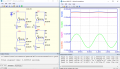
The study of the effect of resistors in emitters. Pay attention to the numbers at the bottom of the graphic window. It can be seen that the addition of resistors greatly affected the output impedance in the standard current mirror. In the Wilson current mirror, the impedance deteriorated slightly when resistors were added.

1727852035785.png
 

Bordodynov

Joined May 20, 2015
3,431
The impedance has deteriorated, but the current is holding better. Does the influence of local feedback affect?
You're wrong. The current is holding up worse. The transmission ratio is better closer to one. And resistors improve reproducibility parameters - reduce the effect of the base-emitter voltage spread.
 
Top