Will this circuit power my light definitively?

Thread Starter

Sgulin

Joined Nov 1, 2018
4
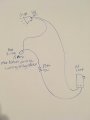
Here is a photo of my circuit with all the numbers. Will it work? I calculated everything but my main concern is the resistor (just found out resistors have wattages, I was about to use a 1/4watt) and the reed switch “working voltage dc100” no idea what that means.
 

Attachments

WBahn

Joined Mar 31, 2012
32,917
I can't tell for sure, but it looks like you are saying that the light is 12 V, 6 W. Is that correct? What kind of light? Incandescent? LED?

If so, then it would draw about 0.5 A when connected directly to a 12 VDC power source (possibly quite a bit more for a fraction of a second at power on). So you would not need (nor want) a resistor in the circuit. If your circuit is going to draw 0.5 A, it would be a good idea to use a reed switch rated for significantly more than that -- at least twice.

The 100 VDC rating on the switch is a measure of the maximum open circuit voltage it is rated for. If you exceed that rating, then it is possible to get and potentially sustain an arc across the contacts when it opens.
 

Thread Starter

Sgulin

Joined Nov 1, 2018
4
It looks like it might work but:
What kind of 12V light is it?
Why the resistor?
Is the 12V from the wall wart regulated?
It’s a halogen bulb
I thought I needed a resistor because the power supply is a dc 12v 2amp output and the reed switch has a max current of .5 amps
 

Thread Starter

Sgulin

Joined Nov 1, 2018
4
I can't tell for sure, but it looks like you are saying that the light is 12 V, 6 W. Is that correct? What kind of light? Incandescent? LED?

If so, then it would draw about 0.5 A when connected directly to a 12 VDC power source (possibly quite a bit more for a fraction of a second at power on). So you would not need (nor want) a resistor in the circuit. If your circuit is going to draw 0.5 A, it would be a good idea to use a reed switch rated for significantly more than that -- at least twice.

The 100 VDC rating on the switch is a measure of the maximum open circuit voltage it is rated for. If you exceed that rating, then it is possible to get and potentially sustain an arc across the contacts when it opens.
That’s correct. It’s a halogen light. I thought since the power supply puts out 2amps and the reed switch can only take .5 max then it needed a resistor. Additionally I couldn’t find reed switches on Amazon rated for more then .5 amps
 

DickCappels

Joined Aug 21, 2008
10,659
It looks fine. I would leave the resistor in the circuit to limit peak current, especially when the lamp filament is cold.

You might find that the lamp is too dim because of the resistor. If that is a problem, then you can put a MOSFET in place of the reed switch and use the reed switch to control the MOSFET.
 

WBahn

Joined Mar 31, 2012
32,917
It looks fine. I would leave the resistor in the circuit to limit peak current, especially when the lamp filament is cold.

You might find that the lamp is too dim because of the resistor. If that is a problem, then you can put a MOSFET in place of the reed switch and use the reed switch to control the MOSFET.
With JUST the resistor in the circuit, the current would be 0.5 A. So with the lamp also in the circuit, how much voltage will be available to drive current through the bulb?

I would think that the resistor would limit the power delivered to the bulb to be 10% to 20% of it's rated power and I wouldn't be surprised if that didn't drop the temperature of the filament so low that it emitted little or no visible light. I could be very wrong and would be interested in knowing either way.
 
Top