Facebook
 Google
 GitHub
 Linkedin

Hi!
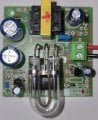
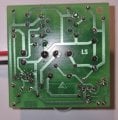
I have two driver boards for xenon flash light. I received them faulty, with some signs of previous repair attempts. For learning purposes I am also trying to fix...
Some notes:
The power supply part seems to be a self oscillating flyback type to me. Something similar described in this topic:
https://forum.allaboutcircuits.com/threads/simple-rcc-flyback-switching-power-supplies.170463/
The BC639 transistor were surely faulty, which I replaced several times, but after applying the supply voltage starting from low voltage and turning up towards 24V at some higher voltage, the current suddenly shoots up and the transistor smokes again and again. Till this happen I don't see any oscillation activity starting so probably the transistor does not turn off.
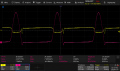
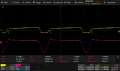
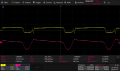
I tried to build the power converter part of the circuit on a breadboard without the right part of the circuit (only till C8, omitting anything else to the right) and it starts to oscillate but at around 160kHz and no significant output voltage is produced on the secondary. Only a few volts.
The 160kHz seems to be a bit much, since testing the transformer standalone from a sig.gen. it seem to produce the higher output on the secondary somewhere about 20-25kHz.
But I cannot make the oscillating frequency lower than 110kHz by changing some part values. Oh, and it only works if I omit also the C5 capacitor. When I add it it does not oscillate, like in the PCB.
Maybe this oscillation starts with some parasitic effects caused by the breadboard or I don't know. But probably this is not how it was designed to operate
Any idea how I should progress with the investigation? What could be the error or what should I check/test?
Really would appreciate any help/guidance. Thanks!
(Btw the ltspice simulation more or less works...)
I have two driver boards for xenon flash light. I received them faulty, with some signs of previous repair attempts. For learning purposes I am also trying to fix...
Some notes:
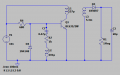
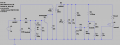
- I rev. engineered the circuit board and put it into ltpice (hope I did it right). Since I did not found any xenon flash model, I replaced it with a voltage dependent switch and a resistor on the drawing on the right.
- I don't have any clue if the board was working at all anytime
- I don't know if the part types or values are the original ones or due to the previous repair attempts
- Transformer windings are measured with LCR meter, but don't know how to incorporate into the model the core properties (I took apart one of the power supply transformers, and it had around 40-50 windings on primaries, and around 900 on high voltage secondary side. I have the more precise notes somewhere...)
- The PCB had a marking PULSAR24V from which I suspect, that it was designed to be supplied from 24V (probably DC, though it has a diode at the power input terminal, but probably for polarity protection)
The power supply part seems to be a self oscillating flyback type to me. Something similar described in this topic:
https://forum.allaboutcircuits.com/threads/simple-rcc-flyback-switching-power-supplies.170463/
The BC639 transistor were surely faulty, which I replaced several times, but after applying the supply voltage starting from low voltage and turning up towards 24V at some higher voltage, the current suddenly shoots up and the transistor smokes again and again. Till this happen I don't see any oscillation activity starting so probably the transistor does not turn off.
I tried to build the power converter part of the circuit on a breadboard without the right part of the circuit (only till C8, omitting anything else to the right) and it starts to oscillate but at around 160kHz and no significant output voltage is produced on the secondary. Only a few volts.
The 160kHz seems to be a bit much, since testing the transformer standalone from a sig.gen. it seem to produce the higher output on the secondary somewhere about 20-25kHz.
But I cannot make the oscillating frequency lower than 110kHz by changing some part values. Oh, and it only works if I omit also the C5 capacitor. When I add it it does not oscillate, like in the PCB.
Maybe this oscillation starts with some parasitic effects caused by the breadboard or I don't know. But probably this is not how it was designed to operate
Any idea how I should progress with the investigation? What could be the error or what should I check/test?
Really would appreciate any help/guidance. Thanks!
(Btw the ltspice simulation more or less works...)