Don't you keep your order records? For me, it's my e-mail database. If I can remember what it's called, I can find the details of anything I've ordered in over a decade. (Yeah, the database is kinda big.) Short of that, I'd say get your micrometer out.
Don't you keep your order records? For me, it's my e-mail database. If I can remember what it's called, I can find the details of anything I've ordered in over a decade. (Yeah, the database is kinda big.) Short of that, I'd say get your micrometer out.
Ordered from ebay but it is a generic description now after all of this time. No details on exactly what was ordered.
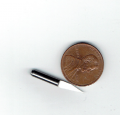
I am measuring .32 mm with my cheapie micrometer and that is about what I have entered as a tool diameter for the last time I used pcb gcode a year ago.
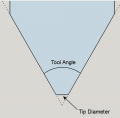
I may misunderstand but isn't the thickness of the router blade (the z-axis perpendicular to the screen when viewing your drawing above) far more than that?
No you don't mill that deep. There is a calculator out there (don't have it handy right now) that tells you the actual width based off the width of the tip and angle of the bland and depth being cut.
It is not the depth of the cut. It is the width I need to know. The isolation software needs to know how many passes it will need to make. Of course I can still experiment.
Just know a vernier , digital, dial or a true vernier is still easier to not get the correct feel with it when measuring. And just being "digital" doesn't make them any more accurate, just easier to read.
Even knowing the 'width' of the tip on those type cutters doesn't mean that's how wide they will cut. A test cut at depth of cut is a better and probably the only way to really know. Those "D" engraving cutters are not held to the same standards as an end mill. A little off center with the grind will make the path of cutting edge rotation eccentric giving a larger than expected cut.
Just know a vernier , digital, dial or a true vernier is still easier to not get the correct feel with it when measuring. And just being "digital" doesn't make them any more accurate, just easier to read.
Even knowing the 'width' of the tip on those type cutters doesn't mean that's how wide they will cut. A test cut at depth of cut is a better and probably the only way to really know. Those "D" engraving cutters are not held to the same standards as an end mill. A little off center with the grind will make the path of cutting edge rotation eccentric giving a larger than expected cut.
It was a one-off a while ago, I still have a photo of it somewhere, if I find it I will post.
It was not the self powered type, so I coupled a small H.S. DC motor to it.
Max.

 Facebook
 Google
 GitHub
 Linkedin