Controlling pulse width AND space width independently using 555 timer

Thread Starter

Enough2Bdangerous

Joined Nov 24, 2024
3
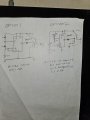
So just to be up front I am not an engineer just a hobbiest who knows just enough! I am trying to make a 555 timer circuit that allows me to control both the pulse width and the space width independently, with the output driving a relay which drives a small DC motor. I attached two options for my circuit as I can't find any thing on line that answers whether I run R1 and R2 in series as in Option 1, or if I break them out into two RC networks as in option 2. Any help is greatly appreciated.timer schematic.jpg
 

boostbuck

Joined Oct 5, 2017
1,032
Option 2 wont work - pin 7 is the discharge path for the timing capacitor that pins 6 and 2 measure the voltage on.

You can't separate the capacitor like that.
 

crutschow

Joined Mar 14, 2008
38,316
Neither of those circuits will do what you want.

The easiest way to get completely independent frequency and plus width is to use two 555's.
One is configured as an astable to generate the variable frequency, which triggers the second configured as a one-shot to give the variable pulse-width.
 

LesJones

Joined Jan 8, 2017
4,511
Use two 555s. Use the first one in astable mode. This will set the period of the PWM signal. Use the second 555 as a monostable. This will set the pulse duration. NOTE changing the PWM period will change the PWM duty cycle as the off period of the PWM wave form will decrease as the pulse period is decreased.
If you don't want the duty cycle to change when the period changes I suggest starting by generating a variable frequency triangular wave . Feed this triangular wave into one input of a comparator and feed the other input on the comparator from a variable voltage. The value of this voltage will set the duty cycle of the PWM waveform. The PWM signal comes from the output of the comparator.
Les.
 

Thread Starter

Enough2Bdangerous

Joined Nov 24, 2024
3
Neither of those circuits will do what you want.

The easiest way to get completely independent frequency and plus width is to use two 555's.
One is configured as an astable to generate the variable frequency, which triggers the second configured as a one-shot to give the variable pulse-width.
My apologies - I neglected to supply the info that this can be manually triggered once then must re-trigger itself till turned off. I got the circuit from a you tube video about making a light flasher which led me to believe that changing the value of R2 would lengthen or lessen the space width. Retriggering was driving me nuts as my understanding is that pin 2 must see a high dropping low and rising again. Thought about using two 555's but never considered an astable driving a one shot. If I wanted my space width to be controllable via POT between 15 and 30 seconds and my pulse width between 5 and 12 seconds that is simply resistance and capacitance calcs right?
 

crutschow

Joined Mar 14, 2008
38,316
If I wanted my space width to be controllable via POT between 15 and 30 seconds and my pulse width between 5 and 12 seconds that is simply resistance and capacitance calcs right?
That's correct, as long as they are within the limits of the capacitor and 555 bias and leakage currents.

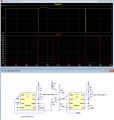
Below is the LTspice sim of an example two 555 circuit:
Pot U3 controls the frequency and pot U4 the pulse width.

1732763926480.png
 
Last edited:

sghioto

Joined Dec 31, 2017
8,633
If I wanted my space width to be controllable via POT between 15 and 30 seconds and my pulse width between 5 and 12 seconds that is simply resistance and capacitance calcs right?
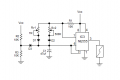
Correct. The option #1 in post 1 will work, you don't need two 555 chips.
The problem with that configuration is that the two controls interact with each other.
Another issue with long timing delays is that when first powered up C1 has to charge to 2/3 Vcc before the output goes Low.
What this means is the first ON cycle is appx twice as long.
This version eliminated both issues.
When power is applied C1 charges rapidly to appx 1/3 Vcc to start the first timing cycle correctly.
Rv1 sets the ON time for the relay and Rv2 sets the OFF time.
1732767294156.png
 

sghioto

Joined Dec 31, 2017
8,633
I don't think that is his intention.
My interpretation is a timer with independent on and off times.
It's controlling a relay.
 
Top