Why V(t) = 0 at t=0+?

Thread Starter

jvcerbino

Joined Nov 21, 2024
1
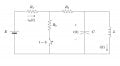
the switch opens at t=0. the circuit is in permanent regime at t=0-. Why isn't V(t) in t=0- the same voltage as the r2 and r3 resistors? Since at t=0- they are all in parallel, and V(t 0-) = V(t 0+).
 

Attachments

WBahn

Joined Mar 31, 2012
32,883
What is the voltage across an ideal inductor in steady state (what you are calling "permanent regime")?

Aside from that, you're reasoning about v(t) and R2 and R3 is very faulty.

Yes, R2 and R3 are effectively in parallel at t = 0-, but this is NOT v(t). The capacitor is NOT in parallel with either R2 nor R3. The fact that you recognize that R2 is effectively in parallel with R3 should scream out to you that v(t) has to be zero at that point. For R2 and R3 to be in parallel, the right side of R2 has to be connected, and hence at the same potential, as the bottom of R3. But the top of C is connected to the right side of R2 and the bottom of C is connected to the bottom of R3. But we've just established that these two points are at the same potential, so what is the potential difference across C?
 

MrAl

Joined Jun 17, 2014
13,709
the switch opens at t=0. the circuit is in permanent regime at t=0-. Why isn't V(t) in t=0- the same voltage as the r2 and r3 resistors? Since at t=0- they are all in parallel, and V(t 0-) = V(t 0+).
Hi,

I do not think your question is clear enough for anyone to understand immediately.
I'll abbreviate V(t) as just "V" so we can write V(0-) or V(0) or V(0+).

When you say "they are all in parallel", I think what you mean is that C is in parallel with L and the two resistors in series R2 and R3 are in parallel to both L and C. So we have the sum Rx=R2+R3, then in parallel we have C, L and Rx at t=0-.
That would mean that the voltage across Rx is the same as the voltage across both L and C at t=0-, so V(0-) is the same across Rx, L, and C.

So then why are you asking the question about why that "isn't" true?
Did you mean to ask about the voltage V(0+), which is the voltage across L and C versus the voltage across Rx at t=0+ ?
That could be entirely different because then R3 isn't even in the circuit anymore, and you should calculate that.

Not sure if you have not done this yet, but you should calculate the initial current in the inductor, and the initial voltage across the inductor, and the initial voltage across the capacitor ( that's at t=0- ). The initial voltage across the inductor should be easy to figure out.
 
Last edited:
Top