Stop trying to jump ahead, and simply answer @ericgibbs question. He is only asking what Rc should be. Can you you answer that? (Hint: You do not need Hfe to answer it).
There's only one value of Vd for a given I, so R=(Vin-Vd)/I
For transistors, you need to design so that variations in Hfe make very little difference to the outcome.
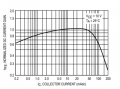
Firstly inspect the Hfe v. collector current graph and operate the transistor with a collector current that corresponds to a nice flat bit of the curve, so that variations in collector current don't change Hfe much.
You can get base current by dividing collector current by Hfe - the datasheet will give minimum and maximum values of Hfe, so you can get a worst-case value for base current and a best-case value. For a 1mA collector current, the transistor will probably take a base current around 10uA. If you make sure that the current in the resistors that connect the base is about 100uA then a change in the base current itself of 1 or 2uA will make very little difference to the overall outcome.
Transistors are quite imprecise devices, parameters vary all over the place, but it is still possible to make some very precise amplifiers!
So if I choose Ic = 5mAdc then Hfe (normalized) = 1 so:
\[H_{fe} = 1 \cdot [800 - 420] + 420 = 800\]
Question 2: How would you approach the following?
I still have too many unknowns: I1, I2, Vb, Vce, and all the resistors that I primarily want to find.
If I only could assume some I1, I2, and Vb I could calculate R1 and R2.
But still, I wouldn't be able to calculate Rc and Re since Bce is unknown.
So in order to solve for all the resistors, except for Ic and Hfe, I need to know I1, I2, Vb, and Vce as well.
How do I choose all of that?
I don't know but it is supposed to be known. Let's say 5.25Vdc (since I have it in my lab so I can do a real experiment and measurements on a Breadboard.)
Rc, I want to figure out its value as shown in my post #24
My first goal is to figure out the resistors based on an Ic that I want to achieve (Let's say Ic=5mAdc).
I don't know but it is supposed to be known. Let's say 5.25Vdc (since I have it in my lab so I can do a real experiment and measurements on a Breadboard.)
Rc, I want to figure out its value as shown in my post #24
My first goal is to figure out the resistors based on an Ic that I want to achieve (Let's say Ic=5mAdc).
It really depends upon what the circuit will do in the system.
Things to decide are:
The circuit output impedance (as determined by what the output is driving)
The output maximum signal voltage (which affects the needed supply voltage)
The circuit desired gain
The frequency response
The signal source impedance
The circuit power consumption.
Once you decide on those values (or if they are a don't care), then you can start selecting component values.
You can't design a circuit without at least some minimal requirements for its performance.
It really depends upon what the circuit will do in the system.
Things to decide are:
The circuit output impedance (as determined by what the output is driving)
The output maximum signal voltage (which affects the needed supply voltage)
The circuit desired gain
The frequency response
The signal source impedance
The circuit power consumption.
Once you decide on those values (or if they are a don't care), then you can start selecting component values.
You can't design a circuit without at least some minimal requirements for its performance.
The circuit output impedance (as determined by what the output is driving)
a) Is this \( Z_{out} = \frac{V_{out_{ac}}}{I_{out_{ac}}} \) that we are learning in theory and sometimes even use it in the Thevenin equivalent as Zthevenin?
The signal source impedance
The same thing right? \( Z_{in} = \frac{V_{in_{ac}}}{I_{in_{ac}}} \)
Question 2:
The circuit desired gain
\( gain = \frac{Vout_{ac}}{V_{in_{ac}}} \) This is the gain right?
Question 3:
The frequency response
I don't think I know how to calculate that. I need to research it.
Question 4:
The circuit power consumption.
I don't really know how to calculate that since in classes we only calculate the power on specific components.
Is it \( P_{system} = V_{out} \cdot I_{out} \)? Or I must sum all the powers of each power component which sounds
cumbersome.
Well, you somewhat missed my point.
Schools teach mostly about analyzing circuits, not synthesizing them, but you are trying to synthesize one, which is a different and more complicated process.
Those items on my list are not for you to calculate, but to be specified as part of the design synthesis.
For example my note on circuit power is how much you would like the circuit to use, not how to calculate it.
The tough part of the design is often specifying exactly what you need.
It you don't know what the circuit is supposed to specifically do, than it's not possible to design it, even if you have all the analysis equations you need.
I just thought that if I design a circuit and thinking that I want for example gain = -a, Zout=bΩ, Ic=cmA etc with known a,b,c,etc values then I could do the math to figure out the resistances that I must use in order to achieve these values.
I want for example gain = -a, Zout=bΩ, Ic=cmA etc with known a,b,c,etc values then I could do the math to figure out the resistances that I must use in order to achieve these values
Yes, In theory you could do those calculations for any random value of a, b, c, etc. but you will likely have an amp that cannot be built with real components.
To babaliares:
As I have mentioned already in my post'6 - at, first, I think it is really necessary to understand the working principle of the gain stage (before starting componenet selection). Let me explain:
* Normally, we start (power supply values given) with a SELECTION of the DC collector current Ic. Why?
Answer: Because the desired voltage gain depends on this quiescent current Ic.
* Why on Ic? Because the gain expression contains the transconductance gm which is nothing else than the inverse slope of the
control function Ic=f(Vbe).
And the slope of this function depends, of course, on the selected DC value (because it is an exponential function.) There is a very simple formula for the transconductance: gm=Ic/26mV (app. for room temperature).
* The voltage gain depends on THREE quantities only: The collector resistor Rc and the transconductance gm and the amount of signal feedback (if available).
During selection of suitable values for Rc and Ic you must not forget that the DC voltage drop Ic*Rc is limited by the available power supply voltage Vcc (rule of thumb: Ic*Rc app. 50% of Vcc).
* As a second step you can select a DC stabilizing emitter resistor Re (causing DC negative feedback with Re~0.1Rc) as well as the base circuitry - corresponding to the desired collector current Ic with consideration of the base current Ib=Ic/B and assuming Vbe~0.65...0.7V .
* Best results can be obtained with low-resistive voltage divider at the base node which an provide a base voltage of Vb=Vbe+Ie*Re.
The (small) values of the divider resistors R1 and R2 should be selected (lower limit) with respect to power consumption and total input resistance of the stage.
* (Hint: The exact value for the required base-emitter voltage Vbe is unknown, but assuming a value within the mentioned range is sufficient because of DC feedback caused by Re. The feedback effect makes the whole circuit less sensistive to this uncertainty.)
* Rule of thumb: Divider current Id at least 10 times the base current Ib (Id>10*Ib). Under this condition you can - in many cases - neglect the existence of the base current for a first rough calculation (which goes through the upper divider resistor).
This is allowed with respect to all other uncertainties within the design (uncertainty of Vbe, parts tolerances).
1) Why is the I(Rout) current constant? Shouldn't it be ac? I only found one way to explain this:
a) The ac starts only in the collector's path (after vout, Rc node).
b) The Iac(R1) will not split because Vcc is shorted in AC analysis so Iac(R1) will fully go into the ground.
c) This means that I(Rc) will be fully DC.
d) Which means that when Idc(Rc) splits, one current will be the I(Rout) = 26mA and the other will lift Ic up.
The emitter's current is also dc is this normal?
1 is also explaining why I(Rout) and Vout are zero in the first image. It's because there is only dc there so the capacitor
blocks it.
So what am I missing? Am I taking the wrong node as output?
It is quite simply that small values of capacitance do not pass much of the input signal so it may look like the output is a constant DC, the point where it is biased to.
The value of the cap is relative to the frequency. For very low frequencies you need a higher value cap, for higher frequencies a much lower cap.
It also depends on the input resistance of the DC part of the input, which means the bias resistors come into play also. So 1uf with 100megohm bias resistors (if that were possible) may work ok but with 1k bias resistors probably not.
The math behind it is not too complicated although it is best done using complex numbers.
The impedance of a cap in series with a resistor is:
Z=R+1/(j*w*C)
where w=2*pi*frequency,
and a very very very rough approximation that works in some cases is:
Z=R+1/(w*C)
but the complex calculation is better.
The voltage divider case is what you are seeing here, and that is:
Vout=Vin*R/(R+1/(j*w*C))
and if we simplify that into the amplitude, we get:
Vout=Vin*(w*C*R)/sqrt(w^2*C^2*R^2+1)
and in this expression if we make C very small we see Vout go to a very low value possibly near 0 volts.
In fact, if we set C=0 we get Vout=0 which means NONE of the AC input voltage was passed to the input stage and that means the output will not show any change.
Set that C higher however, and we see Vout (AC) change, it will go up, and the larger the value of C the closer it gets to the maximum value it can attain.
Try some different values to get a feel for how this works and work through the math it will be very enlightening.

 Facebook
 Google
 GitHub
 Linkedin