Why is there reverse installed diode in the begining of power supply?

Thread Starter

UnnamedUser159

Joined May 3, 2016
501
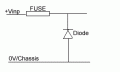
I have one automotive car audio here and have buyd new IC for it. If i follow the simple entry of the device the 12v are going though the fuse first and after it there are about 12v. On this point there are cathode of one diode and one pin of inductor.
On the other pin of the inductor i see again that 12v but at anode of the diod there is nothing.
One diode should conduct from anode to cathode right? Why it`s installed this way in begining of powering one device? Feedback ?

The scheme is simple but if needed will attach photo when my phone is charged.

thanks
 

LesJones

Joined Jan 8, 2017
4,524
Your statement "but at anode of the diod there is nothing." is not clear. Do you mean that the anode of the diode is connected to the supply negative (Ground. ) ? If this is the case then the diode is for reverse polarity protection. If the polarity is reversed the diode will conduct causing the fuse to blow. (Assuming that some idiot has not fitted a fuse with too high a current rating.) This method avoids the 0.7 volts taht would occure with a series connected diode.

Les.
 

Thread Starter

UnnamedUser159

Joined May 3, 2016
501
Your statement "but at anode of the diod there is nothing." is not clear.

There is not voltage

Do you mean that the anode of the diode is connected to the supply negative (Ground. ) ?

Just the + of power supply goes first though one fuse and on its second pin is cathode but not anode
 

mcgyvr

Joined Oct 15, 2009
5,394
As stated a diode near the input is typically for reverse polarity protection should you hook the - and + leads backwards..
 

MisterBill2

Joined Jan 23, 2018
28,059
Very specifically, what reverse protection means is that if the polarity of the supply is connected backwards then the diode is supposed to conduct and pop the fuse, thus preventing anything else from being damaged. That is what it is for. Thus it is vital to not put a larger current fuse in.
 

-live wire-

Joined Dec 22, 2017
959
It is kind of a stupid design though. They should instead use a MOSFET. The thing is, the fuse may not blow fast enough and you do not want to constantly have to replace fuses. Maybe even solder in a mosfet with resistors, etc. in place of it.
 

joeyd999

Joined Jun 6, 2011
6,441
They should instead use a MOSFET.
But a MOSFET may require heatsinking depending on the max board current. That could require a significant amount of board space for a component that does absolutely nothing except during a very rare -- or never occurring -- fault condition.

It is kind of a stupid design though.
Careful: there have been times when I thought a particular design was "stupid". But then a discussion with the designing engineer sometimes revealed brilliance from which I learned.
 

wayneh

Joined Sep 9, 2010
18,135
Careful: there have been times when I thought a particular design was "stupid". But then a discussion with the designing engineer sometimes revealed brilliance from which I learned.
Agreed. A diode like that might cost, what, 3¢ to an OEM? If you can design a reverse polarity protection circuit for less than that, go for it.
 

-live wire-

Joined Dec 22, 2017
959
The genius is that it explodes when connected backwards, and you will never make that mistake again due to the injuries. You will kill far less boards in the future, that way.
 

Externet

Joined Nov 29, 2005
2,663
Boards would be killed anyway after the capacitor explodes, as reversed polarity is still present, destroying all semiconductors.

Murphy's law clearly states "Expensive electronic equipment destroys itself to protect its fuse"
 

ian field

Joined Oct 27, 2012
6,536
Boards would be killed anyway after the capacitor explodes, as reversed polarity is still present, destroying all semiconductors.

Murphy's law clearly states "Expensive electronic equipment destroys itself to protect its fuse"
I've seen copper tracks sacrifice themselves to save the fuse.
 

k7elp60

Joined Nov 4, 2008
562
In my opinion the reverse diode is adequate. because the diode is conducting in the forward direction which instantly lowers the reverse voltage to the voltage across the diode junction, and the fuse will blow or open provided it has the proper operating voltage. Some fuses will not open if overloaded by current if the fuse in the circuit has a higher working voltage than specified for the circuit.
 

kubeek

Joined Sep 20, 2005
5,796
Some fuses will not open if overloaded by current if the fuse in the circuit has a higher working voltage than specified for the circuit.
Is this some anecdotal experience, or do you have something more substantial information? I ask because even railway signalling which is one of the most stubborn and strict areas I have encountered takes a fuse as a component that if you exceed the specified I2t it will become an open circuit, allways and completely.
 
Top