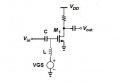
With AC signal applied, then there is a fraction of input voltage drop in inductor.
\(V_{in}= V_{GS} + V_{L}\)
Do you mean that it used in AC signal to put AC signal to gate of transistor?
You've basically got it. Without the inductor, the gate voltage is simply Vgs and the input signal can't affect it. Whatever current is pushes/pulls through the capacitor goes straight to the Vgs source. The inductor let's the high frequency signals from the input get to the gate while letting the low frequency signals from the bias source get their too.
Without the inductor, both Vin and Vgs are connected to the gate with different voltage. Then how do you know the gate voltage is Vgs not Vin?
And is there a short circuit that happens in this case?
The AC would be shorted to ground in the bias source.
The inductor, or choke provides a high impedance to the AC source as well as providing a low resistance path for the gate bias voltage.
Without it there would be no AC signal on the gate.
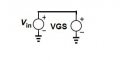
I meant as the picture bellow. Vin and Vgs are connected to the gate and they have the different voltage.
I mean what happen when a AC source and a DC source are connected in parallel without any resistor.
The AC would be shorted to ground in the bias source.
The inductor, or choke provides a high impedance to the AC source as well as providing a low resistance path for the gate bias voltage.
Without it there would be no AC signal on the gate.
The AC would be shorted to ground in the bias source.
The inductor, or choke provides a high impedance to the AC source as well as providing a low resistance path for the gate bias voltage.
Without it there would be no AC signal on the gate.
Yes I can...
There is no AC signal because the gate bias supply will shunt the AC to ground unless the bias is decoupled by some means a choke is not the only way to accomplish this you could also use a high value resistor. with the end connected to the gate bias source bypassed with a cap...
Yes I can...
There is no AC signal because the gate bias supply will shunt the AC to ground unless the bias is decoupled by some means a choke is not the only way to accomplish this you could also use a high value resistor. with the end connected to the gate bias source bypassed with a cap...
Without the inductor, both Vin and Vgs are connected to the gate with different voltage. Then how do you know the gate voltage is Vgs not Vin?
And is there a short circuit that happens in this case?
There are a number of ways of answer this question.
A1) You don't know the gate voltage precisely because you have two sources tied together, and hence all bets are off and you can neither analyze the circuit nor predict its behavior.
A2) There really isn't a short -- remember the input capacitor. So you have a source tying the gate to Vgs and the input signal just charges and discharges the capacitor.
A3) The gate voltage will vary to some degree with the signal since the Vgs source has some output impedance associatated with it. In the case of a gate bias network, the impedance might be considerable. But it is also unknown. Similarly, the signal source has an output impedance -- possibly also considerable and definitely also unknown. So while the circuit may well work reasonably okay, we still can neither analyze it nor predict it's behavior.
At the end of the day a voltage source is a voltage source and at any moment in time the outputs combine via the properties of the circuit network connecting them to produce the voltage at any paritcular point in the circuit.
Do this. Take in input signal and apply it to one side of a capacitor and tie the other side to ground. What affect does the input signal have on the voltage of the ground? Now tie tha other side to the positive side of a battery Ithat has the other side tied to ground). What affect does the input signal have on the voltage of the battery? Now swap out the battery with a DC voltage source called, oh, how about Vgs. What affect does the input signal have on the voltage of the source?
You really, really, REALLY need to spend some serious time and effort learning basic circuit fundamentals and analysis. You are going to be hindered, haunted, and handicapped until you do. This site has a decent E-book to help you along.

 Facebook
 Google
 GitHub
 Linkedin
 15.9 KB Views: 57