Tumble Dryer not heat, replaced most parts!

Thread Starter

mullingover

Joined Nov 25, 2025
44
Hi all,

This is a long shot as I have scoured the internet and found nothing useful for a Whirlpool AWZ3428 tumble dryer but I expect all machines have a similar configuration. I have repaired it successfully before, but this time no luck. It all runs, but no heating.

What's happened in order:
1. main control board blew a component. So I got a new one of these: https://www.sos-accessoire.com/cart...t-laden-ignis-proline-481221470915-20152.html
2. Tumble dryer wouldn't heat, error lights saying "clean filter". All completely cleaned, defluffed and clear flow to outside and humidity detector strips inside the drum well connected and cleaned.
3. Tumble dryer STILL wouldn't heat, error lights saying "clean filter". I replaced the thermostat that checks temperature flow (to help it know if things are possibly blocked): https://www.sos-accessoire.com/sond...laden-ignis-kitchenaid-481225928863-7278.html
4. Tumble dryer STILL wouldn't heat, error lights saying "clean filter". I read that the other control board related to humidity detection may need replacing. So I replaced it: https://www.sos-accessoire.com/modu...aden-ignis-kitchenaid-481223958063-11341.html
5. Tumble dryer STILL wouldn't heat, error lights saying "clean filter". By this stage the only thing logical to replace was the heater itself. So I did: https://www.sos-accessoire.com/resi...rlpool-bauknecht-laden-481225928949-7473.html
6. Machine worked perfectly!! For...er....a SINGLE cycle! Now it appears to run normally, no error lights, but NO HEAT.

Also done the reset sequence from the control board (turning dial, pressing 3 times on "start", etc).

For the life of me, I cannot see what else can cause this. I am far from an expert and it must look comical I have all these new parts, but to date changing items had kept this machine going 5 years longer than most. Maybe there is a surge of power to the heater causing one of its thermofuse things to flip and not reset? Or is there some other mysterious part I am not thinking of?

Thanks for any advice!
ps, house wiring modern, safe, earth and with circuit breakers.
 
My sample-of-1 experience:

  • 1980s dryer. (no control boards; different from yours)
  • Fails NO HEAT ten years ago.
  • Interweb says to ohm-out what you call the "thermofuse" and shows OPEN for me.
  • Search for "Dryer Thermal Fuse" and buy a 3-pack from Amazon.
  • Works just fine ever since.

The thermal fuse is a piece of wire with a very low melting point. (Visualize low-temperature solder.) Hot air -- not a high current -- melts it. These fuses open when the hot air from the heater (mine is 3500W) does not flow through the tumbler and out the exhaust vent. It is a safety feature that prevents lint from getting hot enough to catch fire. Now, we maintain the lint filter a lot clearer than before. (We clean the lint filter before every use. I still remember the huge amount that we would pull out every month when the alarm went off. Much more disciplined today.)

Your newer machine must have some kind of intelligence that understood a low air-flow and high-temperature condition that was apparently sufficient to melt the thermal fuse, and then recorded some kind of fault code.

Anyway, one person's free advice ........
 
Last edited:

wayneh

Joined Sep 9, 2010
18,135
There is a service manual. I only found it on one site that wants 5.95 or something like that for the download. If it really is for your model, that would probably be worth it if you can’t find it for free.

My dryer is gas-fired and so I can’t help much. One question I’d ask is how it determines that the filter needs cleaning. Pressure drop maybe? Whatever sensor it’s using might be bad. Although it seems like you have a new problem. Another good thing to check is a clear exhaust path. Check and double check.
 

Externet

Joined Nov 29, 2005
2,664
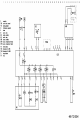
Open heater element is the most common reason, from the habit of always running a dryer at full blast heat setting. Check its continuity. Access to repair is involved. Cannot be soldered, use a screw splice to fix/join burnt heater element ends. Diagnose before blindly replacing parts.
1785891267577.png
 
Last edited:

Thread Starter

mullingover

Joined Nov 25, 2025
44
Thanks for the advice, everyone. Just to reiterate: passages of air evacuation are completely clear, clearer now that at most of the 15 year old machine's installation. The heater element itself is not damaged (tested with multimeter). But I suspect there's a kind of surge or something that's caused both the old heater and new one (with just a single use) to fail.

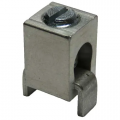
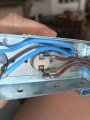
As a (VERY TEMPORARY) test, I was thinking of joining these two connectors together to bypass what appears to be the thermal fuse (see photo). This fuse has OL (I believe this means a blown or broken fuse, although I read this resets if exposed to -30 degrees celcius). If the dryer does get hot - and correct me if mistaken - I think it would potentially pinpoint the problem to the supply? Because again, it really is cleaned of fluff.

I don't mind all the new parts. If I could just figure this out with all you experts, I have pieces to keep this machine going another 15 years :) And gets the domestic boss off my back.
 

Attachments

Alec_t

Joined Sep 17, 2013
15,149
This fuse has OL (I believe this means a blown or broken fuse, although I read this resets if exposed to -30 degrees celcius).
If it reads OL on an Ohmmeter then yes, it's open circuit. Some thermal fuses are resettable (there may be a small button to press), others aren't. That -30C suggestion seems like an AI hallucination to me, but I may be wrong.
 

Thread Starter

mullingover

Joined Nov 25, 2025
44
Some thermal fuses are resettable (there may be a small button to press), others aren't.
Thanks Alec! This type isn't re-settable. I appreciate the need for safety, but wondered if there's value in testing the bridging/bypassing of this fuse to help isolate a cause? Is there a known/universal fuse with reset button I can purchase, so I can replace the old one and at least deal with this quickly and safely next time? No amount of internet searches could find the original type (codes on it are " 43-10 3107").
 

wayneh

Joined Sep 9, 2010
18,135
... wondered if there's value in testing the bridging/bypassing of this fuse to help isolate a cause?.
Yes, there is value in diagnosing the problem by using a temporary bypass. It should only take 30 seconds or less to determine if that makes a difference. Just resist the temptation to use the dryer without that safety feature.
 

Thread Starter

mullingover

Joined Nov 25, 2025
44
Well, taking the new (actually, secondhand but tested before putting it in) heater out, with the multimeter it has no conductivity across the heating filaments. Seems banjaxed already. Taking the old (original) heater again that does have conductivity across the heating filaments, I bypassed the OLfuse (connecting wires together) and re-inserted. But the machine thought it needed filters cleaned; bypassing fuse seemed to send such a message to the control board. So I just put the old original heater back in, this time not bypassing any fuse and all connected just as it was out of the factory. Now it gets heat(!!). How can it if the fuse reading is OL Ohmmeter? However, after running a few minutes it again stops (claiming filters is blocked...nothing's blocked, believe me!!). Perhaps the secondhand heater was also far from perfect; perhaps these thermal fuse things get fatigued, and I should just get a brand new one? But is there any test to perform to make sure there isn't some incorrect current getting to the heater in the first place? I don't want to lose extra money damaging a brand new heater, since they are pricey.
 

wayneh

Joined Sep 9, 2010
18,135
Again, the appliance uses some sort of detection/sensor to make the judgement that the filter needs cleaning. Pressure drop would make sense to me but it might even be a visual sensor, or it just looks at the heater element temperature. Your element probably turns off due to an overheat condition, same as my gas unit.

Hang on a second. It just occurred to me that your unit uses the same "squirrel cage" fan to move air as mine does. It's a very well know point of failure because it has a plastic hub attached to the steel shaft of the motor. Once the flat spot gets worn off, it can't handle much torque and ceases to move enough air. I've replaced mine twice in 40 years, so it's not awful.

But it is hard to diagnose because even if you dig in far enough to observe it, it might appear to be turning just fine. You have to see if you can turn it by hand and see the dryer drum turn, as it's driven off the opposite end of the motor's shaft. If it's difficult to turn with modest pressure holding the drum, then the hub is probably OK. If it turns easily without moving the drum, the hub is shot and the fan is likely not moving enough air.
 

Thread Starter

mullingover

Joined Nov 25, 2025
44
It just occurred to me that your unit uses the same "squirrel cage" fan to move air as mine does. It's a very well know point of failure
Thank you. That's never occurred to me and is exactly why I was so keen to tap into the knowledge here! I can see how this makes sense, all heat blocked next to all these thermal fuse type things, minus the passage of air. I am going to check this out in the morning.
 

Thread Starter

mullingover

Joined Nov 25, 2025
44
It just occurred to me that your unit uses the same "squirrel cage" fan to move air as mine does.
Hi Wayneh,

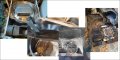
Attached are photos of pretty much a complete disassembly. Although dusty, airflow was never blocked. Now disassembled, will now thoroughly clean. With a wrench at the belt side of motor, I was not able to move the fan by hand. It moves well with the motor, doesn't slip or "freewheel". The blades still have the shape of a fan sucking air, but I don't know how it would compare to new (for example, if the blades have worn, but I don't see damage or scuffs).

Never having taken it to this level of disassembly, I checked but also couldn't see any other item that can be replaced or hasn't been considered, or that could cause a surge in current or other issue.

Is the theory possible that old heaters can end up with the thermal fuse type thingies getting metal fatigue and eventually under-performing? Turning off at lower temperatures than when they should? And to hell with it, try a brand new one as a last ditch?
 

Attachments

Alec_t

Joined Sep 17, 2013
15,149
When I had a thermal fuse of similar type go open-circuit I dismantled it. The contents included a lump of Woods metal which would normally bridge* two contacts but melts at ~70C. I don't see how such a fuse could suffer metal fatigue or other deterioration with age or current surges.

Edit:
'keeps two contacts together' would be a better description.
 
Last edited:

Thread Starter

mullingover

Joined Nov 25, 2025
44
The contents included a lump of Woods metal which would normally bridge two contacts but melts at ~70C. I don't see how such a fuse could suffer metal fatigue or other deterioration with age or current surges.
I don't know what these look like inside, but I did come across this video when researching:
 

Thread Starter

mullingover

Joined Nov 25, 2025
44
Thank you. Seems to confirm what I see, that there's no other component in the chain here. Domestic boss is nagging me she needs another 450 euro new machine, but is it worth that 85 euro BRAND NEW heater as a last try, on the assumption the thermo sensors/stats were old and ineffective? Or will this new one probably get fried, too?

I suppose being fried by current isn't possible (the control board would take that hit first, right?)?

This is about saving this machine as much as my marriage now....
 

MrChips

Joined Oct 2, 2009
35,031
Have you checked for AC voltage reaching the heater?
There are only a few places that would prevent the flow of current around the loop.

  1. relay
  2. thermal switch
  3. heater element
  4. connecting cables
 
Top